Writer Nicola Trup tackles Romania’s first long-distance trail, created by a grassroots group to help enliven local villages and extend opportunities along the route.
‘It’s important for people to hike a lot, so that the authorities can see there are alternatives to logging,’ says Iulian. As we plod uphill, pine scent and birdsong fill the air, confirming that walking among the trees is infinitely better than tearing them down.
Roughly 30% of Romania is covered by woodland, yet deforestation – some legal, some operated by the so-called ‘wood mafia’, an organised crime network involved in large-scale illegal logging and timber trafficking – is a very real threat here. And preserving the landscape is one of the reasons Iulian Gabor and his colleagues created Romania’s first long-distance hiking route.
Developed over four years and completed in 2022, the Via Transilvanica now stretches 1400 kilometres (870 miles) from Putna in the north down to Drobeta-Turnu Severin in the southwest, with a 200-kilometre (124-mile) extension to Brasov in the Carpathian-ringed central Transylvania region of Romania. To create it, existing trails were linked and improved; overgrowth and 50 tonnes of rubbish were cleared, markers were added, and maps and apps were created for hikers.


However, ‘it was never a tourist project,’ says Alin Useriu, the tall, authoritative founder of Tasuleasa Social, the NGO and Intrepid Foundation partner behind the trail, when we visit the organisation’s headquarters in rural Bucovina, northern Romania. In keeping with Tasuleasa’s focus on collective action and building communities, the Via Transilvanica isn’t just about walking, though. It’s about creating opportunities for people living along the route by offering a slow, sustainable tourism model they can actively be a part of. ‘Via Transilvanica brings back life to these small villages,’ says Alin.
Accordingly, about 700 locals act as volunteer ‘foster parents’, taking responsibility for sections of the trail, while others earn a living offering home-cooked meals or beds for hikers. At Tasuleasa HQ, Iulian – a bearded 36-year-old, never seen without a cap on – shows us an accommodation pod with six bunks and a bathroom, which the NGO hopes to replicate along the Via, so more local hosts can offer affordable stays.
Read more: Active escapes to get you moving


On the trail in Romania
Travelling with a small Intrepid group on a new trip launched this year, we’re exploring a few sections of the Via in Bucovina with local leader Raluca Kocsis. Before we start, she tells us not to expect to see bears, wolves or lynx, because although Romania has Europe’s largest populations of each species outside of Russia, they will hear us coming – and keep well away.
Happily, there’s other wildlife to be seen as we walk: butterflies flutter across our path, and the occasional tiny lizard or worm-sized snake briefly appears before vanishing into the undergrowth. We spot the hoofprints of roe deer and pause to listen to the distinctive calls of cuckoos.
On our first foray into the forest, there’s an eerie low mist as we follow a puddle-dotted path flanked by towering conifers. ‘There are many folk stories about forest fairies and spirits,’ says Raluca. ‘Some of them are a blessing and some are evil’. On an atmospheric day like this, these tales feel fitting – even if, like the bears, the fairies are nowhere to be seen.
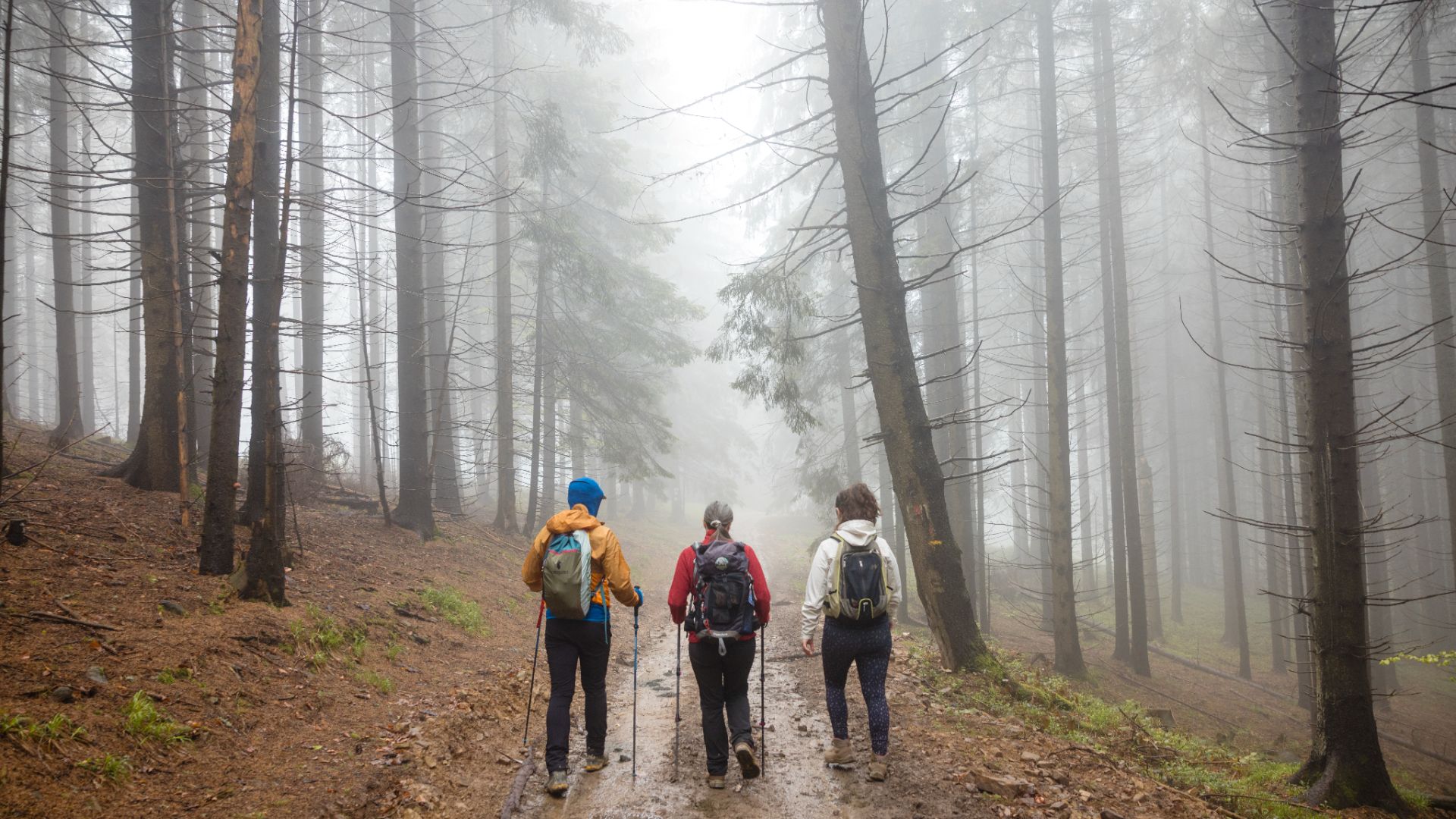
When the Habsburgs ruled this mountainous area, from the late 18th century until 1918, they replaced a lot of the beech trees for which the Bucovina region was named (‘buk’ being the Slavic word for beech) with spruce, pine and fir. Today, some of the trunks are painted with the Via Transilvanica emblem – an orange letter T in a circle. And each kilometre of the trail is marked with a unique stone post designed by an artist. Some are abstract shapes, others carved with animals or plants, and one – at Fundu Moldovei depicts a bum, a play on the village’s name, the ‘Bottom of Moldova’.
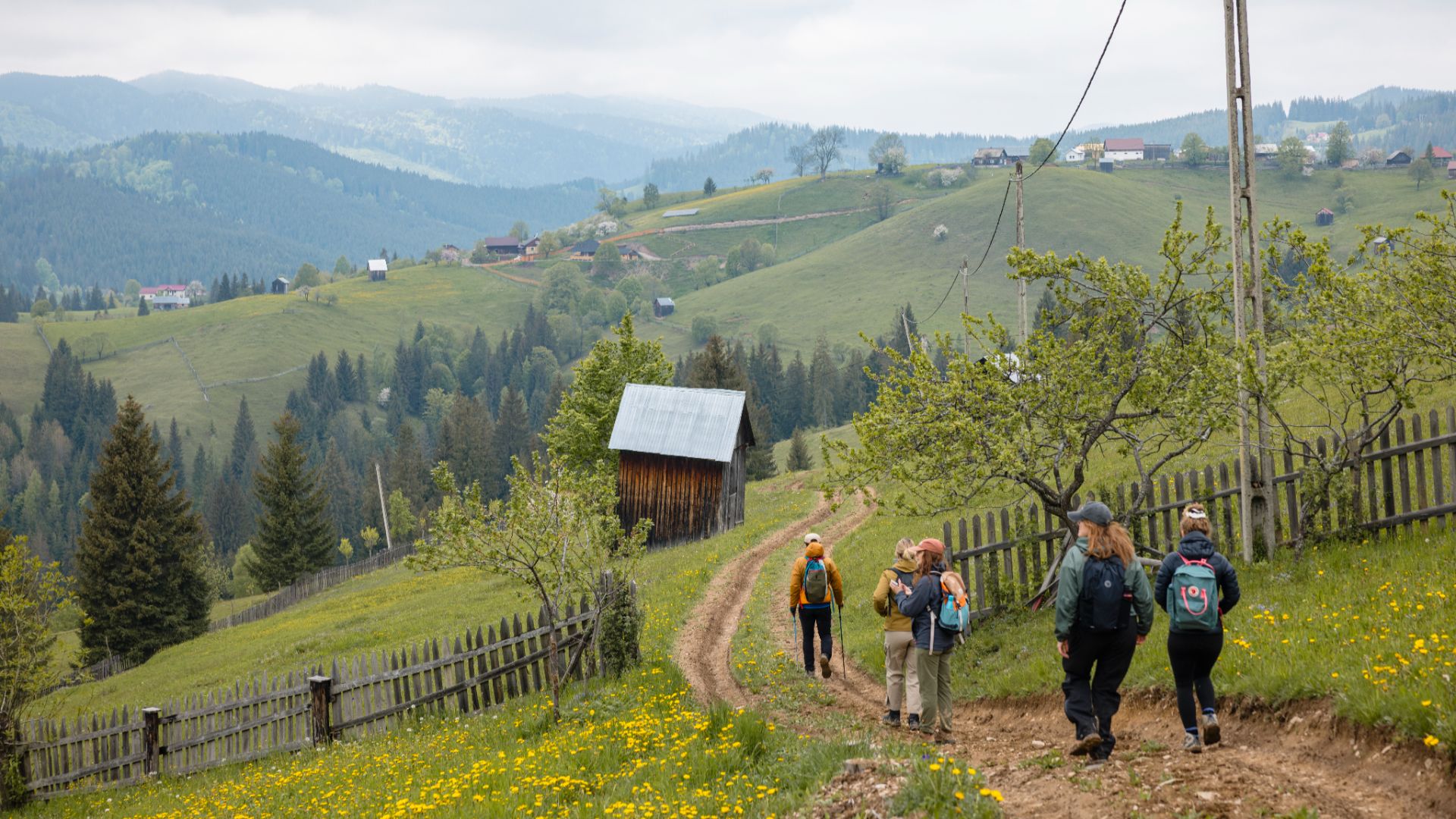
From the forest we emerge onto a hillside also thick with mist, where the gentle clanking of cowbells alerts us to cattle grazing nearby. The alpine views aren’t visible today. But, as it turns out, in the blazing sunshine of the next few days, we will get more than our fill.
On one clear morning, we walk uphill, past tall haybarns, cows and sheep, and at the top, the landscape opens out in all directions. Wildflower meadows, tree-studded valleys, layers of peaks as far as the horizon, and not another soul in sight. ‘You see that?’ asks Raluca, pointing to a cloud of what looks like smoke emanating from a patch of forest. ‘It’s pollen from the trees.’
Read more: Responsible ways to travel with purpose


Hiking to homespun hospitality
The path undulates in a mostly manageable way, and we’re rewarded for a particularly challenging ascent in the blazing sun with lunch at Bordeiul Gligilor, a family run guesthouse offering meals on a terrace in a gently sloping field. Daniela and Stefan Gliga – a smiley couple in their 50s – dash about, bringing us traditional liqueur and little decorated cups for toasting, followed by sarmale, stuffed cabbage rolls that are such a hit, seconds are ordered and recipes requested.
Among the other businesses that have emerged since the Via was established is Popas La Cosma, where father and son Cosma and Constantin Craciuneac – the latter in a traditional embroidered shirt and hat with feathers in the band – entertain us with magic tricks over a spread of cheese and charcuterie. Their hosting careers started when they added a water tap for hikers outside their home, a collection of wooden buildings set around a field of wildflowers. A bench came next, followed by a table and then a dedicated guesthouse, also built in wood, and now each year they welcome about 1500 guests, who either stay over or just stop in for something to eat.


Further along the trail, not far from the mountain resort town of Vatra Dornei, is the alpine-style lodge of Cabana Gigi Ursu. Owner, Geta Ursu, tells me the Transilvanica has made a big difference to the place she opened with her late husband in 1977; she now gets a lot of business from hikers like us.
An energetic, trainer-wearing, 70-something host, Geta raises a glass with us before she and her 14-year-old grandson, Andrei, bring out a feast that includes deliciously salty cheese with homemade chilli jam. Andrei baked the fluffy bread that accompanies the meal, Geta says, though when I ask whether she taught him everything he knows, the answer is ‘of course’. I kick off my shoes and slump into a beanbag on the deck, a deep sense of peace washing over me as I look across the vivid green valley.


Holy ground and hallowed traditions
The trail offers a glimpse of some of the region’s manmade wonders, too. ‘In Romania, Bucovina is known for traditions,’ Raluca tells us. Regional costume is worn for special occasions, wooden houses dot the countryside and the church still plays a central role in the lives of many.
Dotted around this part of the country are eight churches that are collectively listed as the Churches of Moldavia World Heritage Site, due to their beautiful frescoes. In between hikes we visit two of them, at Sucevita and Moldovita monasteries. Both were built in the 16th century, and under their sweeping, pagoda-like roofs, they’re painted – inside and out.
Sucevita’s facade depicts the ‘Ladder of Virtues’, the spiritual journey from earth to heaven, while Moldovita’s shows Jesus’s family tree. ‘You will see there’s almost nothing left on the northern side,’ says Raluca – and she’s right. While much of the fresco is still preserved in fine detail, after centuries of being battered by the elements, one side of Moldovita has been almost washed clean. In the open porch, meanwhile, a depiction of the final judgement is covered in scratched-out Germanic names, a remnant of Habsburg rule, when Orthodox churches and monasteries were closed.
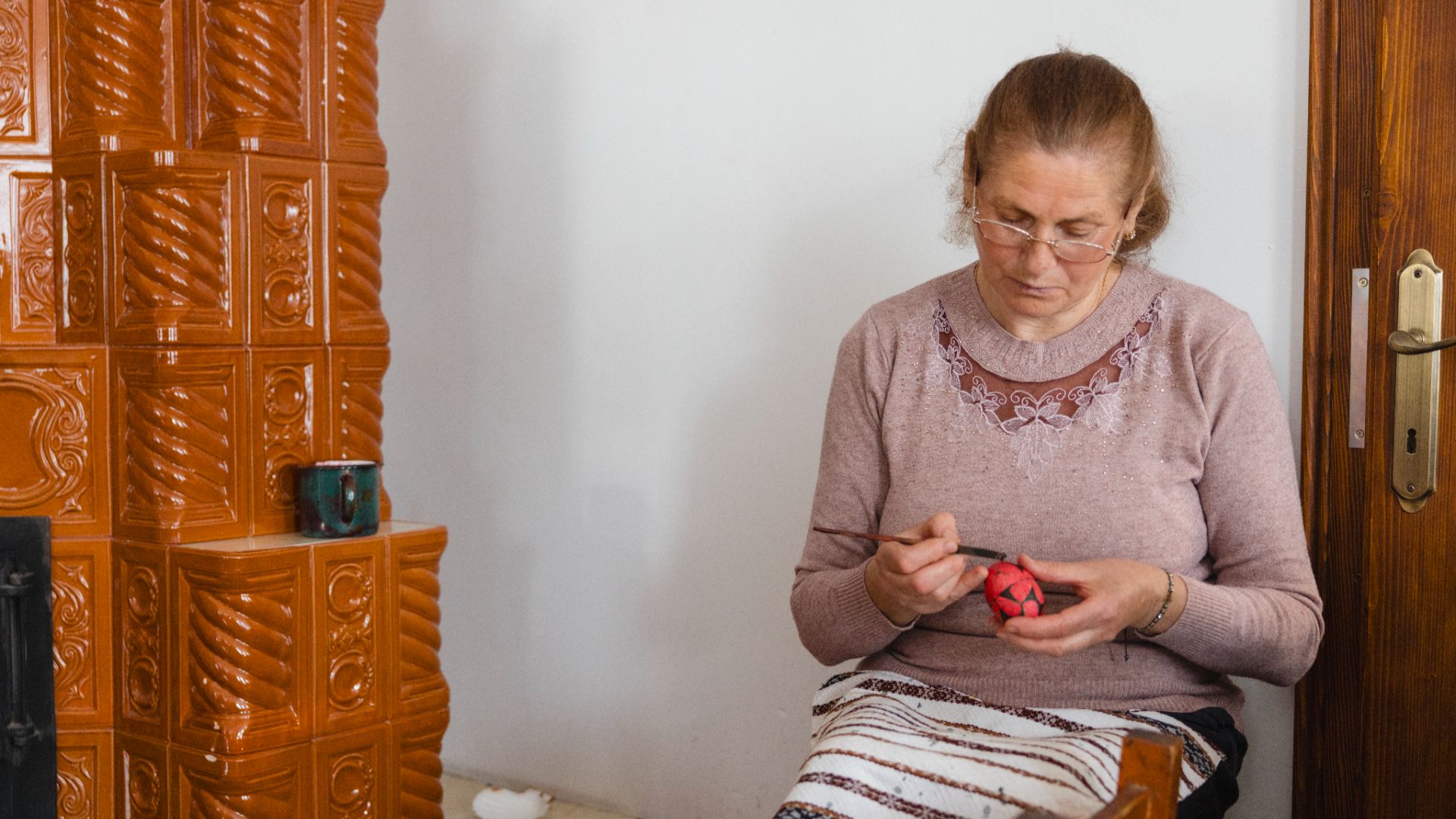
In nearby Moldovita village, we visit Viorica Semeniuc, one of several local women continuing a 17th-century egg-painting tradition that originated as an Easter celebration. We sit in her spotless living room, the walls hung with religious paintings and a colourful patterned rug, enraptured as she demonstrates a batik technique. With gold-rimmed glasses and her hair pulled back into a tight ponytail, she warms pigmented beeswax before placing a tea towel on her lap and using a special copper needle to draw a pattern, dipping the egg in layers of dye to add colour. The end result is a striking geometric design in black, white, yellow and red – the village’s signature colour scheme.
It’s an art form that predates the Via Transilvanica by several centuries, and by welcoming visitors into her home, Viorica is helping to keep it alive – hopefully for several centuries to come. I may have travelled to Bucovina to hike, but the people I’ve met along the way prove the trail is about so much more.
Follow in the footsteps of the Via Transilvanica on Intrepid’s Hiking in Romania adventure.