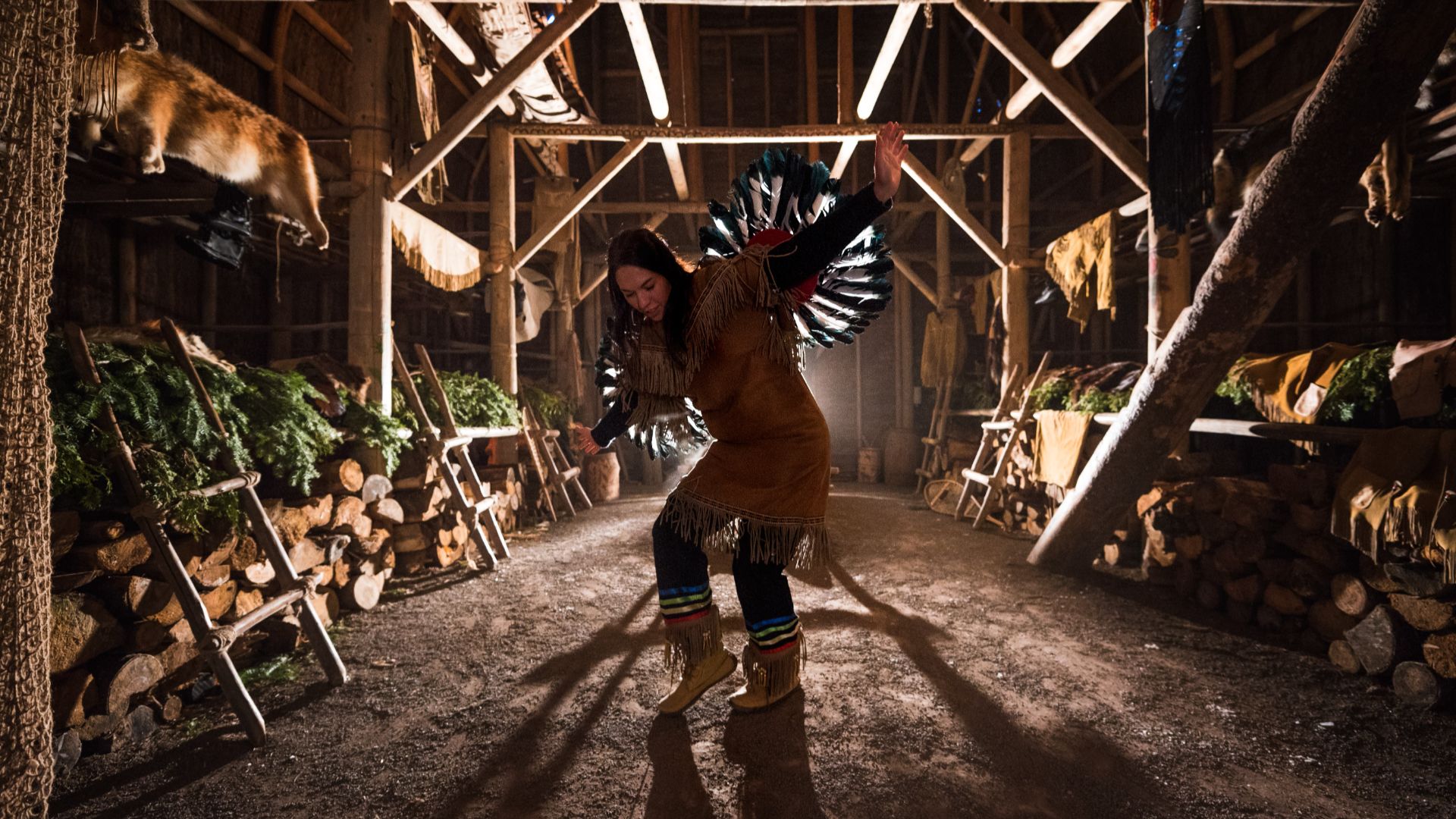
As part of a new Intrepid experience, travellers can now meet members of the Wendat people in their immersive First Nation community, where no questions are off limits.
When I ask our local host, Dominic, how long his Indigenous community has been welcoming visitors, I’m thinking about modern tourism – the kind that brings Intrepid groups to Wendake, on the outskirts of Quebec City. He grins. ‘Oh, since 1534 when the first Frenchmen came out of the boat.’
Dominic Ste-Marie is a professional First Nation storyteller – with a playful sense of humour, obviously. He’s youthful and easygoing, vibrating with energy and pride for his craft and community.
Our group has gathered with him inside Wendake’s longhouse, a traditional Indigenous dwelling. There are no windows, so at first my eyes must adapt to the darkness. I can then make out the rows of bunk beds that could house dozens of family members together, dried ears of corn hanging from above, and a small hole in the roof to let out smoke from the cooking fires. We are invited to sit, assembling on simple log stools around a lit fire. It’s time for a story.
I lean in, eagerly. For just a few hours earlier, at the Huron-Wendat museum – a space dedicated to Dominic’s ancestors and their Indigenous heritage – another Wendake guide had told us something that stopped me cold. The origins of the name ‘Huron’. I thought I knew all about this word – after all, I’m Canadian, and grew up in a region of Ontario nicknamed ‘Huronia’, supposedly after the original peoples of the area.
Except that wasn’t their name for themselves. In all my years of schooling, I was never told what I learned in Wendake, that Huron actually meant something imposed and derogatory: ‘boar’s head’.


A Nation welcomes the world
Quebec City is often described as one of the most European places to visit in Canada. One of the earliest French settlements in the country, it has maintained its charming, cobbled streets and historic city walls that travellers love. But a 15-minute drive away, a visit to the community of Wendake provides a different perspective on Canadian history.
As Dominic pointed out, Wendake has been welcoming guests for centuries. More recently, the First Nation community has hosted inquisitive travellers for interactive experiences that aim to share the rich history and living culture of its people.
Arriving at the Huron-Wendat Museum, we are greeted by staff in traditional clothing who walk us through hundreds of years of history. As it turns out, they are directly connected to the Indigenous inhabitants of Georgian Bay, where I’m from, something I never knew.
It’s here I’m first told the word ‘Huron’ is from the French word ‘hure’, meaning boar’s head: a derogatory settler term for the Wendat warriors’ hairstyles. The contemporary term of ‘Huron-Wendat’ – as Dominic’s community was more recently known – aimed to restore the chosen name, meaning simply: ‘islanders’.
But today, they’ve gone one step further, by recently voting to abandon the word ‘Huron’ entirely in an effort to shape their own identity and reclaim their narrative once more.
Read more: How to connect with Indigenous culture
Myths and legends
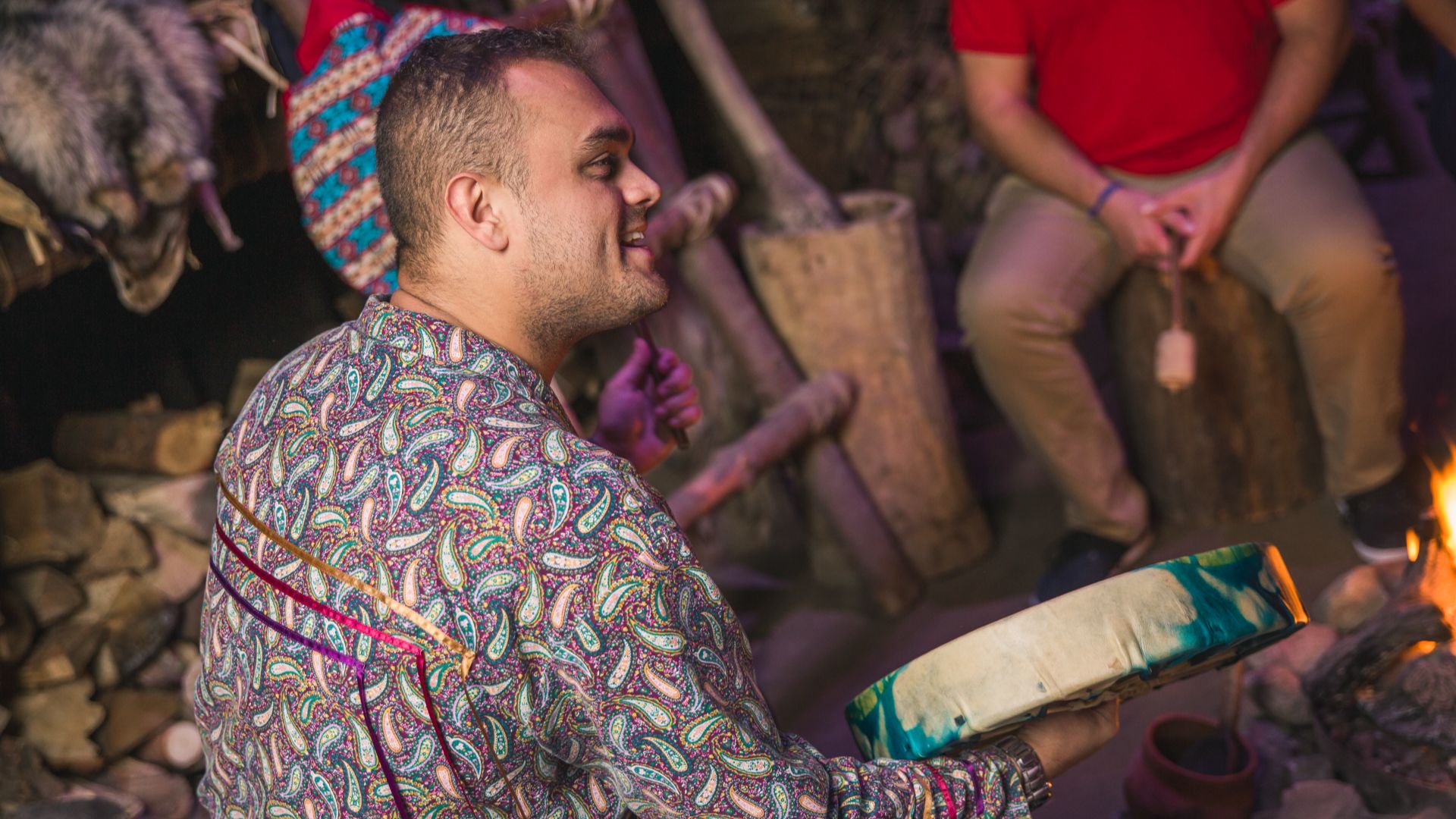
‘It’s a very foundational human experience to just sit by a fire, gaze into the flame, being hypnotised and listening to some stories,’ Dominic tells me. He grew up in the area, listening to his grandmother tell stories, like the creation story of Mother Earth, and became a professional storyteller about 13 years ago.
Dominic says he decides on which story to tell based on the listeners in front of him. ‘It’s very much vibe-based,’ he explains. ‘It’s really about making sure I feel like I can say something that’s going to be useful.’
In the longhouse, our group hears the tale of the Corn Husk Doll, after a guest asks about some dolls without faces hanging on the wall. Without hesitation, Dominic seamlessly transports us into the realm of legend.
It goes something like this: once upon a time, the Great Spirit of Corn crafted a doll made from dried husks, which was sent out to play with the children of different villages. The doll became enamoured with the children’s attention, and her own beauty. After ignoring warnings to stop staring at her own reflection in a pond, the Great Spirit took her face away…
It’s a good scary campfire story. But it’s also a lesson: a reminder that no one person in the community is better than anyone else. Just one in a repertoire of morality tales created and honed by generations and passed along in longhouses, just like this one.
I ask Dominic what he hopes listeners will take away from his storytelling sessions. Once again in Wendake, I’m surprised. It’s not so much the tale, or the teller, he says, but the longhouse setting itself, that’s the teacher.
‘Indigenous cultures had just as many ideas per person per year as any other society,’ says Dominic. ‘If we believe that we are of the same people, we will sit around the same fire. If we believe that we are of a similar scheme of thinking, we may say that we live in the same longhouse’.
Read more: Stay with nomadic reindeer herders in Mongolia


The road to reconciliation
Travelling in your own country often hits differently. When I’ve been overseas to see the archeological sites of ancient Egypt, Mayan villages in Guatemala or Viking museums in Iceland, I like to think I bring a humble curiosity, a true willingness to learn about the original peoples of the places I visit. As a Canadian travelling in Canada, I’ve come to realise it’s less about learning and more about unlearning.
Because I really did arrive in Wendake thinking I already knew the story. Then I found out I had a lot wrong. Even the history of my own hometown.
One thing I’m sure of is that this knowledge gap is no accident. Rather, it’s a result of decades of deliberate erasure of Indigenous culture in Canada – language, ceremonies and stories suppressed in our education system. But I truly believe that travelling here – or wherever authentic stories reside – can be part of everyone’s personal reconciliation with a complicated colonial past.
I want to ask a local what the Wendat think about that, but, admittedly, I’m sheepish to bring it up. Questions like these can bring up uncomfortable feelings. But naturally in our conversation, Dominic opens the door.
‘I think reconciliation begins by meeting each other, by exchanging ideas, sharing moments,’ he says. ‘Here in Wendake, the storytelling activity is a place where you’re guaranteed to share these moments with an Indigenous individual who is there – with a wide understanding of this culture – so that visitors can have whatever they wonder about us, answered.’
Read more: Hike to meet the Zapotec community of Mexico


From Wendake to the world
Wendake is one of the most accessible Indigenous tourism experiences you can have in Canada, where travellers can have a direct economic impact on supporting a First Nations community. And as passionate as Dominic is about Wendake, he’s also the first to say there’s much more to explore.
‘There are just as many cultures per square kilometre of land in North America as there are in Europe,’ he says. ‘We are extremely proud of Wendake. But that doesn’t mean that we want people to stop here. We also want people to visit other Indigenous cultures’.
Indeed, Intrepid is working to integrate authentic Indigenous experiences into trips wherever possible around the world – from Australia to Mongolia and Malaysia. In Canada, it has partnered with the Indigenous Tourism Association of Canada to support the growth of Indigenous tourism across the country and ensure travellers leave with a deeper connection and understanding.
I know that connecting with Dominic in the longhouse taught me things about the Wendat identity and the history of this land that our education system has failed to acknowledge. I leave with a whole new perspective on where I come from, and a new way to say thank you for it: tiawenhk, Wendake.
Meet the Wendat First Nation of Wendake on Intrepid’s Discover Quebec adventure.