A new VIP New Orleans Jazz Tour with Intrepid Urban Adventures introduces visitors to the city’s musical heritage and lets locals see their home through fresh eyes – and ears.
‘OK, I’m gonna rip the Band-Aid off,’ warns our guide, Kristi Vickers, as the sun sets over Louis Armstrong Park. ‘Centuries of race and class segregation produced the cultural conditions that led to the creation and evolution of jazz,’ she says.
We’re in Congo Square, sitting beneath the ‘ancestor tree’, a sprawling oak with branches like octopus tentacles that’s been here for over 200 years. Originally a gathering place and trading post for Choctaw people (the Indigenous Native Americans who lived here before colonisation), it’s one of the most important sites in New Orleans.
Kristi, who was born and raised in the city, tells us that the Choctaw called this place Bulbancha – ‘the land of many tongues’. The name hints at how this multicultural port city on the Mississippi River gave rise to such a diverse and dynamic genre of music.


Rhythm and roots
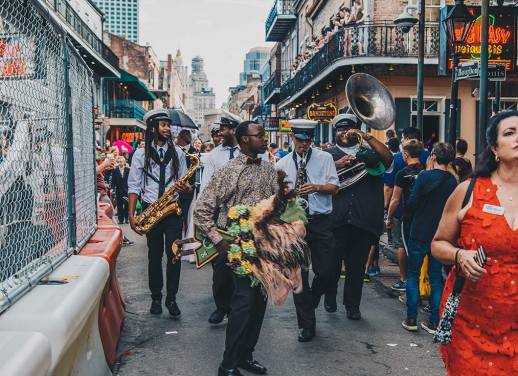
‘In the 18th century, during the French and Spanish colonial era, enslaved Africans in Louisiana were granted Sundays off, and would gather in Congo Square every Sunday to play drums, dance and worship; those rhythms are foundational to jazz,’ says Kristi. Over many decades, those traditions merged with musical styles from Europe – including classical and folk – and the city’s numerous immigrant communities. This shaped the sound that inspired Louis Armstrong and the city’s famous second lines – joyful street parades that see crowds following behind a brass band, known as the ‘first line’.
At a time when so much of US history is being sanitised or erased, I appreciate Kristi’s clear explanations about how colonisation – especially the way it classified and divided people by skin colour and economic status – and Jim Crow laws, which existed from the late 19th century until 1965 and enforced racial segregation and inequality, are integral to the story of New Orleans and jazz music. The art form cannot be understood without an understanding of the context in which it was created.
But this New Orleans jazz tour isn’t a lecture. At each stop, Kristi plays music on a mini speaker strapped to her shoulder. I can tell how much she loves jazz because she gives a little shoulder shimmy and smile for each song, as if she’s transporting herself back in time, imagining it live and inviting us to travel back with her through the music.


Jazz bonds generations
‘Jazz is just a great way for people to come together without even having to talk, just pick a tune and have some fun,’ Tavarus Armour, a local teenage drummer, says with a smile.
He is a member of Second Line Arts Collective (SLAC), a local non-profit nurturing the next generation of musicians and supporting them in building sustainable careers. On a new musically enhanced VIP Urban Adventure – available to private groups of seven or more – Tavarus, Gregory Agid (the co-founder and executive director of SLAC) and other SLAC students will help bring history to life by providing live musical accompaniment at stops along the way.
As we leave Louis Armstrong Park and head into the French Quarter, I ask them: ‘why jazz?’
‘Jazz bonds generations,’ Gregory says. ‘I was mentored by someone who lived this life. And now I’m at the point where I’m mentoring the next generation. One day, 20 years from now, this cat’s going to be mentoring the next,’ he says, nodding at Tavarus as they exchange knowing grins.
‘One of my favourite quotes is “the tradition is eternally modern”,’ Gregory adds. ‘Every generation adds a little bit of their own sauce into it.’
As we chat, we discover that Gregory and Tavarus’s origin stories as musicians are divinely intertwined, despite their 20-year age difference. As a youth, Gregory studied under Alvin Batiste, an acclaimed clarinetist who learned from and played with another legendary composer and musician, Harold Battiste (no relation). When Tavarus shares that it was the music of his cousin, Harold Battiste, that inspired him to take drumming seriously, we’re all wowed. It appears that among New Orleans’ jazz musicians, there is often only one degree of separation.
Tavarus beams as he talks about his upcoming move to New York to study music. To him, jazz music is as vital as oxygen – ever-present in how he sees and experiences the world. It’s not lost on me that he’s continuing the tradition of New Orleans musicians going up north to grow their repertoire, just as Jelly Roll Morton, Sidney Bechet, Louis Armstrong and other jazz greats did before him. SLAC’s mission and presence on the tour exemplifies how the jazz tradition endures, and why supporting the city’s musicians is essential.


In New Orleans, music is life
As a local, I usually avoid busy Bourbon Street. But I’m curious to visit Fritzel’s European Jazz Pub, simply known as Fritzel’s. I’d never been inside and realise quickly that I’ve been missing out.
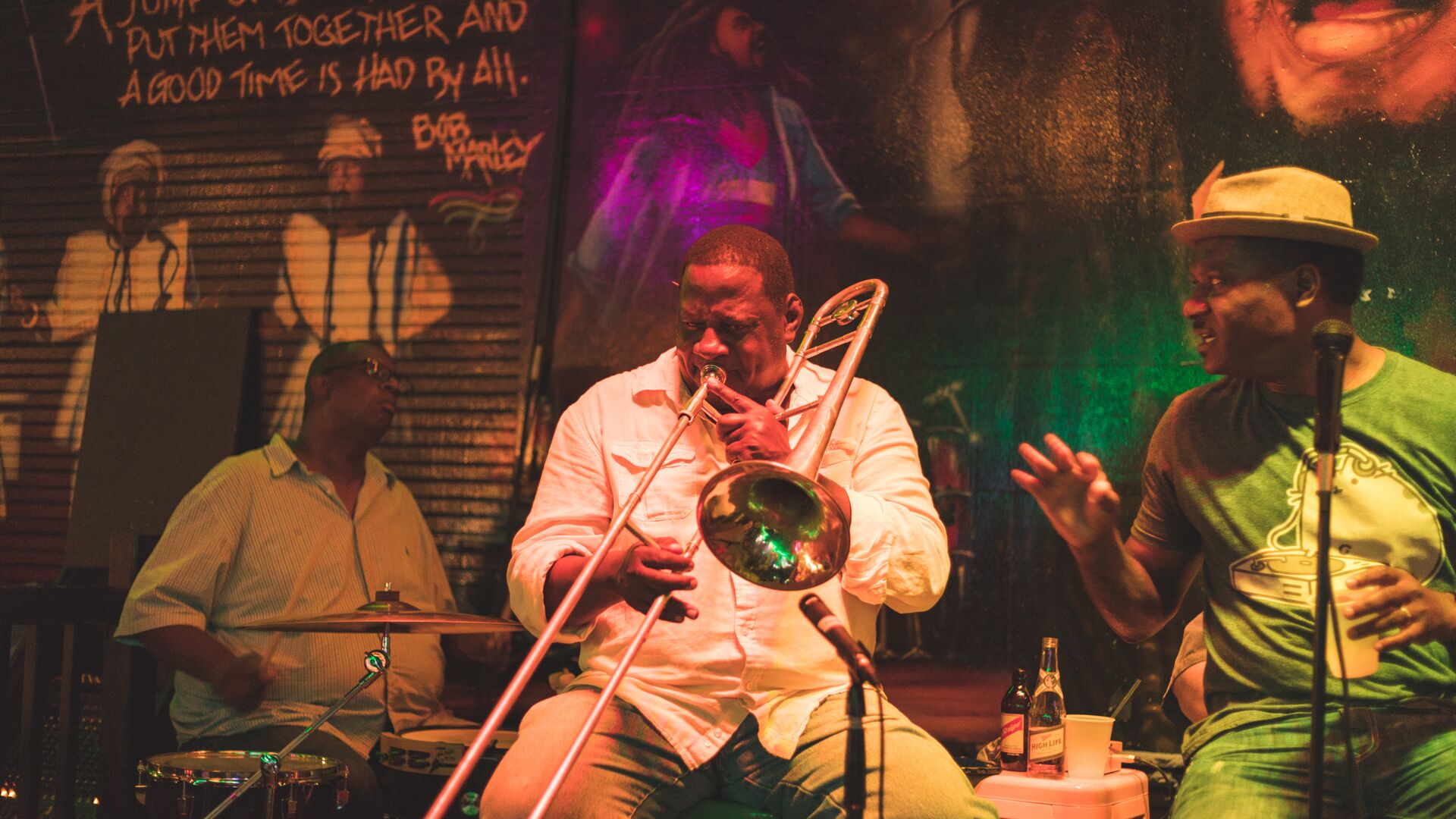
‘Fritzel’s is the only proper jazz club on Bourbon Street. Jazz and alcohol, that’s it!’ says Kristi. That’s her opinion, she admits, but it tracks; Fritzel’s has a decidedly different vibe from the cacophony of sound permeating this stretch of the French Quarter. It’s been open since 1969, making it the oldest and longest-running jazz club on Bourbon. It’s an intimate, laidback setting with a bar, a small stage and some wooden pews and tables that get you up close and personal with the musicians – so you feel like a participant in their world.
‘Music is the fabric of this place. Music is life.’
As we settle in, the four-piece band – comprising a saxophonist, bassist, drummer and guitarist – takes turns showing off their skills through improvisational solos, a core tenet of jazz music. Each musician takes us on a journey, translating their spirit through their instrument of choice.
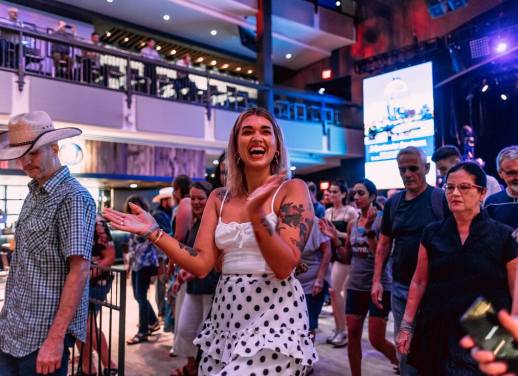
We end the evening at the club 30°/-90° on Frenchmen Street. As we enter, the band plays a funky-yet-ethereal Sun Ra cover, the bassist chanting ‘interplanetary’ while the saxophonist blows and bops. The room’s packed with people nodding their heads, tapping their feet and swaying to the music; individually following different rhythms that combine for a united groove. I can’t help but join them.
This Urban Adventure gives visitors, and locals like me, an authentic way to tap into New Orleans’s musical heritage and meet the culture bearers keeping jazz alive today, tomorrow and forever.
Once you understand how jazz reflects the distinct history of New Orleans, you can see how it’s woven into all aspects of the city’s culture. It’s ancestral. It’s communal. It’s one of the many languages that have evolved and thrived here since the days of Bulbancha.
‘Music is the fabric of this place,’ Gregory affirms. ‘Music is life.’
Check out the exclusive VIP New Orleans jazz tour, find your own rhythm on another Urban Adventure in New Orleans or follow the music trail from Nashville to NOLA on a multi-day small-group adventure.