Intrepid leader Ben Duncan Angee shares animated anecdotes from 30 years of guiding to celebrate the launch of a new Premium Family trip in Borneo.
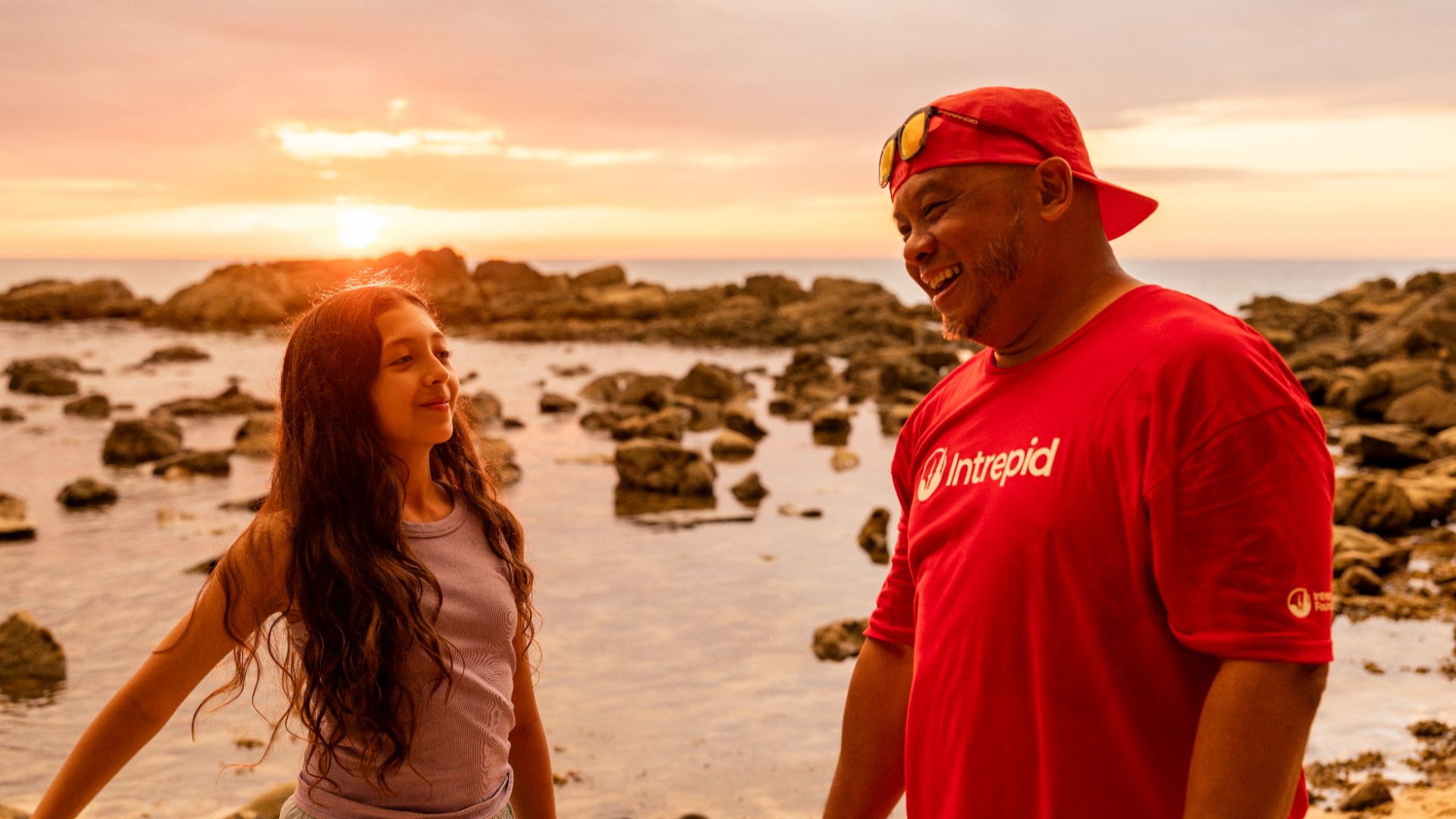
You never quite know the true size of a lesser adjutant – Borneo’s giant bare-necked stork, whose wingspan reaches up to two metres (seven feet) – until one poops on your head. That’s the kind of invaluable, funny and immediately relatable knowledge that Ben Duncan Angee – a burly, beaming local leader with 30 years of experience – has amassed over three decades of guiding groups through his home state of Sabah and beyond.
Naturally, it also makes him the perfect fit to lead Intrepid’s new Borneo Premium Family Holiday – a nine-day adventure, which spans from coral-planting on tropical Gaya Island to wildlife-spotting along the Kinabatangan River and seeing semi-wild orangutans in the Sepilok reserve.
It’s on the banks of the soupy Kinabatangan ahead of the launch of this new family adventure that Ben breaks into his animated anecdote, as the lesser adjutant once again swoops overhead, gracing the group with a rare appearance.


Finding family bonds in Borneo
‘This is my office,’ Ben says delightedly, waving his hand across the river, as the setting sun turns its oxbow bends a deep shade of umber. ‘It’s better than being chained to a desk. That’s why I love what I do. The animals, the people… I meet different characters from around the world and I get to share my story too – about my country, my village, my people.’
It’s clear that children immediately warm to Ben. With his fun, engaging approach, it’s impossible not to. However, as a dad himself to a now 15-year-old boy, his own path to fatherhood wasn’t easy. ‘My boy was born premature at seven months,’ he says. ‘So that time of my life was very stressful. I only ended up having one boy, quite late in life, so one of my regrets is not having more children. Being a father is one of the greatest gifts,’ he says.
In lieu of having other kids, Ben has embraced his role as a surrogate father in the groups he guides, leading young adventurers through the wilds of Borneo, teaching them about the island’s flora and fauna, and sharing what he knows.
Working with kids, he tries to give them information little by little, in bite-sized chunks. ‘It’s easier for them to absorb that way,’ he says. ‘Someone taught me this information. Now it’s my time to pass it on.’
Read more: On tour with a rock ‘n’ roll family trip to China
Discovering where the wild things are
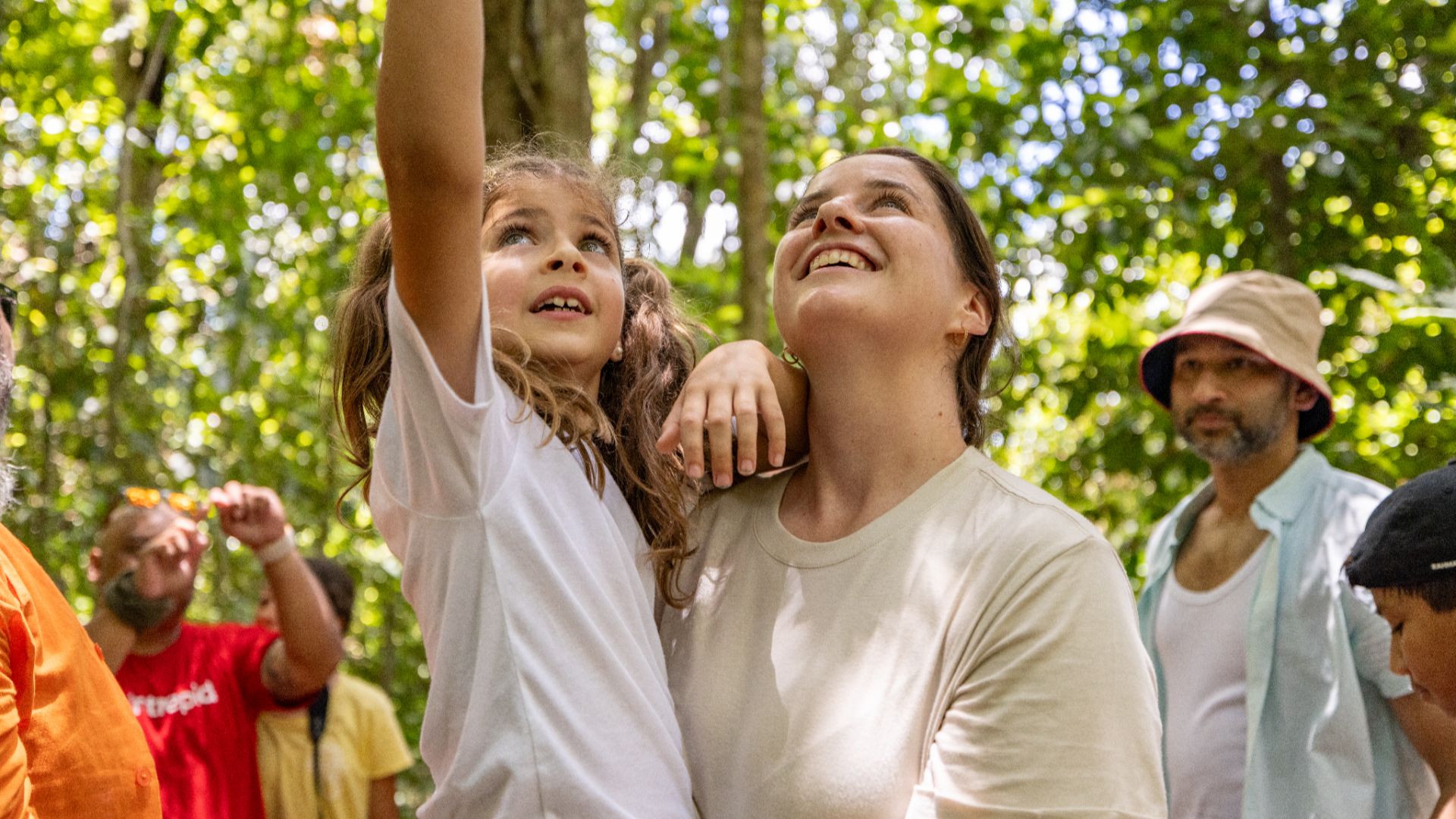
One subject that’s, of course, of great interest is Borneo’s wildlife, especially the ‘Borneo Big Five’, which encompasses the (preposterous looking) proboscis monkey, the (cute) pygmy elephant, the (not-so-cute) saltwater crocodile, the (flamboyant) rhinoceros hornbill and the (no introduction needed) orangutan. As natural history lessons go, Borneo’s classroom is an engaging one.
There’s a chance to see Borneo’s primary primate on a visit to the Orangutan Rehabilitation Centre in Sepilok, twinned with a stop at the Bornean Sun Bear Conservation Centre, just across the road (or in Borneo’s case, the jungle).
The rehabilitation centre is home to around 60 to 80 orphaned, injured and displaced red apes, who are encouraged to roam freely in the protected rainforest, supported by supplementary twice-daily feedings, that are open to the public. The meal-time food provided is intentionally monotonous to encourage the orangutans to forage for themselves.
‘In an ideal world, a conservation centre shouldn’t have to exist,’ says Ben. ‘But because the world is what it is today, we need to have them, so that future generations can experience this wonderful animal we have here’.
Read more: Family travel experiences your kids will talk about forever
Carving out time for conservation
Spotting orangutans in the wild is difficult, even for experienced leaders like Ben. They’re often high up in the trees, and if they don’t move, it’s tricky to see them. Instead, Ben’s top tip is to look for the nests. ‘Sometimes when we go out, we look for the old nest. Because the orangutan nest is usually quite exposed. So we know the chances are there might be some orangutans in the area. Then, if there’s movement, that’s the orangutan. So always start by looking for the nest’.
Having been to Borneo’s twin Malaysian states of Sabah and Sarawak twice before myself, I’ve been lucky enough to spot wild orangutans both times – once, very memorably, seeing a baby and a mother dangling like simian paperchains from the sky-high canopy above Gomantong caves. The experience never ceases to stop you in your tracks.
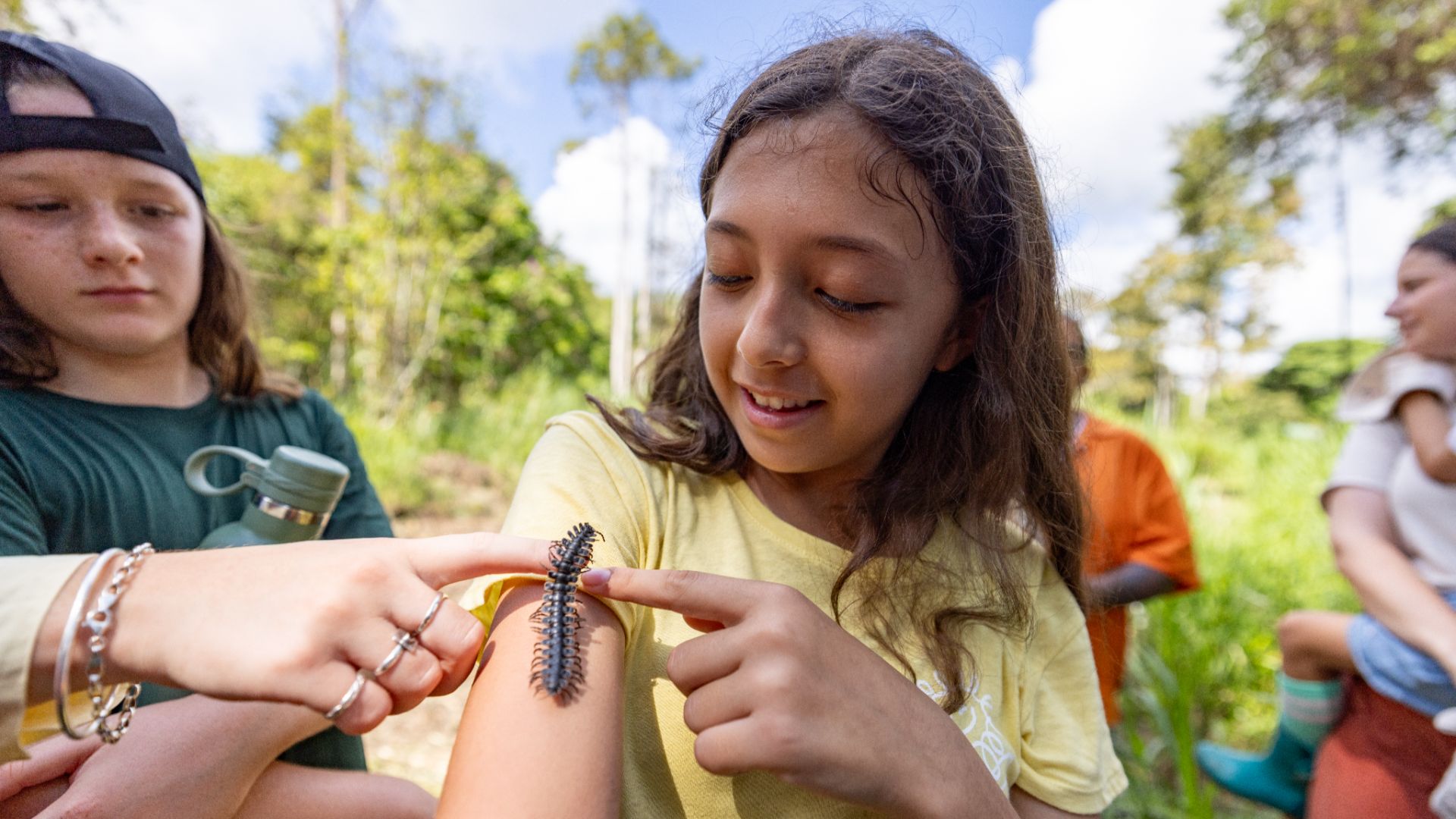
But as Ben notes, the island’s wildlife is under threat due to habitat loss driven by palm-oil plantations, logging and infrastructure expansion, the illegal pet trade and human-wildlife conflict.
‘That’s why we also need to teach kids about conservation,’ says Ben. ‘Because these kids are the future leaders of tomorrow. If we educate them now, we’ll have a very bright future in terms of preserving the animals and the surrounding environment’.
Read more: How to make your next family trip a hit
A lesson in primate parenting
I wonder if there’s anything Intrepid’s human travellers can learn about family dynamics and successful cohabitation, at home or on the road, from Borneo’s primates – which also operate in family troops.
Ben smiles and quickly recalls a group he once led where there were a lot of older teenage kids – and one six-year-old in the pack.
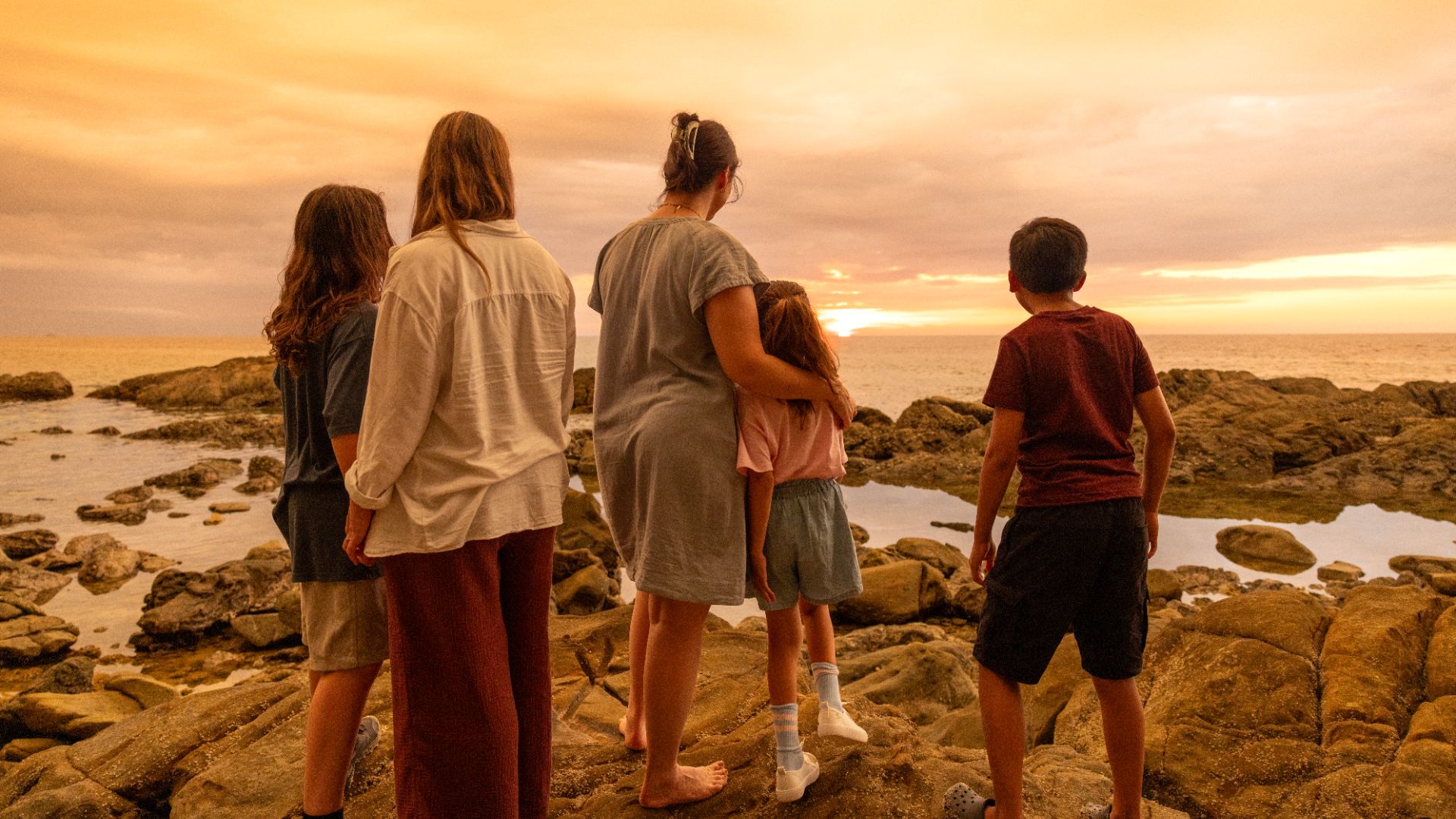
‘They operated in a way that was very similar to the silver-leaf langur monkey. When the baby is born, it’s maroon in colour, distinct from the normal silverish-grey of the rest. The baby is very bright by design so everyone in the group can see where the baby is, everyone can keep watching the baby and make sure the baby is safe.’
‘In my group, it was the same. Everyone looked after the six-year-old. The older ones looked after the younger one. They always tried to encourage the younger one to get involved. They always made sure they weren’t being left out,’ Ben remembers.
It’s enough to bring a tear to your eye – something which, I’m sure we can all agree, is preferable to the poop of a lesser adjutant.
Upgrade your next adventure with Intrepid’s new Borneo Premium Family Holiday. Intrepid’s family trips are designed for children aged between five (or ten for some trips) and 17.
Images: shot on location by Intrepid; additional wildlife photography by Ben Duncan Angee.