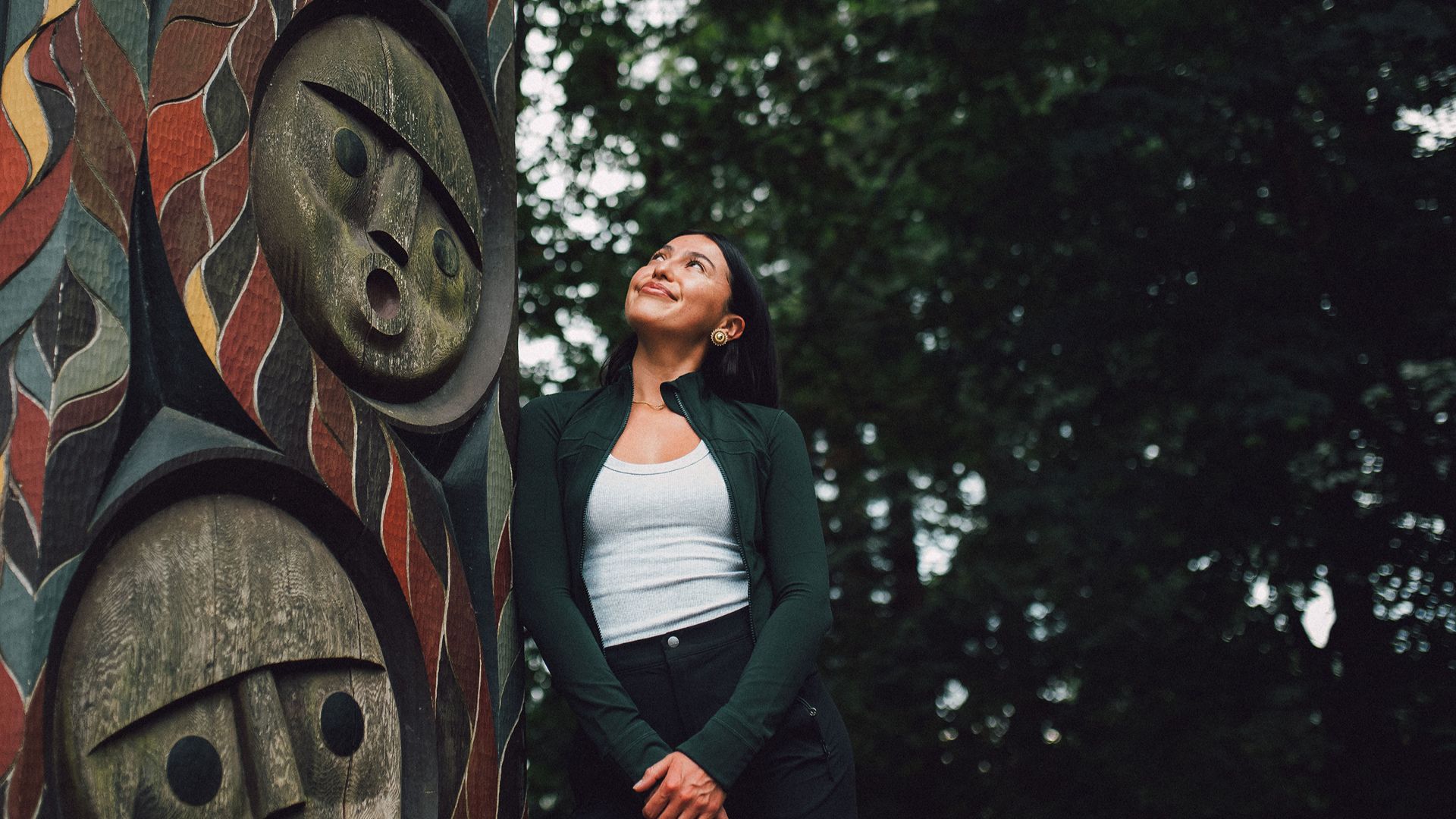
On a new Indigenous-led experience, created in partnership with Intrepid, one trailblazing local is using age-old ancestral knowledge to pave the way for future generations.
Talaysay Campo, a member of the Squamish and Sechelt Nations and the Gen-Z cofounder of Talaysay Tours, leads us through the forest along Whistler’s Lost Lake Trail. My feet settle into the earthy, worn path – traversed by countless footsteps over time, yet still welcoming. Sunlight weaves through the trees, touching my skin and lighting up the stream ahead.
I’ve come to take part in We Are the Land, a new Indigenous-led experience run by Talaysay and created exclusively for Intrepid’s Grand Canadian Rockies trip. The focus is to be immersed in nature, paving the way for a deep connection with the land, all viewed through an Indigenous lens.


A modern take on tourism
It’s an intriguing proposition, especially given that Talaysay represents the very modern face of Indigenous tourism. When she’s not leading hikes, she also models in her spare time, runs an apparel brand, actively engages with social media and has just launched a new skincare brand – all in the name of furthering Indigenous causes.
Today, however, her focus is solely on the trail. She stops to introduce us to plants I might have walked by without ever knowing what purpose they serve, such as skunk cabbage and its traditional use as medicine to treat coughs and heal wounds. Further along, fireweed catches my attention, its vivid purple hue standing out against the forest greens. She shares it’s one of the first plants to return after a forest fire, representing a symbol of hope and resilience.
Talaysay sees the trees, plants, water and animals as her relatives – something to respect, care for and learn from. The more she talks about the land, the more I can feel myself being reminded of the affinity I, too, share with nature.
As a child growing up in Toronto with roots tracing back to the Mohawk people of Six Nations on the Grand River, my mother taught me about herbs and plants and their healing qualities from an early age. Listening to Talaysay talk about the teachings she received from her own family, I feel a deep appreciation for my Indigenous roots, too.
Read more: Meet the Indigenous storytellers reframing Canada’s complicated history
The strength of the trees
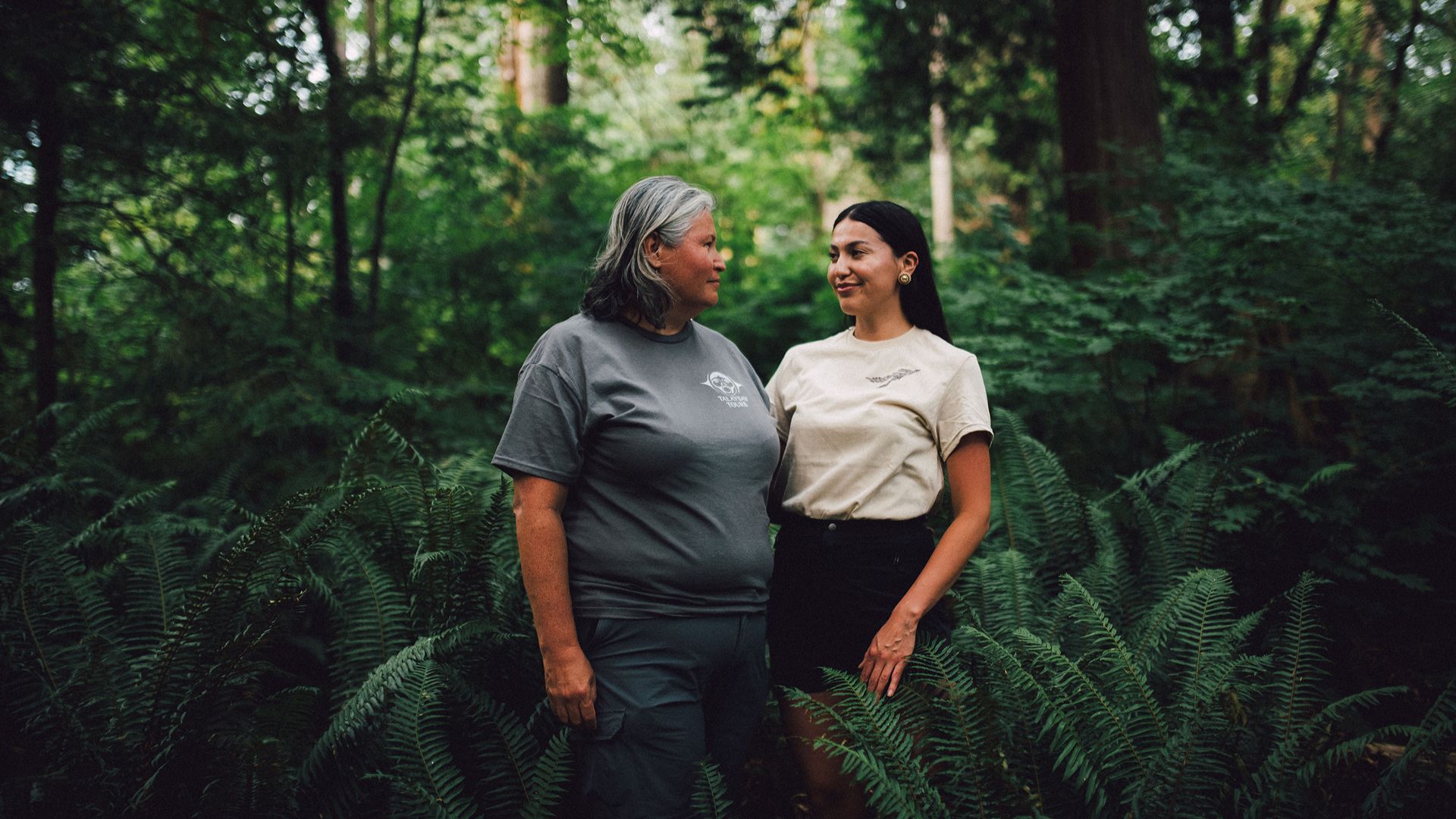
We pause in a forest clearing, surrounded by cedars. Standing beneath the towering trees, I immediately feel their history and strength. Talaysay leans in, sharing how useful they are to her people with a deep appreciation. ‘It’s the best wood. Lightweight – and can even be woven into cedar hats, baskets and canoes.’
I look up into the trees and think of my late mother. There is something about their strength that reminds me of her.
Talaysay speaks about her own mother – and fellow cofounder of Talasay Tours – Candace Campo, with deep affection. Her face lights up when she talks about her family and her mother’s dedication to nature and keeping the stories of their ancestors alive.
Her mother passed down knowledge of Indigenous plants and medicines, just like mine. Her father shared deep ceremonial traditions with her. Talaysay is even named after her aunt – a true matriarch who helped with cultural language revitalisation in their community.


Water that sustains
Growing up in Sechelt, British Columbia, Talaysay has a deep love of the water and comes from the fish-trap family of Indigenous communities who preserve and pass down specialised knowledge, construction and operation of fish traps as a shared livelihood or cultural tradition. Her people are often referred to as “the salmon-cedar people”, a description that seems perfectly fitting as she moves between stories and teachings of water, forest and the resources that have sustained generations before her.
Talaysay is open and transparent, eager to impart so much of what she has learned to both young and old. Despite her very modern take on furthering the Indigenous cause, when I ask about the role of elders and whether the stories and traditions have changed as the tours have developed, her answer is clear: ‘We do not add to things unless the elders say it’s okay.’
The cultural protocols and stories are run through an elder from the community; they are always involved in the cultivation of future tours and teachings.
Read more: More ways to connect with Indigenous culture


What the forest remembers
This practice of borrowing respectfully from the past to nurture the next generation applies to everything Talaysay’s people do. A similar philosophy extends to the berry bushes that are abundant during the late summer months. During the first two weeks of summer, the berries aren’t harvested. Talaysay says her people leave them for their animal ancestors – for, as her brother likes to joke, ‘first dibs’. And they don’t take the last berries, either. That teaching came from observing bears foraging in the wild. The bears didn’t strip the bushes bare. They leave some behind.
‘Those bears knew that the berries were going to go back in the ground to come up for the next generations.’ There is something profound in that simple act. Leave something behind for what comes next.
Finally, we arrive at an open field overlooking a tranquil lake. Talaysay invites us to try homemade hush tea, made from a family recipe: a mix of raspberry leaf, licorice root, mint and rose hips.
Surrounded by the open landscape, I think about how much of what we’ve learned has been passed down – not just through words, but through observation and listening to the land.
Read more: Walking with Mexico’s Zapotec community


Teaching the next generation
Talasay is seeing the same openness to observe among younger travellers, too. More people of her generation are engaging with Indigenous tourism, she tells me, and when they come on the tours, they’re not just interested in the plants and wildlife. ‘I think the stories are their favourite part.’
Talaysay is determined that those teachings don’t stop with her – and are carried forward to future generations. To ensure this, she’s found very contemporary ways of bringing the teachings she inherited from her ancestors into her everyday world.
She models for several brands and often partners with Canadian brands, such as Lululemon, to promote diverse faces in the fashion industry. Her own Love the Land apparel label also incorporates the work of young Indigenous artists, bringing their designs and cultural knowledge into contemporary clothing and creating opportunities for young people to express themselves and develop professionally. And her new skincare line, THEDA × NENA – created in honour of her mother – incorporates local West Coast cedar and local sage, which grows abundantly in the nearby Okanagan Valley.
Talaysay also uses social media to get the message out, posting regularly. ‘I see it as a journal of the chapters of my life that I’m going through,’ she says. She’s passionate about creating space for the wider Indigenous youth to connect and spark conversations, so that they see themselves as part of the future, too.
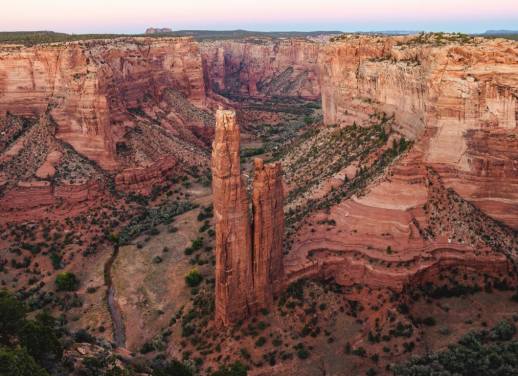
Read more: Meet the Navajo guides of Canyon de Chelly


A strong connection
As the walk comes to an end, I think again about the cedar trees. Their tenacity and the way they carry so much history in their strong trunks. How being in their presence brought my mother to mind.
I came on the walk expecting to learn more about Indigenous plants, stories and the land. I didn’t anticipate feeling so strongly connected to something I already carried with me. Spending time in nature learning and being fully present reminded me that the land doesn’t belong to us – we belong to the land.
The new We Are the Land experience is bookable now on Intrepid’s Grand Canadian Rockies adventure, departing from May 2027.