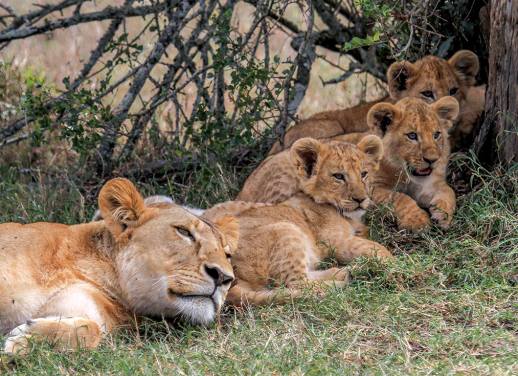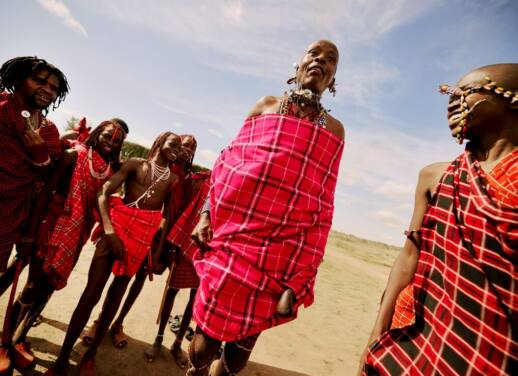
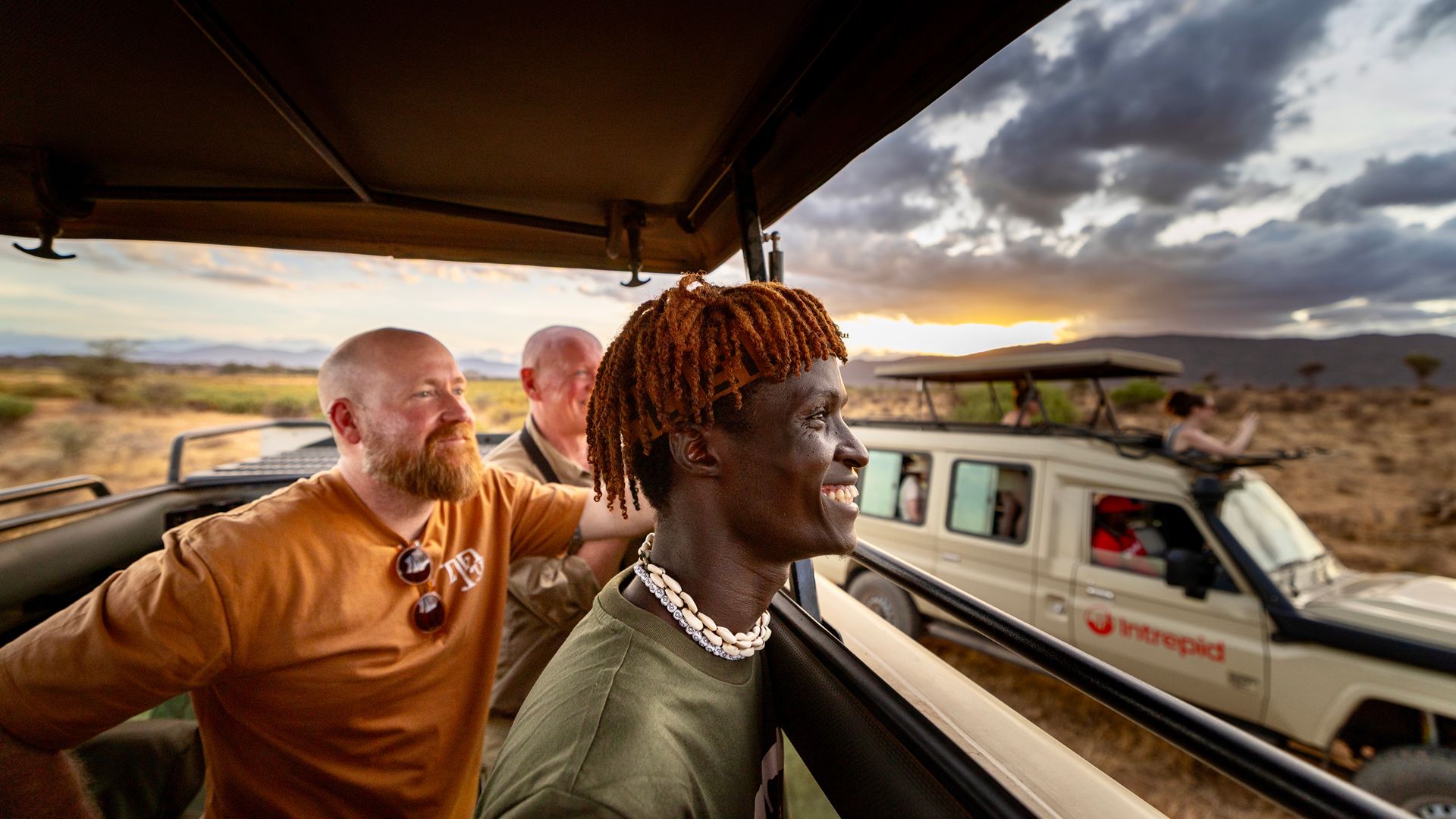
Rachel Chang explores one of Intrepid’s Not Hot List destinations for 2027, discovering a land where stargazing and safari meet, all steered by the local Samburu people.
My eyes scan the scenery of Samburu National Reserve, meticulously soaking in every inch of the golden-hued landscape. Despite flying more than 16 hours to get here, there’s something familiar about my arid surroundings which harks back to the dry California summers I grew up in. But then, as if to remind me where I am, from out behind a bush, a drape of black and white interrupts my gaze. Unhurriedly, the stripes of a zebra emerge. Then another, and another.
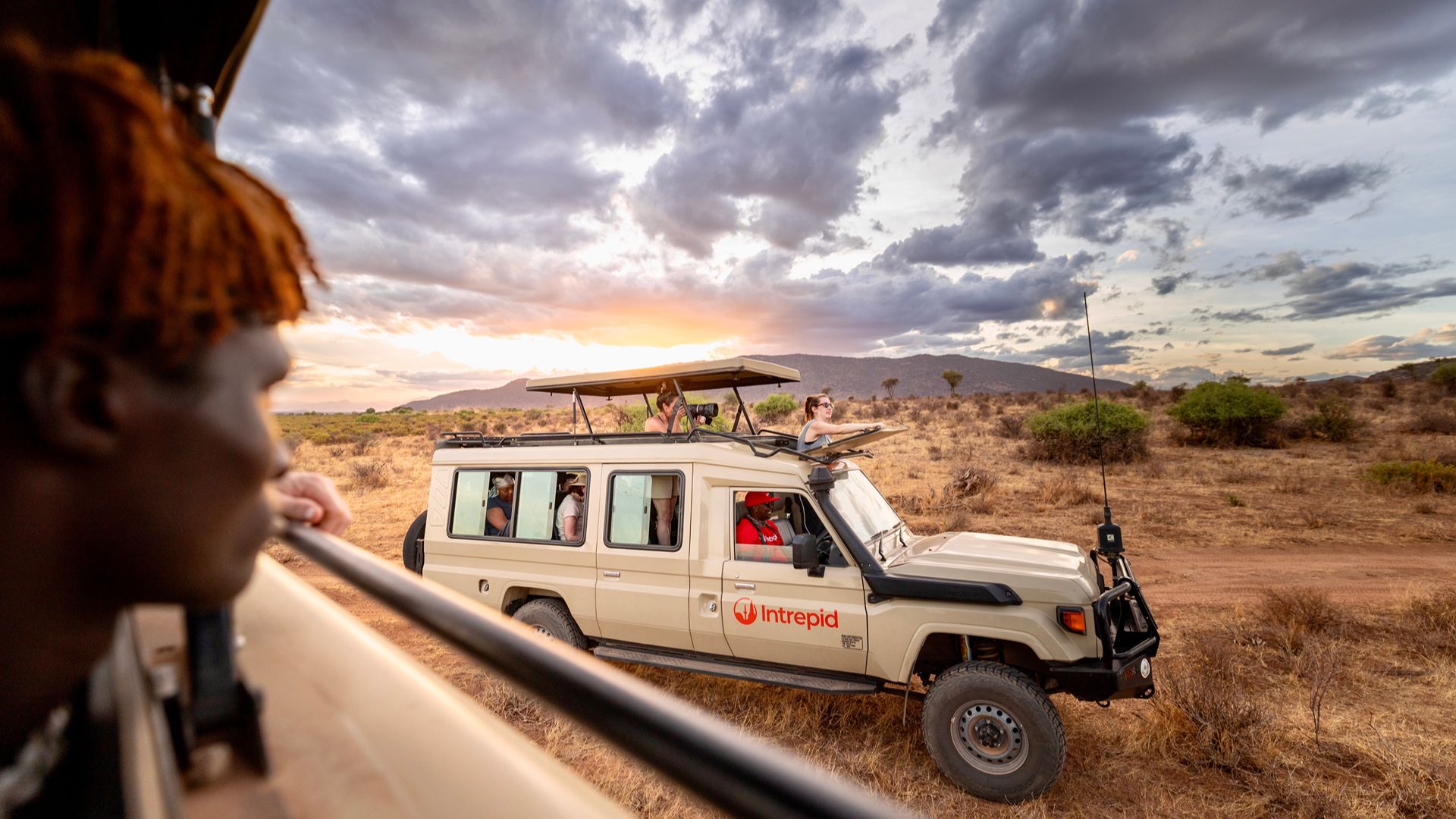
Matching the mammals’ gentle pace, I poke my head out of our 4WD’s roof, as we navigate around the corner to a riverbank. A monkey leaps out of a tree to my right, just as a cluster of giraffes graze their way down to the water. In the distance, vultures line a barren tree. Every which way we turn, I’m completely enveloped by nature.


Wildlife with a difference
Of course, when I set off on Intrepid’s new Kenya Safari Adventure, I expected to check off the same iconic African animal roster as everyone else: the Big Five. But immediately, there’s something different about the creatures in Samburu. With narrower stripes that stop above the belly, the zebras are actually endangered Grevy’s zebras. And with strikingly saturated polygonal patterns, those are, in fact, reticulated giraffes.
That’s because Samburu has its own ‘Special Five’. There’s also the Somali ostrich (a subspecies of the fastest-running bird), the beisa oryx (a straight-horned antelope) and the delightfully peculiar gerenuk (a long-necked, big-eared antelope with a penchant for standing on its hind legs).
But what makes spotting Samburu’s endemic species so unique is that here, there’s no competing with other safari vehicles for a sliver of sightline just to see a tuft of fur in the distance. In Samburu, almost every safari vehicle we pass – despite being from competing lodges – stops as our drivers exchange insight into where the animals are. There’s a communal nature to the experience that makes it feel like an exciting group expedition.
I quickly discover that because Samburu’s landscape is mountainous and dotted with bushes and acacia trees, you never quite know what you’ll find around the next corner. This, alongside the lack of crowds, makes the experience feel intimate.
This bears out in the visiting figures, too. There are 90% fewer travellers to this northern Kenyan reserve than the 300,000 who visit the Maasai Mara annually. Of course, Intrepid’s trip visits both – the big hitter and the lesser discovered – providing a nice contrast. But I acquire a soft spot for the relaxed atmosphere at Samburu, which topped Intrepid’s annual overtourism-addressing Not Hot List this year, noted as a quieter alternative for those seeking community-supporting wildlife experiences.


A starscape like no other
As darkness falls, my eyes rise from the fauna into the sky. Living in New York, any chance to see a few stars is a treat. But as I look up at the blanket of stars, there’s an immenseness I’ve never before witnessed.
‘We’re all from different corners of this planet, but there’s something we all share: the night sky,’ says Kimani Wa Nyoike, managing director of Leo Sky Africa – Intrepid’s astrotourism partner in the region – as he welcomes us to the optional stargazing experience at Samburu Sopa Lodge, our accommodation for the night. ‘We all have different views, different seats in the house and I would argue that Samburu is the VIP section.’
Indeed, the reserve’s prime location by the equator – fewer than 100 miles from 0° latitude – provides a rare vantage point for seeing the constellations from both the Northern and Southern Hemispheres. Add in the semi-arid climate and Samburu offers some of the world’s clearest skies for stargazing.
It’s no wonder the Indigenous Samburu people have been looking upwards for generations, forging a bond with celestial bodies in their everyday lives. Indeed, Earth’s closest neighbour Venus is believed to be the tribe’s first home and the planet still serves as a guiding figure. Meanwhile Lapa (the Samburu name for the moon) is seen as a father figure and protector of the community. ‘When the local people look up at the sky, they see it as a map of living things,’ Samburu cultural astronomer, Jonathan Leemungesi, explains.
But they’re also keenly aware of the science behind it all, says Lynne Wonder Kariuki, Samburu Sopa Lodge’s astrophysicist: ‘The Samburu even have people assigned to just study stars, so they have that insight – combined with their own rich cultural knowledge.’ If proof of their expertise were needed, the Samburu discovered that Sirius is actually a binary star system of two stars, long before modern telescopes confirmed it.
In tribute to this generations-long connection with the skies, Samburu Sopa Lodge now has a new planetarium, built in the style of traditional Samburu huts, so visitors and locals alike can have a fresh viewpoint to take in the sky we all share.
Community that runs deep
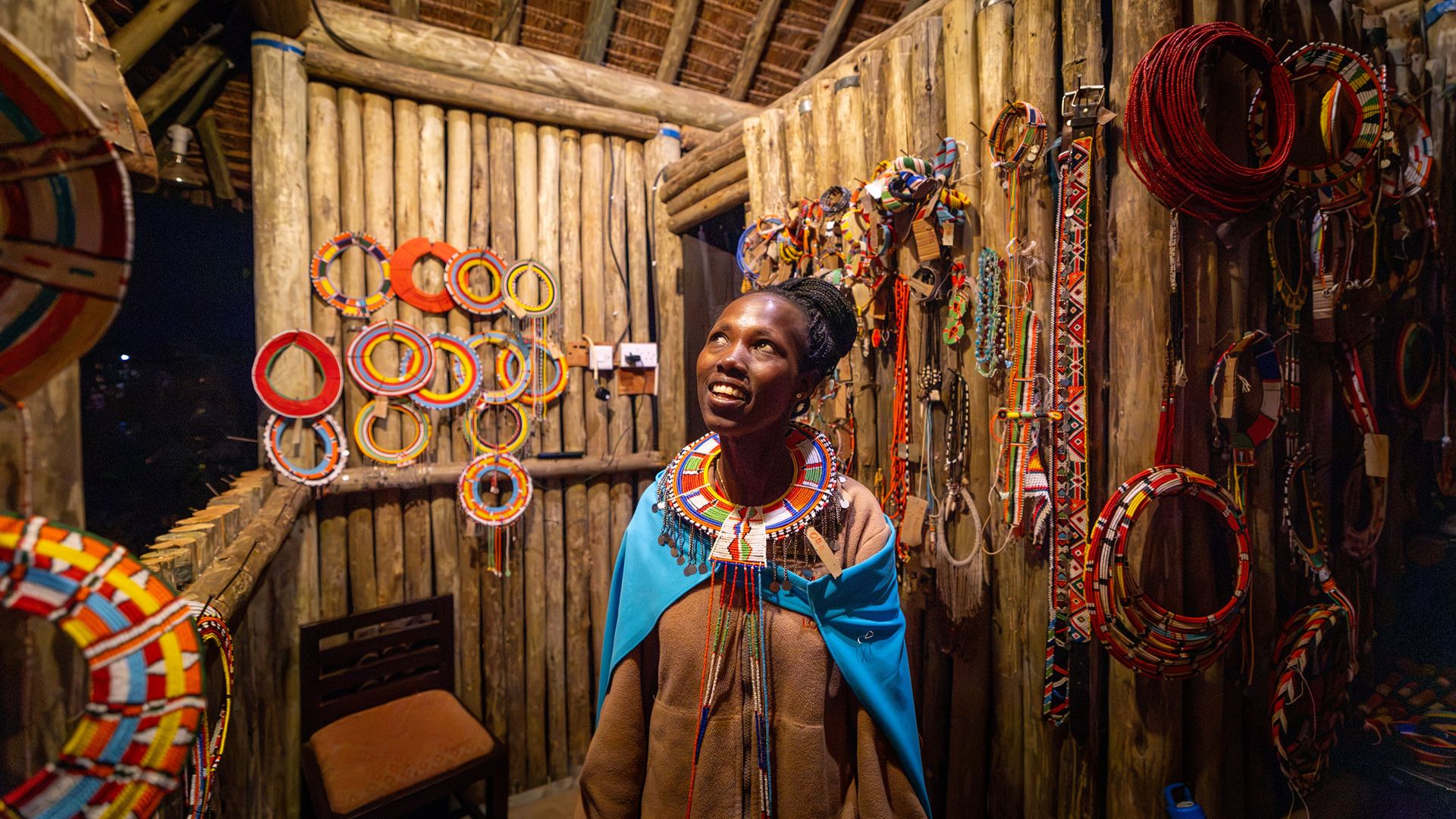
Local people are also championed in the lodge’s community bead shop, run by local Rose Lekakwar. She walks me through the various pieces, from the sayen necklace worn by unmarried women to the sengaen bracelet for married women. Despite the intricate designs, I’m surprised when she tells me they’re all chosen by instinct. ‘It’s all about colours of joy, happiness or beauty – whatever draws you,’ she says.
But more than anything, she’s thrilled to have people engage with their crafts and customs. ‘I like people to come and experience our traditions,’ she says. ‘If it’s a lady, come and feel what it’s like to be a woman in Samburu – come sit down under the shade of a tree and do the beadwork and milk the goats. If you’re a man, go out there and do the cattle grazing and mix the blood and milk [a Samburu tradition] and taste it. Just get the full experience.’
In fact, the lodge itself has become an extension of the nearby village. Not only does nearly 50% of the staff hail from there, but the entire community has access to the lodge’s medical clinic and dispensary for free. They also provide water for the locals, as well as food for the nearby school.
Architecturally, the lodge also tries to blend into nature as much as possible, modelling its buildings on the Samburu’s makuti thatched roofs and manyatta-inspired structures. This, combined with the friendly, local Samburu staff, renders it more of an experience than a hotel.
Knowledge sharing to protect the elephants
This connection between culture, people and nature – all rooted in respect – continues at Save the Elephants, the flagship research centre of the renowned Kenya-based nonprofit, which is located in Samburu and has successfully eliminated the area’s poaching in the last two years.
While noted partners such as Chelsea and Bill Clinton have used their influence to draw attention to the cause, it’s the day-to-day efforts – powered by the locals – that really have steered the efforts. Community women dubbed Mama Tembos (elephant mothers) monitor the elephant corridors while local Samburu researchers meticulously track the movements of every individual animal.
Two of them – James Mpapa and David Lochuragi – join us on an afternoon game drive one day, adeptly showing off their skills in identifying each elephant by name and family from a distance, while simultaneously recording details of every sighting.
‘The Samburu people are very receptive [to protecting the elephants] because they have been living with this wildlife for so many years,’ says Abraham Lesalon, Save the Elephants’ coexistence coordinator. ‘It’s part of their culture. You find wildlife roaming the towns and nobody bothers them.’
While any African safari shows you wildlife, in Samburu the interactions truly feel tied to meaningful purpose. As I travel through the area, I’m keenly aware through every handshake and smile, the impact that travel has on this community – who share their knowledge and expertise in return.
‘Cultures are deeper than what we read and what we see,’ my Intrepid leader Antony Koine Makumi tells me at the end of our adventure. ‘The Samburu people are very proud of their culture – what they wear, what they say, how they speak. In this ever-changing world, I’ve even more respect for them for keeping their traditions for so long.’
Follow the stars to Samburu National Reserve on Intrepid’s new Kenya Safari Adventure.