Is the way we’re travelling today changing? Less about ticking off the same sights, more about uncovering the essence of a place, as Todd Fong discovers on a new tour in Osaka.
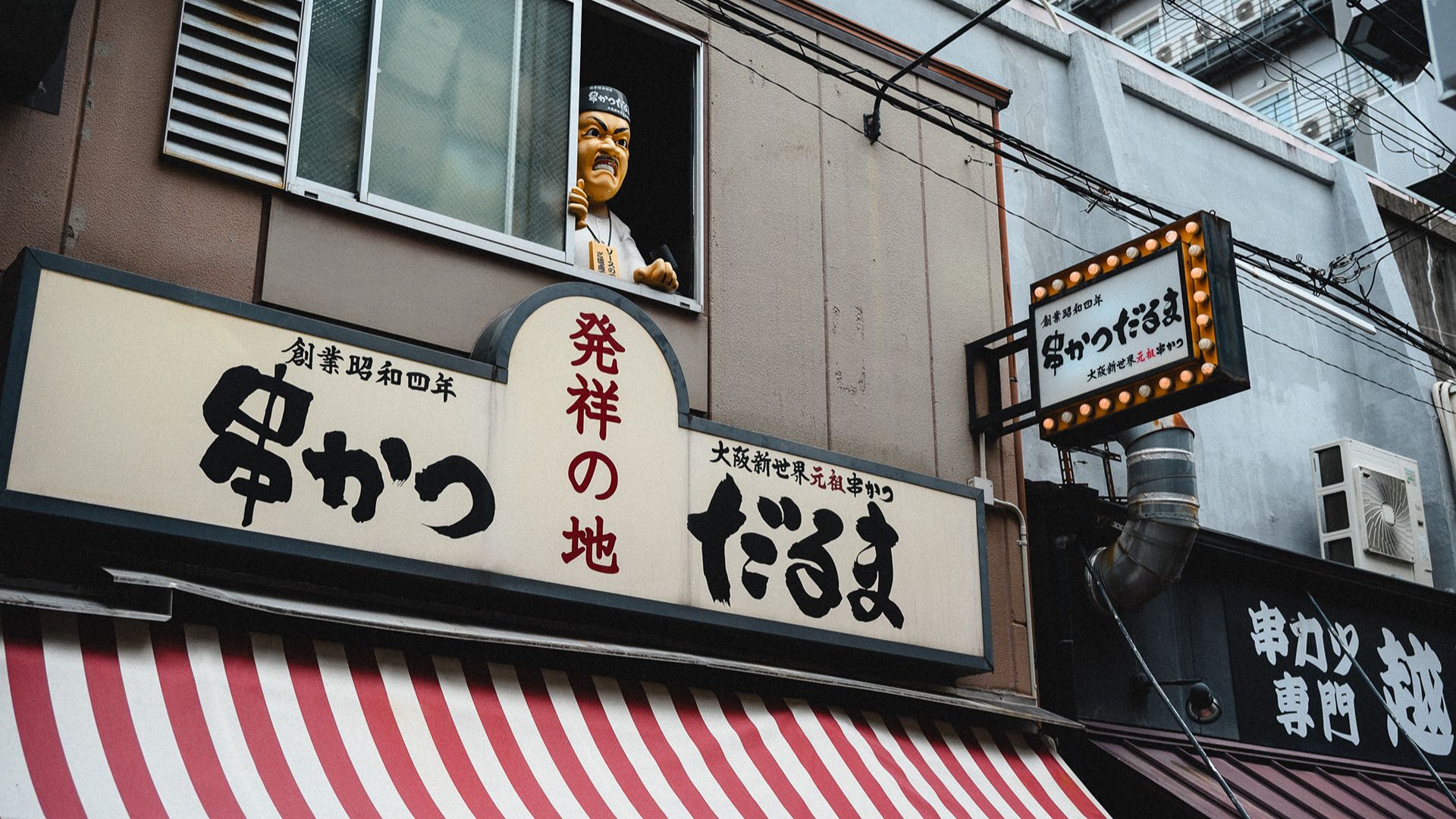
The angry face of a chef glares down at me from the second-storey window. Although not a real one, but a lifelike plastic reproduction of a stern skewer-making chef, it’s an intimidating introduction to the original Shinsekai district location of the now-ubiquitous Osaka chain restaurant, Kushikatsu Daruma.
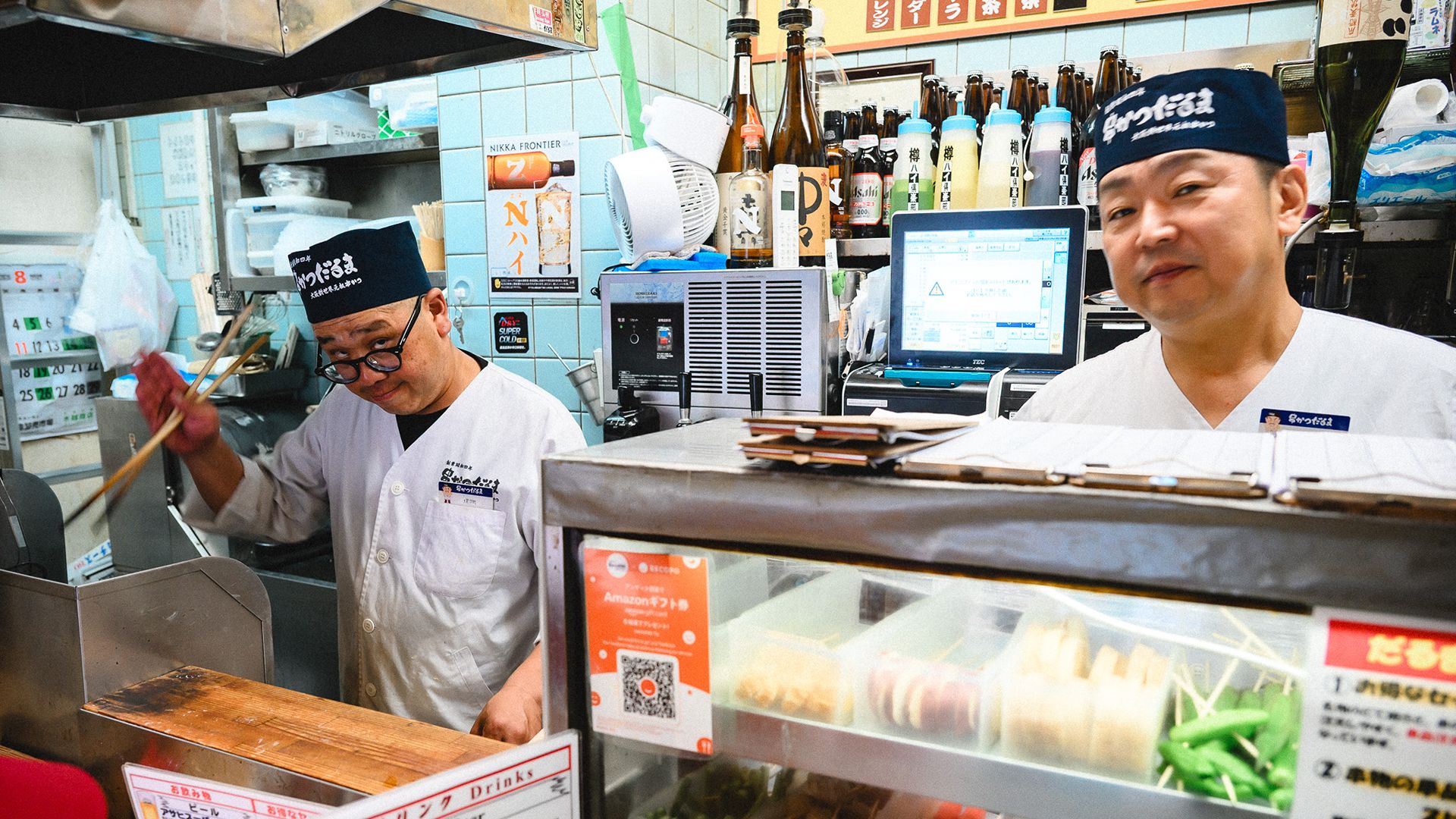
Happily, the sense of foreboding quickly subsides upon sliding open the door and hearing the hearty greeting of ‘irasshaimase!’ of the two friendly chefs behind the counter. The genuine welcome, along with the playful banter I receive across throughout the meal, reminds me why Osakans have a reputation for being among the friendliest and most straightforward people in Japan.
It’s a reputation that’s important, because despite Osaka’s many charms, it isn’t built to compete with the Shinto shrines and UNESCO World Heritage Sites of older sister, Kyoto, or the statuesque super towers of younger sibling, Tokyo.
Because apart from Osaka Castle perhaps, the excellent Kaiyukan Aquarium or the pop-culture attraction Universal Studios Japan, there simply aren’t any major attractions in Osaka. Yet, curiously, the city still ranks among Japan’s most popular destinations.
So, what are the other qualities that make Osaka so irresistible? And is it indicative of the way we’re all travelling today: less diverted by bricks and mortar, more lured by the pull of place and people?
My guide Kazu from Intrepid Urban Adventures set out to help me discover exactly that on a new tour that delves into Osaka’s subcultures – its vintage stores, working-class history, otaku obsession with arcades and video games, and, of course, its proud place as ‘tenka no daidokoro’ (the nation’s kitchen) – over any one single sight, physical landmark or designated attraction.
Read more: Where to go in Japan based on your travel vibes


The underrated history of Japan’s third-largest city
To start with, most people know little about Osaka’s importance in Japanese history. From the 16th-floor observatory of the Abeno Harukas building near Tennoji Station, Kazu reveals little-known facts about the city to me: its brief stint as the nation’s capital nearly 1,300 years ago; its importance as a port of both international and domestic trade along the many waterways connected to it; its strategic value for the warlords who sought to unite Japan under one military leader, the Shogun.
From the observatory, the size of the city is evident, from the low-lying sprawl of working-class neighbourhoods to the shimmering skyscrapers of Umeda in the Kita business district.
During our half-day adventure, we will focus mainly on the Minami entertainment districts, where Osakan businesspeople come to unwind after a long day’s work, starting in Shinsekai, ‘The New World’.
Inspired by early-20th-century New York City and Paris, Shinsekai has seen its share of Osaka’s history. It was founded as a model neighbourhood of the future in 1912. After WW2, it began to devolve into a seedy red-light district where organised crime ruled the streets.
Read more: Things to do in Japan that most solo travellers miss


But in recent years, Shinsekai has managed to shed its less attractive elements while maintaining its nostalgic atmosphere. Today’s Shinsekai is a gaudy collection of neon signs and lanterns advertising an enormous array of izakaya standing bars and more wholesome entertainment establishments, such as pachinko parlours and retro-gaming arcades.
It’s in one of these arcades that I relive my high-school days, playing Street Fighter on an old-school console like it’s 1987. Ah, the sweet memories of getting my ass kicked by computer-controlled Ryu is something that can’t be savoured in any other way. I could easily spend our entire tour reliving my childhood, but thankfully Kazu is there to remind me we have a lot more to see – and eat.


Eat, shop and play like an Osakan
Seated at the counter of Kushikatsu Daruma, Kazu introduces me to one of Osaka’s post-war soul foods: kushikatsu. This dish, along with the equally loved takoyaki (fried octopus balls) and okonomiyaki (savoury pancake), was created as a cheap, quick meal for day labourers in the early 20th century.
Originally deep-fried strips of cheap cuts of beef and potato on skewers, kushikatsu has since evolved – to the point where if something tastes better fried, then why not fry it?
Seafood, quail eggs, vegetables and even cheese are all viable ingredients, deep-fried in a batter of egg, wheat flour and panko breadcrumbs. These addictive bite-sized dishes are then dipped in a bowl of tonkatsu sauce – but never, ever double-dipped. If you need a bit more sauce, take a piece of the sliced cabbage served as a side and scoop a bit more sauce to drip on your kushikatsu.
During the meal, the playful chefs also explain a bit about the chain’s 97-year history, showing us photos of major Japanese celebrities who’ve dined there and introducing me to other guests as ‘the writer for the New York Times’, which I’m unfortunately not. The playful, lively atmosphere is quite different from many Tokyo establishments, where your goal is to eat in silent solitude and vacate your seat as quickly as possible.


After lunch, Kazu navigates us through nostalgic shotengai, covered streets lined with shops, bars and restaurants catering to locals – Japan’s precursor to the shopping mall.
Some of these shops seem to have not aged past the late Showa Era, a period when Japan rapidly grew into a manufacturing and economic powerhouse in the mid to late 20th century. Osaka staples from the Showa Era, like neon leopard-print blouses, are still proudly on sale on the same streets where tiny standing bars are hangouts for retired salarymen who have been regulars there for 40 years.
We breeze through Den Den Town, Osaka’s sibling to Tokyo’s Akihabara. Both evolved from a collection of electronics shops and street vendors into meeting places for otaku: people obsessed with the character culture of anime, manga and video games.
Den Den Town is where you can learn what your collection of Nintendo 64 games would be worth if you still owned them or purchase a rare $10,000 Pokemon card, if you have the cash going spare. Since none of those items are on my radar, we make our way instead to Kuromon Market to indulge in another round of bites in the ‘nation’s kitchen’.
Read more: 11 things to seek out on your next trip to Japan


The soul of Osaka is in its food
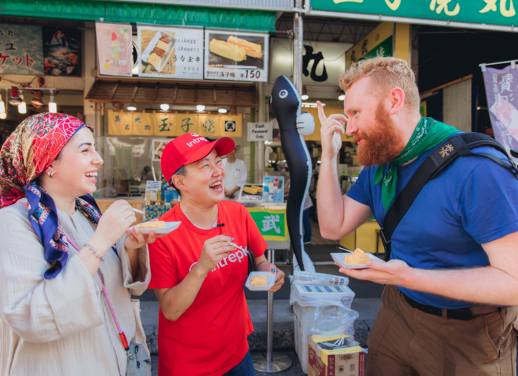
Like many downtown markets, Kuromon was, and still is, a place where locals gather to socialise in bars and restaurants, shop for supplies and sundries, or just kill time. Although signs of tourism are beginning to surface among some of the vendors, you can still find shops selling high-quality slices of sashimi and premium fruit at prices made for locals – and street vendors calling out to passersby like it’s 1967.
What you won’t find are sushi restaurants serving $200 omakase set menus or boutiques selling luxury branded goods. Look around you: you’re among the real Osakans here.
So, we eat like local Osakans, enjoying street food such as fresh, spicy tsukemono (pickled vegetables), obanyaki (a pancake-like dessert stuffed with red bean or custard) and cups of mixed juice. Osaka is known for high-quality mixed juices made from unsold premium fruit on the verge of overripening, to keep it from going to waste. Frugality is another trademark in working-class Osaka: a city where everything serves a purpose.
Read more: Everything I wish I knew before going to Japan


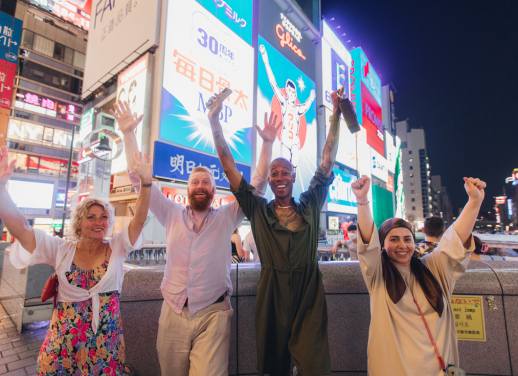
Our final destination is the closest thing to a true landmark we see today: Dotonbori, with its iconic neon-lit riverside, featuring the Glico Running Man. While the image is world-famous, the story behind it isn’t: Kazu explains that Glico’s founder learned that glycogen could be extracted from oyster broth as a health additive to his caramel candies. One piece of caramel was said to give you enough energy to run 300 metres, for those who cared to measure.
Oddly specific riverside advertising isn’t the only thing Dotonbori is famous for, however. Next, we pause to partake in one more of Osaka’s famous soul foods: takoyaki.
For the uninitiated, takoyaki is a chunk of octopus tentacle encased in a ball of fried batter, ideally crispy on the outside and unexpectedly hotter than molten lava inside, capable of searing your brain from inside your mouth.
Despite its slightly unappetising description and associated consumption hazards, takoyaki are actually delicious enough to be eaten by the thousands on any given day in Osaka. Kazu’s shop of choice is Honke Otako Dotonbori, chosen for its unusually large chunks of octopus.
After a brief digestive stroll along the main street, with its enormous, elaborate signboards advertising a visual cacophony of restaurants, bars and shops, we finally reach Ebisu Bridge, under the Glico sign.
Bidding goodbye to Kazu, I reflect that although we’ve seen nothing in particular today, in a day notably short on monuments, I feel I’ve experienced the real Osaka, which, like its residents, is unpretentious, honest and full of good humour.
In an age where it often feels like travel has been reduced to repetitive replaying of the same-same social media greatest hits list, isn’t that all we’re really looking for, after all? Something authentic, shared between you and a place, that can’t be replicated on anyone else’s reel.
Discover the new Retro Streets & Local Eats Adventure with Intrepid Urban Adventures.
Image credit: Photography shot on location by Todd Fong with Intrepid Urban Adventures.