As part of a new Intrepid experience, Diana Jarvis travels to the shoreline of Galicia to try a centuries-old tradition and way of life – where clams hold the key.
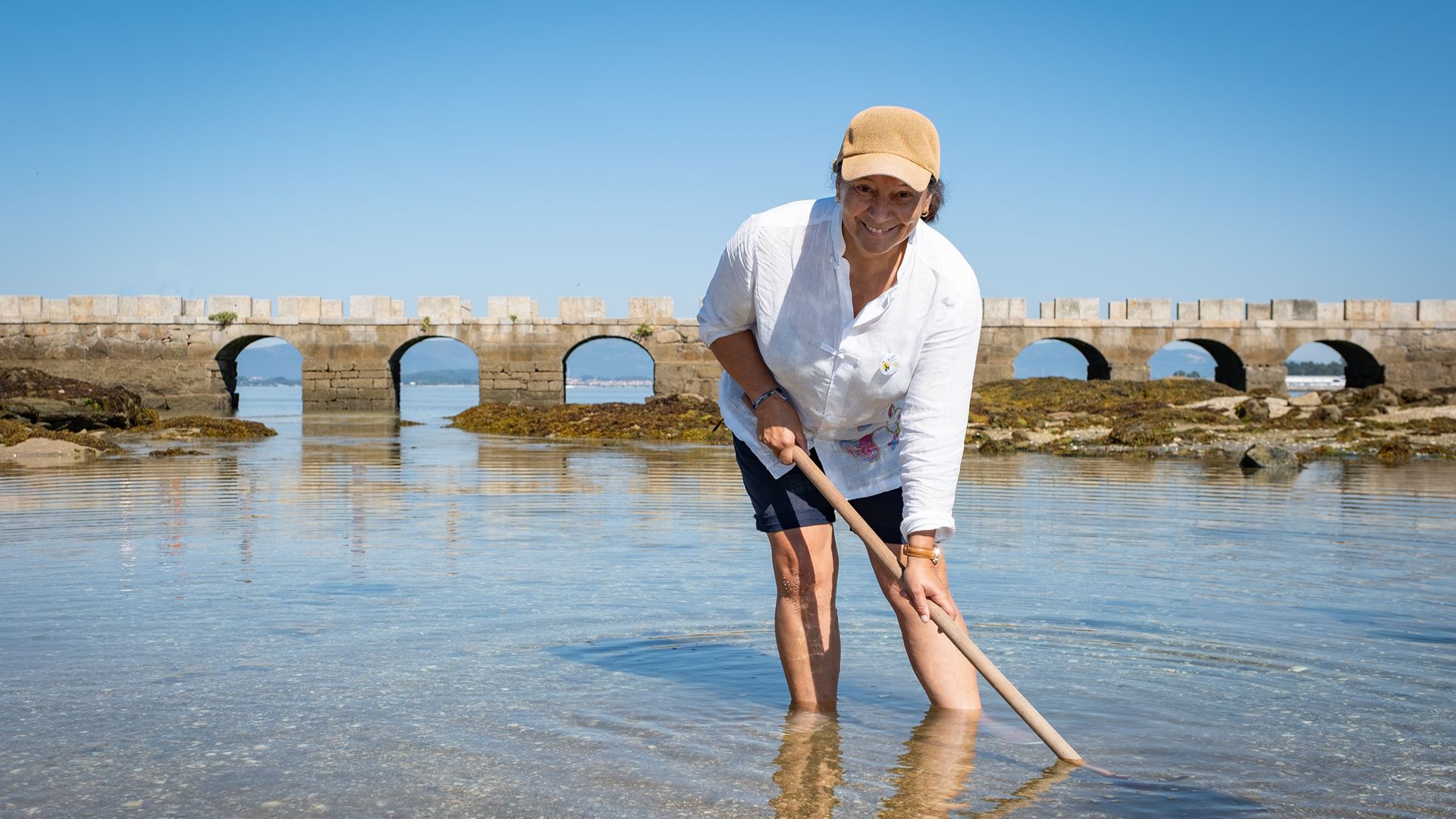
‘Welcome to my office,’ says Charo Oliveira-Dominguez, with a wide smile, as we emerge from the narrow streets of Cambados, a seaside town on the western shores of Galicia in northern Spain. In front of us is a millpond-calm sea, dotted with seaweed-covered rocky outcrops and a stone jetty out to the tiny island of San Sadurnino.
Charo is one of Cambados’ pioneering mariscadoras – a crew of seasoned seafood fisherwomen, responsible for keeping this sustainable harvesting tradition alive amid changing times and climate, and I’m here to learn all about it as part of a new Intrepid experience, recently introduced to the Northern Spain Real Food Adventure.


Meeting the mariscadoras
Following a briefing in the shade of a scallop-shell-clad fisherman’s cottage, where Charo shows us the wide variety of molluscs the mariscadoras collect, I slide my feet into some fetching white wellies and I notice Charo in some snazzy jelly shoes. I ask if they need any specific clothing for this job. ‘Today, in winter we wear waterproof suits,’ she says. ‘Though my mum used to go out just in a thick woollen jersey and bare feet. The mariscadoras were very poor back then,’ she explains.
As we prepare to forage for three species of clam – cockles, grooved-carpet shells and Japonica clams – Charo hands me a sharp-pronged rake that could cause quite an injury if not carried correctly (over one shoulder with the prongs pointed upwards is the way to go, apparently).
‘Hi ho, hi ho, it’s off to work we go,’ sings Tam, our young, sprightly Intrepid leader, as we head on across the stone walkway to the island. The mid-morning sun is already high in the sky and children play among the rock-dotted shoreline on the sandy beach.
Read more: Intrepid’s Not Hot List has landed for 2027


How the tradition began
Shellfish gathering was always a job for women in this part of Spain and typically associated with poorer families harvesting for both subsistence and a little extra cash. ‘The men went out to work in the deep sea as fishermen, while the women stayed closer to the shore looking for shellfish,’ Charo tells me, as she guides us to her chosen spot on the sandy shores.
The women primarily stayed close to home to fit in with their other responsibilities like looking after children and keeping the house. ‘Today, we work 15 days a month, about five hours a day,’ she tells me.
I love the sound of these flexible conditions – sign me up, I think to myself. But it turns out this timetable isn’t entirely flexible – it’s governed by the moon, the tides and the trading hours of the town’s lonja (commercial market).
Charo is in her 60s now and has been doing this job for 27 years, as her mother did before her. She knows of at least two more generations of her family’s women working as mariscadoras, but the tradition is thought to date back over a thousand years.
Her mother’s experience of the role was very different, however: she first started work at the age of seven. She was even arrested and briefly imprisoned along with other mariscadoras, owing to conflicts over quantities taken and tensions in the community from unregulated harvesting.
Before 1995, it wasn’t even perceived as a profession, just something women did on their own to supplement the household income. But since 1996, the sector has been regulated and professionalised: women must now obtain a license to cultivate, which is controlled by Galicia’s regional government and, once issued, lasts five years. They also receive training on the management of the inter-tidal zone and consequently contribute to keeping marine biodiversity in balance.
Read more: Unmissable new food and drink experiences


A living and a way of life
As the morning sun rises in the sky and the high tide is already ebbing away, we wade into the pellucid water and Charo digs into the sand with her rake, pulling at it with strength and purpose. Once the rake’s full, she lifts it above the water and shakes off the sand to reveal a selection of clams of varying sizes.
‘They need to be at least 4 cm long to ensure the creature has the chance to reproduce at least once before capture, ensuring the population grows and remains healthy’, she tells us. Charo can tell by eye, of course, but she pulls out a measuring stick so we can test for ourselves.
There are now 32 legally constituted mariscadora groups from across Galicia represented at the Consejo Gallego de Pesca, a regional government board. This has led to an improvement in working conditions for the women and a decent salary, which is now standardised, even though the price of shellfish is subject to market forces and set by the auction at the lonja.
All mariscadoras in Cambados also now belong to Guimatur, an organisation established in 2004, partly funded by the EU, that promotes marine tourism and coastal conservation. The mariscadoras are no longer regarded as simple harvesters: they’re now seen as an integral part of both preserving cultural heritage and maintaining overall ocean health.
Charo tells me there are around 200 women licensed to cultivate in Cambados and, when I ask how many there were in her mother’s day, she says around 50. I’m surprised by this; I’d imagined it was a dying tradition, but it transpires that the role has been significantly elevated by the regulation and involvement of the EU, plus the women also earn a little extra from taking out groups of visitors like ours, so it’s a much more attractive proposition than it once was. Women can now earn a decent wage from it.


Fishing for our supper
Once I’m a couple of metres from the shoreline, I dig my rake deep into the sand beneath and discover you do indeed need strength for this job. I bring up a rakeful of shells, yet only one or two are big enough to make it into the collection tub. ‘We work as a team in groups of five,’ Charo explains. ‘Together, we share if one woman is not feeling so strong on that day and not finding so many clams. We help each other.’
With five of us in our group, too, it doesn’t take long to fill one tub. On this occasion, the clams are thrown back into the sea. But on working days, mariscadoras will spend a few hours either side of high tide collecting the molluscs. Nowadays, the sale process is digitised: each mariscadora has a barcode which is stuck onto her tubs and taken to the lonja. Through an app on her phone, Charo and others like her can see what’s accrued once the day’s trading has finished.


From playa to plate
From the lonja, the little clams make their way to restaurants and markets across Galicia, so the mariscadoras don’t often know where the fruits of their labours end up. One local customer, however, is Real Espanola Conserva, an award-winning artisan canning factory on the outskirts of Cambados.
Clams are just one of the many fish and seafoods carefully packaged by a team of expert canners here, again all women. The vibrant, convivial atmosphere of the factory floor (full of people, rather than machines), is not something I’d expected to see today. But after the shoreline tour, we visit to feast on some of their sardines in olive oil, mussels in a ‘secret’ tomato and pepper sauce and, of course, clams – all washed down with local Albarino white wine.
As I nibble on a salty clam , I certainly see them differently now. Exceptionally high in vitamin B12 and iron, along with other minerals key for metabolic function; sustainably harvested to ensure a balanced marine ecosystem; a key provider of income for the women on the coast… They’re a superfood in every sense of the word. One we should all savour.
Join the mariscadoras experience on Intrepid’s Northern Spain Real Food Adventure.
Photography shot on location by Diana Jarvis for Intrepid. With thanks to Alexandra Touza David from Ponle Cara for translation support.