Indigenous schoolgirls in the Colombian desert have gained independence, access to education and the opportunity to pursue their dreams, with support from The Intrepid Foundation partner, World Bicycle Relief.
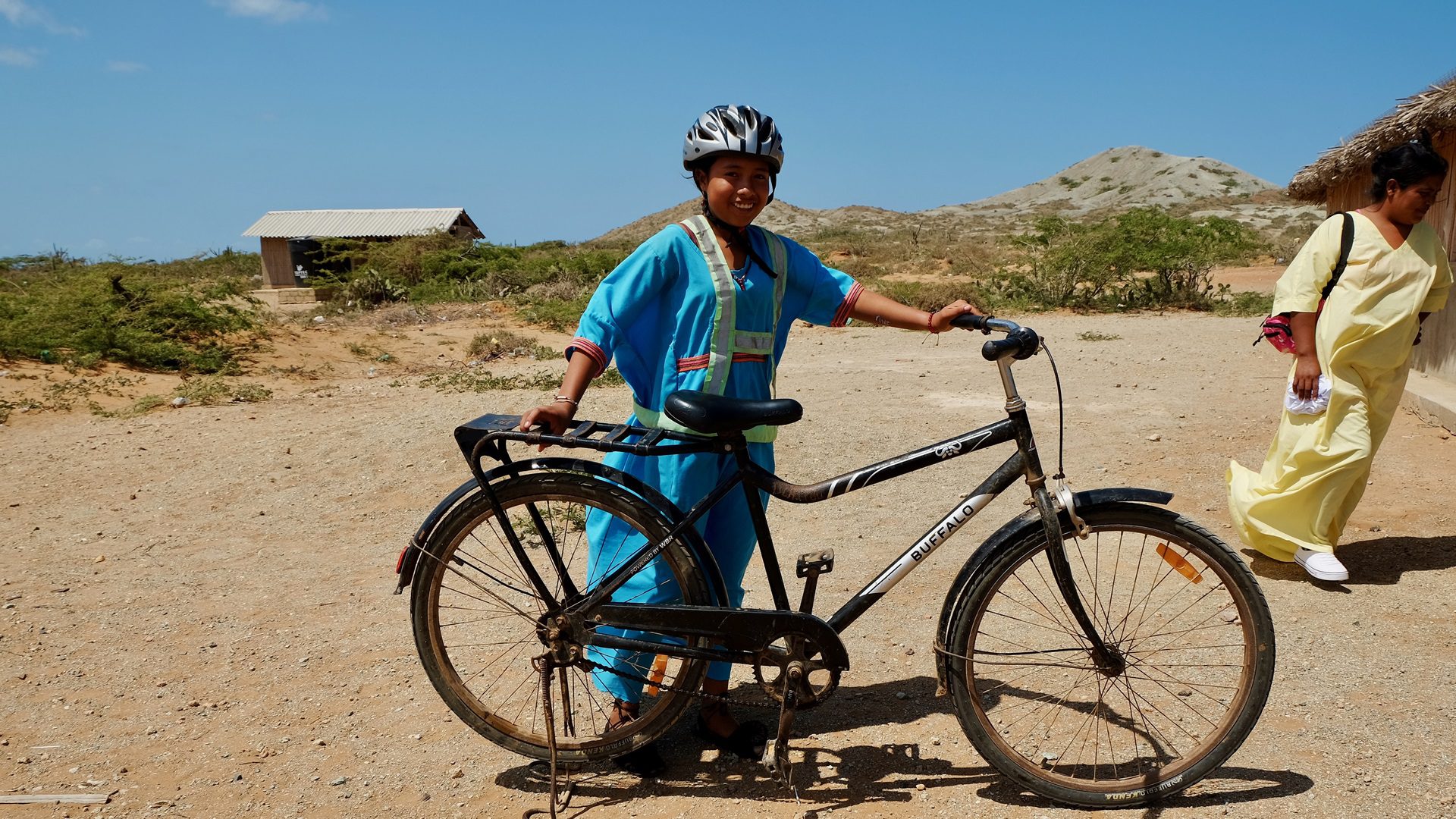
Each afternoon after class, 14-year-old Ani Paola hops on her bike and pedals through the desert to the beach, where she sells colourful, handwoven mochila bags to tourists and practises her English. ‘I take my bike, I go all the way there, sell my handicrafts, and then in the early evening I come home,’ she says. ‘My bicycle helps me a lot.’
Ani Paola belongs to the Wayuunaiki-speaking Wayuu, the largest Indigenous group in Colombia. She was taught to weave by her grandmother in their family’s rancheria, in a small coastal village in the La Guajira region, which sits at the windswept northern tip of South America. Weaving is a fundamental skill that every Wayuu woman must master; the mochila symbolising a mother’s womb, the sacred space where life is created. Girls are taught to craft ancestral patterns from spools of bright woollen thread from as young as eight.
When Ani Paola is not weaving or selling her mochila, she’s studying, teaching traditional dance, or collecting firewood and water for her family. Her dream is to become a marine biologist, she tells me, her voice rising and falling like the turquoise ocean, also the colour of her flowing robes. She was inspired after meeting some foreign biologists at the beach – a chance encounter enabled by her bike. ‘I’d better get my head round it before I go down that career path… how to get people who throw rubbish to pick it up before it pollutes the whole planet.’
The bicycle is key to her ambitions and independence: a vehicle for a girl building a future on her own terms. Ani Paola is one of hundreds of thousands of children around the world whose lives have been transformed by a Buffalo Bicycle from World Bicycle Relief (WBR). The global charity, a partner of The Intrepid Foundation, has distributed 53,000 bikes in Colombia since 2020. Built to endure challenging terrain, Buffalo Bicycles have innovative adaptations such as double chains and a two-speed freewheel mechanism, removing the need for finicky gears. The newer models are aluminium, which doesn’t rust in the salty air of La Guajira.


A route out of poverty, on two wheels
The sprawling desert region is roughly the size of Wales, with open expanses of shifting sands, cactus forests, crystalline ocean and star-scattered skies. But its beauty is beguiling. Signs of hardship are everywhere. In 2024, 39% of the predominantly Indigenous population suffered from multi-dimensional poverty, according to Colombian government statistics, which measure health, education and living standards.
These signs of hardship were visible on my journey to a school set to receive a batch of Buffalo Bicycles from WBR. As our 4WD bumped over desert tracks, tiny children slung a cord across the road, stopping the car to beg for a few pesos. Plastic food packets, scattered by the wind, had settled on the branches of thorny Trujillo trees like forlorn Christmas decorations. La Guajira is one of Colombia’s poorest regions. Children still die of hunger here, even as corrupt politicians pocket money destined for water projects and school meals programs.
‘You have to struggle here for so many things’, laments Alicia, Ani Paola’s aunt. ‘Making mochilas, fetching water, gathering firewood, that’s how it is.’ The struggle for water is the most urgent. ‘The thing we need most here in La Guajira is water’, she continues. ‘When one well runs dry, we have to find another. If the water’s filthy, we can’t use it anymore.’
The Wayuu’s way of life is being threatened by the hotter, drier climate. The nomadic people depend on rainwater stored in wells called jagueys. But as the rains grow more erratic, these dry spells are stretching ever longer and the wells are shrinking, explains Alfredo, the community’s traditional authority and a lobster fisherman. A desert-coloured mochila is slung over his shirt, emblazoned with the logo of a fishers’ association.
Prolonged droughts force girls to seek out jagueys hours away from home. In towns, tankers sell a week’s worth of water for 70,000 pesos (USD 20) per week – unaffordable for poor families. Acute water and knock-on food insecurity directly impacts girls’ schooling. They are the first to be pulled out of education when their families need them for chores. A study in 2021 found that Nepalese girls who spend an extra hour each day fetching water are 17% less likely to finish primary school. If climate change continues to make life in the desert more challenging, the same fate could be on the cards for Wayuu girls like Ani Paola.
Read more: Flying in the face of adversity with Colombia’s skyborne superheroes


Bikes break barriers in rural Colombia
Alfredo decided to tackle these inequities. He heard that a charity was delivering sturdy bicycles to schools three hours south and sought them out. In 2025, WBR delivered 105 bicycles to the school in Alfredo’s community. In March, the school received 50 more.
The organisation aims to distribute 70% of bicycles to women and girls, but the impact is community-wide. WBR calculates that one Buffalo Bicycle helps a household of five and increases their average income by 43%. As the bicycles can bear loads up to 100 kilograms (220 pounds), parents secure bulky goods such as fish and mochilas to the back and venture out to sell while their children are in class.
Alfredo acknowledges that his community’s needs can’t be solved all at once, but describes the bicycles as ‘a step forward’. The risks children are exposed to on long journeys have decreased too. ‘Before, they had to go and fetch water on their shoulders, walking three or four kilometres [two to two and a half miles]… they can now focus on their handicrafts,’ he says.
WBR calculates that one Buffalo Bicycle helps a household of five and increases their average income by 43%.
Yamileth, a 32-year-old mother of two, lives almost two hours from the school, deep in the desert. ‘Access is difficult,’ she says. ‘When we used to walk, the kids were demotivated. We were always the last ones to arrive.’ Now the family cycles to school in an hour. ‘We arrive early,’ Yamileth smiles, and her kids have enough energy to study.
The matriarchal Wayuu are breaking the barriers that women on bikes have historically faced. For example, it used to be considered inappropriate for a woman to sit astride a saddle, or to cycle unchaperoned, out of men’s reach. At the end of the 19th century, doctors opposed to cycling stoked ‘saddle panic’ by warning that bicycles could damage a woman’s uterus, or cause infertility.
Fortunately, the opposite attitude dominates in La Guajira. ‘Riding a bike isn’t hard for us women. We can take a child with us, carry water and gather firewood,’ says Rosina, the school’s director. ‘With the Buffalo, I don’t suffer so much in the sun,’ says Jassay, her ten-year-old niece, whose skin had been irritated by the heat on long walks to school. Children hug Rosina’s knees, dressed in scarlet and green, like desert roses.
It’s as much about education as empowerment. WBR teaches children how to repair a puncture and fix the bikes, to ensure communities are self-sufficient. But girls and boys also learn about looking after the environment and themselves.
‘You should look after the bicycle as you would look after yourself,’ Jose David, a Wayuu field coordinator for WBR, explains to a class. Caring for the bicycle is used as a metaphor to teach children about consent and safety, vital in a region with some of the highest rates of child marriage in Colombia and where teen pregnancies roughly double the national average.
Pedalling into possibility
As the session progresses, the wind slips through gaps in the school’s cactus-wood walls, an ethereal, ever-present voice. It shapes life in these parts, carving pyramids of golden sand and filling the kites of the arijuna kitesurfers (Wayuunaiki for ‘outsiders’) flying across waves in the distance. The wind (joutai) is of spiritual importance to the Wayuu. When joutai blows north-east, it heralds life-giving rains. ‘The wind gives us a new lease of life, a new perspective… it gives us the energy to breathe life into everything,’ says Ani Paola.
Later that day, I spot plenty of Buffalo Bicycles in the desert, mostly ridden by women. A mother pedals across the sand, her toddler perched on the back. A few more bicycles are parked next to a basketball court where kids are playing. It’s astonishing how something as simple and practical as a bicycle can emancipate girls and transform how an entire community operates. Children thrive at school and have time to play with friends. The burden of chores on young bodies is eased. Girls can study, setting their future in motion.
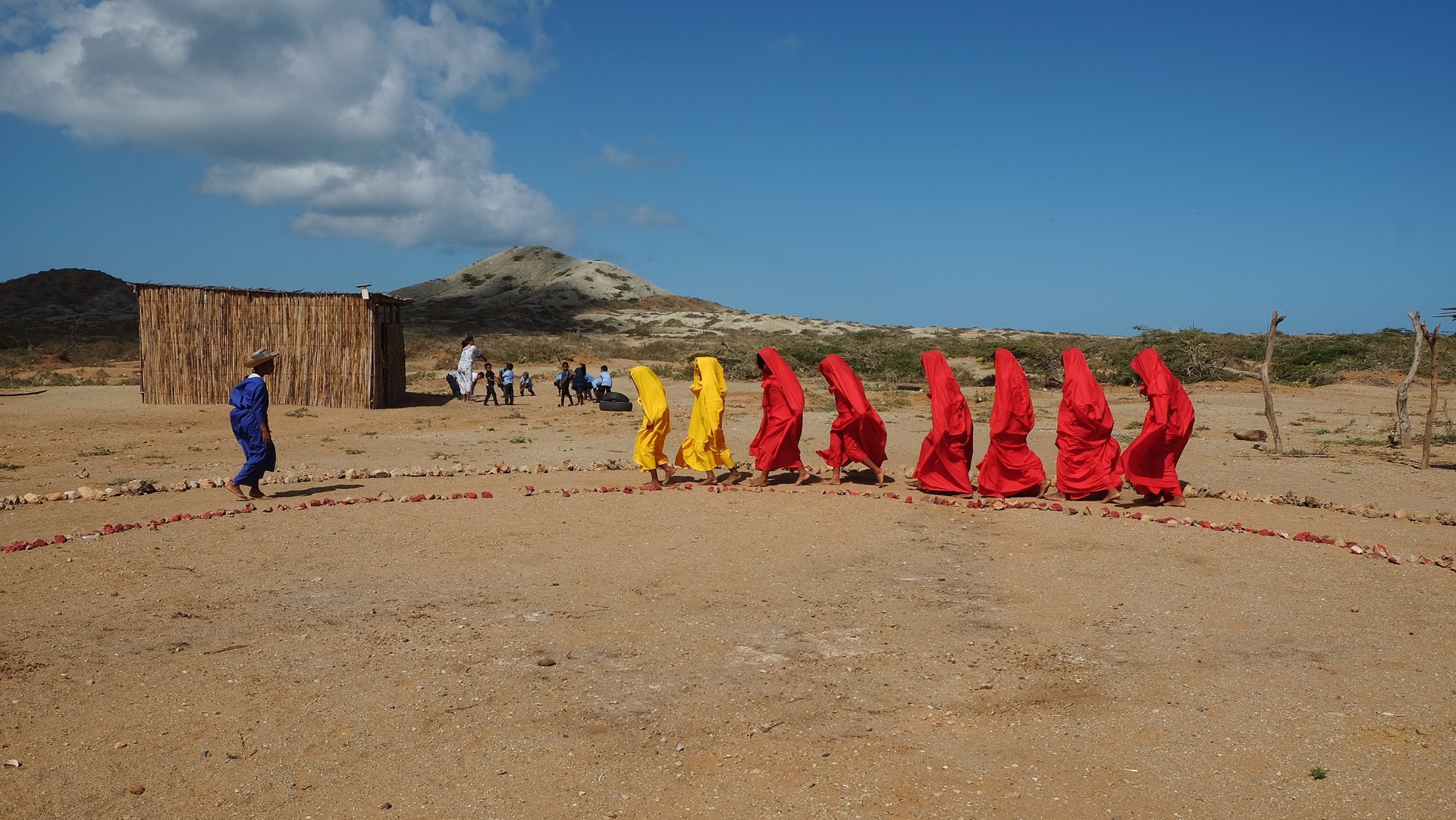
In the schoolyard, girls dressed in scarlet robes begin to whirl to the beat of a drum as their dance class commences. Directed by Ani Paola, they spin in concentric circles across the sand, as free as the wind and the birds of La Guajira.
World Bicycle Relief mobilises people in rural communities around the globe with life-changing, purpose-built bicycles. You can support their work by donating through The Intrepid Foundation.