As Europe braces for another influx of tourists this summer, the guides behind Intrepid’s new Uncommon Day Trips in Barcelona, Venice and Paris explain why, rather than turning away from the hotspots, we should rethink how we explore them instead.
Standing shoulder-to-shoulder in long, slow-moving queues. Narrow streets choked with headset-wearing cruise passengers. A sea of craning necks all vying for a better view.
It’s a familiar scene: arriving somewhere only to find it heaving with tourists. You realise the photos you’ve seen on social media were taken at just the right angle to gloss over the dozens of people waiting for the same shot, and you’ve run out of fingers to count the mass-produced souvenir shops. The expectations you landed with deflate faster than you can say ‘wish you were here’.
This isn’t a great experience for travellers, but for locals it’s even worse. Residents can no longer find or afford housing, daily life is being disrupted and people working in the tourism industry often aren’t paid a living wage.
Despite doing everything to be a ‘good traveller’ – like not walking in bike lanes or stopping abruptly in the street to check a map – it’s hard to shake off the guilt of visiting an oversaturated place. You may question whether you should even be here at all. Fewer tourists, less congestion, problem solved… right? Not quite.
Although overtourism comes with a slew of problems, we can’t overlook the positive impacts of travel when it’s done responsibly. Many communities rely on visitors, and boycotting can have devastating consequences for people’s livelihoods.
According to the team behind Intrepid’s Uncommon Day Trips – a new range of adventures that work with locals to offer a different perspective of popular cities – part of the solution lies in how we travel.
The realities of overtourism
With 80% of travellers visiting just 10% of the world’s destinations, perhaps due to the rise of social media ‘must-see’ trends and cheap flights, it’s no surprise that overtourism has become a behemoth.
While the issue has been gathering pace for a decade, it captured global media attention in 2024 and again in 2025, when thousands of residents across southern Europe – including Barcelona and Venice – took to the streets to protest against ‘touristification’. With blockades, water sprayed at visitors and signs saying things like, ‘your Airbnb was my home’, the situation had reached breaking point.
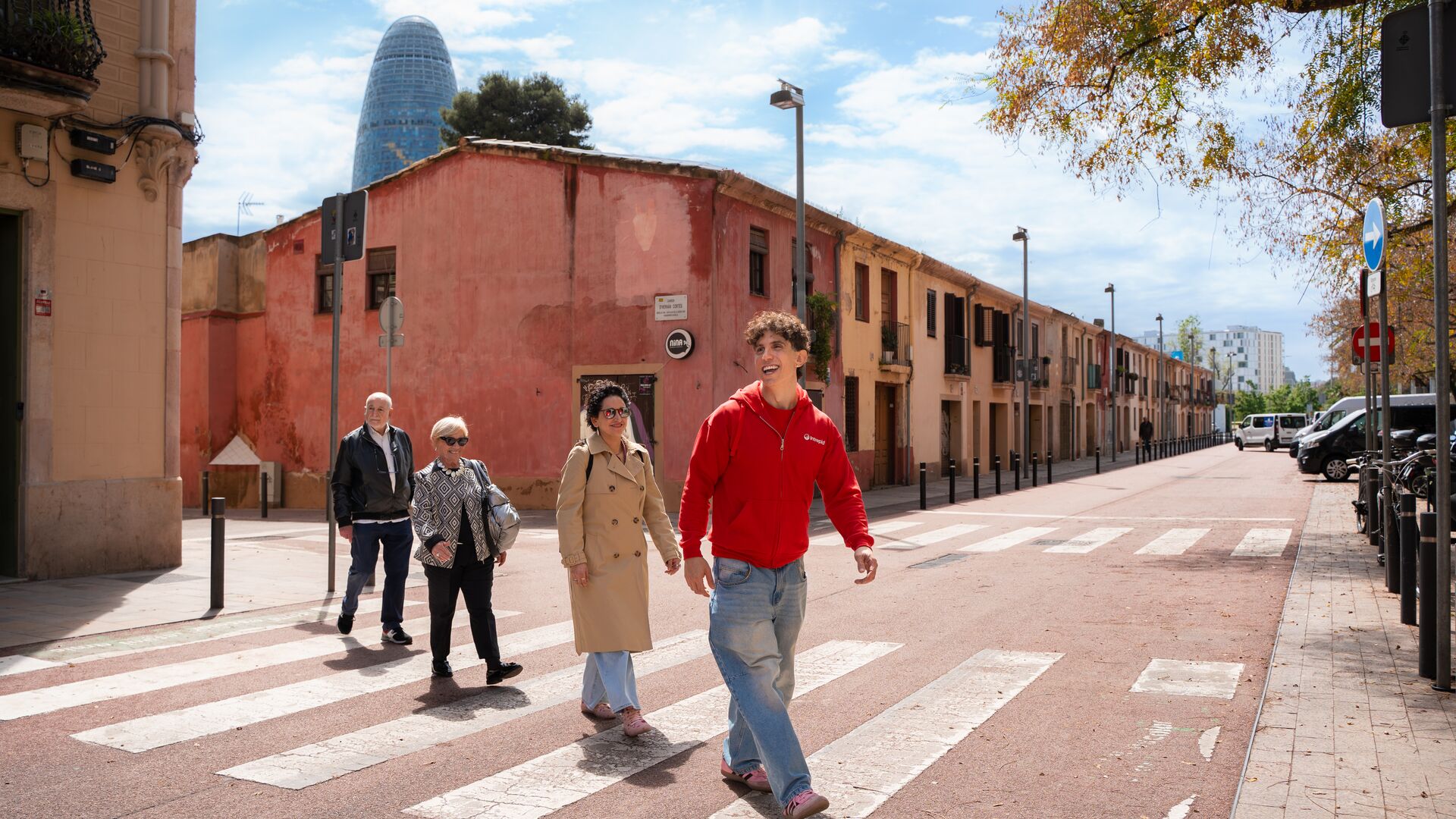
Juan Sanchez, operations manager for Intrepid Day Trips, has lived in Barcelona for seven years. Born in Buenos Aires, he visited lots as a child as his grandparents were Spanish. ‘Much of the frustration that sparked the protests was about the ongoing cost of living and housing crisis. Some residents feel like they’re losing their rights in favour of tourism,’ he says.
But the issue is complicated. ‘People blame tourism, that’s why they want to get rid of tourist lets (rentals), but many people from other EU countries work here remotely on higher salaries and that’s also driving prices up.’
Venice faces similar problems. Intrepid Day Trips guide Camilla Feiffer is a born-and-raised Venetian. Her city has changed a lot over the years, largely due to short-term rentals and skyrocketing rents pushing people out. The population of the historic centre has dropped below 50,000 – the lowest in 300 years – yet it sees around 30 million tourists annually.
‘Many people left when Airbnb took off,’ she says. ‘It happened so fast, and the law couldn’t keep up. It destroyed the city’s authenticity a little bit.’ Staying in locally owned hotels is one way travellers can relieve the pressure, but Camilla knows the appeal of short-term lets all too well. ‘I have a family now, so I understand it’s cheaper and more practical for many reasons. It’s difficult.’
City authorities are making moves to tackle overtourism. In addition to banning large cruise ships, loudspeakers and tour groups over 25 people, Venice charges a day-tripper fee (EUR 5) during its peak season, which has been extended for 2026. Barcelona has doubled its tourist tax, now one of the highest in Europe (up to EUR 15 a night), to fund affordable housing and deter visitors – though Juan isn’t convinced of the latter. ‘Most people will pay it anyway. In my experience, nothing stops people from travelling.’
It’s a phenomenon known as ‘Disneyfication’ – a type of gentrification where neighbourhoods are redeveloped to maximise tourism profits.
However, residents are still choosing to move because their cities don’t feel like theirs anymore. ‘Some people think parts of Barcelona are more like theme parks now,’ Juan says. ‘Some of the new businesses that have sprung up to cater to tourists are interesting, but the city risks losing its personality. Big groups block streets and make daily life difficult, and certain behaviours around nightclubs is causing tension.’
It’s a phenomenon known as ‘Disneyfication’ – a type of gentrification where neighbourhoods are redeveloped to maximise tourism profits. Cheese shops, butchers and bookstores – places where locals shopped for generations – are being lost to tourist tuk-tuks and trinket stands. The result? The place is stripped of the very things that drew you to it in the first place.
Paris hasn’t seen anti-tourism protests of the same scale, but with around 30 million visitors annually and counting – mainly concentrated in central neighbourhoods – it’s feeling the strain.
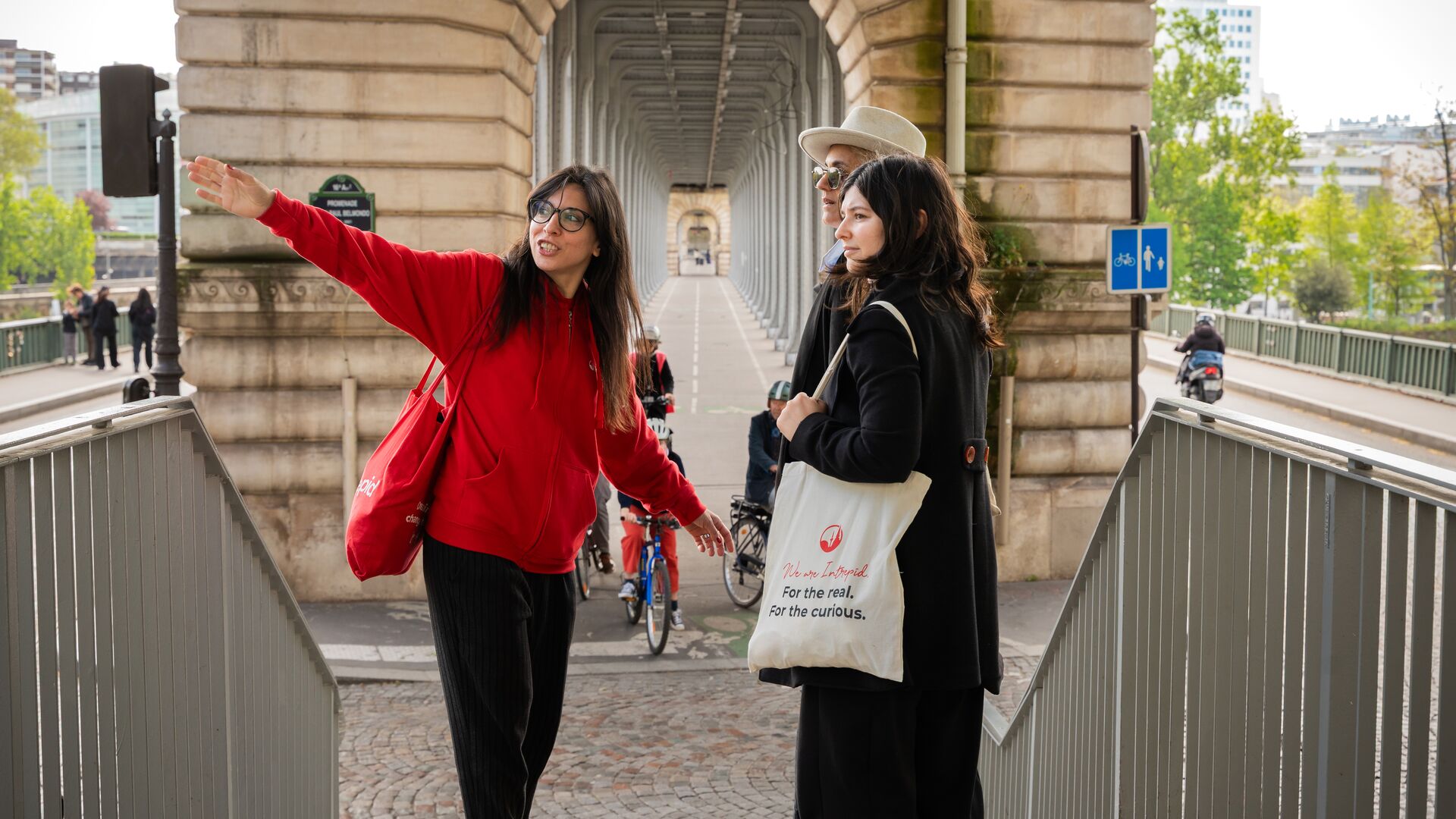
Intrepid Day Trips guide Cecilia Garcia Riglos moved to Paris from Buenos Aires in 2020 to pursue her career as a visual artist after studying at Ecole du Louvre. ‘There’s huge frustration in Montmartre,’ she says, referring to the hilltop district famous for its bohemian heritage. ‘There are companies who bring 60 tourists at once, and the medieval streets aren’t made for huge groups. Some people don’t show respect either. They take pictures of locals without asking and leave trash everywhere.’
Residents hang banners with slogans such as ‘Let Montmartre residents live’, and Cecilia tells me her groups often ask what they mean. ‘Travellers are a little bit scared of Parisians sometimes,’ she laughs. ‘But residents are just trying to protect the area. French people love preserving their traditions. They’ve been fighting for their rights for centuries.’
Read more: How to go beyond Venice’s most famous attractions
We need to strike a better balance
Isn’t the best way to curb the crowds, noise and pollution just to stop people visiting? It’s a fair call – and sometimes necessary to regenerate sites damaged by heavy tourism, like when Thailand temporarily closed Maya Bay in 2018. But when I pose the question to Juan, Camilla and Cecilia, they all agree that it’s not necessarily the right approach.
‘Paris lives off tourism,’ Cecilia says. ‘During the pandemic, and the Olympics in 2024 [when strict security made the city hard to get around], many businesses complained about how the lack of tourism affected them.’
Camilla echoes this sentiment. ‘We saw it during Covid. We’re not saying we don’t want tourists, but it would be better to spread them throughout the year and beyond the well-known places. Staying for one or two nights also helps you have a more meaningful experience, as most people just come for the day, stroll around and don’t really support the city.’
Juan emphasises that tourism isn’t inherently bad. ‘Locals generally welcome visitors with open arms. Barcelona has developed thanks to tourism, and people are very aware of its economic impact and the importance of cultural exchange. The issue doesn’t arise simply because of visitor numbers, but rather the majority visiting just a few places and the lack of responsibility from some companies to tackle the problem.’
The mass tourism model was designed to benefit travellers first, not the hosts. But tourism only succeeds when value is shared.
Tourism is one of the largest and fastest-growing industries in the world. In 2025, it contributed USD 11.6 trillion to the global GDP and supported 366 million jobs. But what happens when most of that cash fills the pockets of international corporations that don’t give anything back to local people? As James Thornton, Intrepid’s CEO, puts it, ‘The mass tourism model was designed to benefit travellers first, not the hosts. But tourism only succeeds when value is shared.’ Travelling the right way – or with the right company – can be one of the most powerful ways to uplift communities.
So yes, it’s true there are plenty of underrated destinations that could benefit immensely from community-led travel, which, in turn, would help loosen the valve in the hotspots (Intrepid actively encourages travellers to consider these places with its annual Not Hot List). However, there are still ways to visit popular places while reducing the negative impacts.
Day trips that take you away from the crowds
Intrepid’s Uncommon Day Trips aren’t your typical city tours.
‘We worked with many people, from residents to university professors, to understand the issues,’ Juan says. ‘These tours genuinely help redistribute tourism more sustainably.’
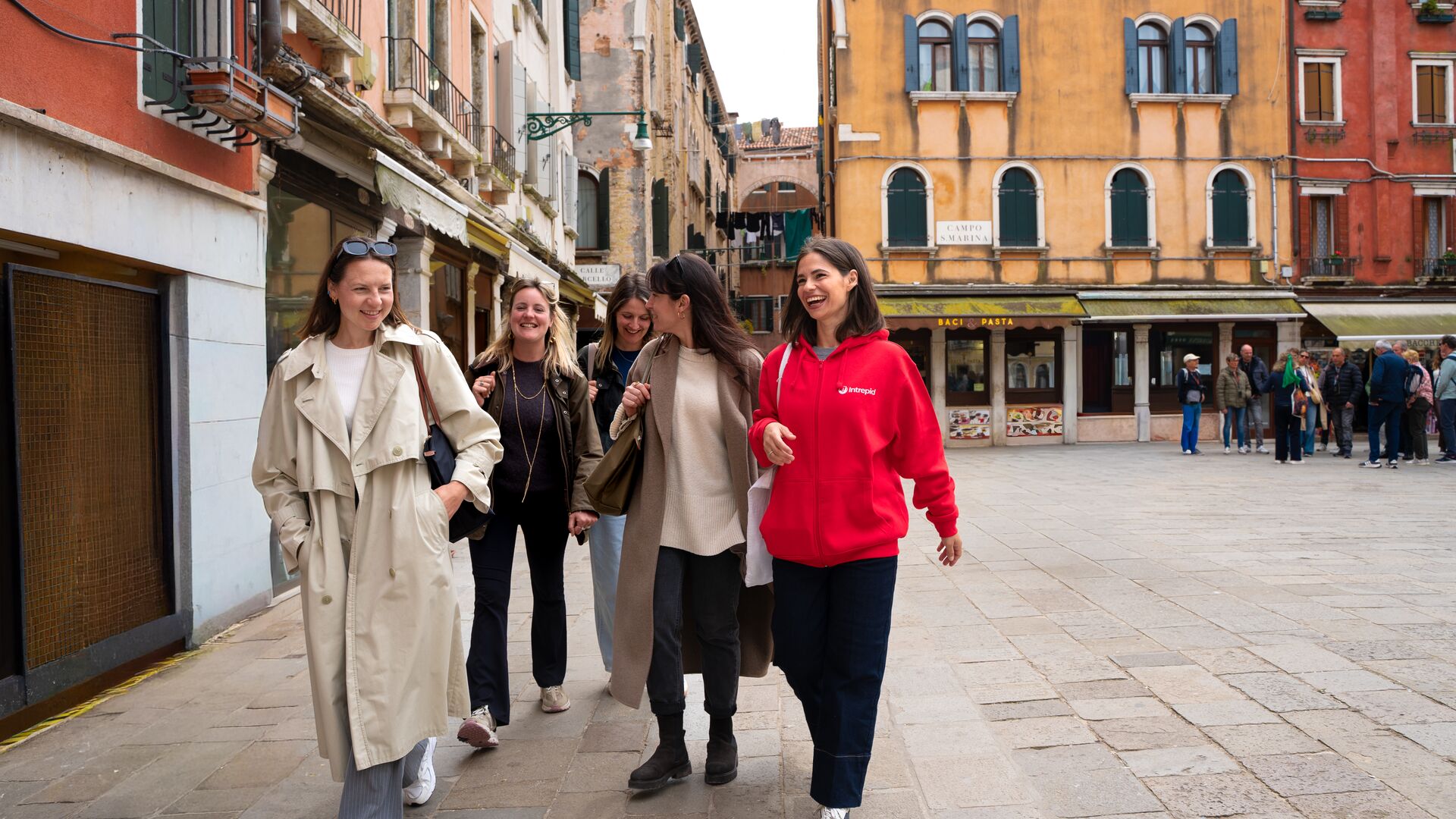
Designed and led by local guides, each tour begins at an iconic part of the city, before taking you to places that spotlight real, local life. With a maximum group size of 12, you’ll take public transport and visit ordinary markets, streets and community hubs where residents hang out every day.


Uncommon Venice
Camilla shares that tourists often forget Venice is a living, breathing city. While most visitors stick to the San Marco area, Uncommon Venice goes behind the scenes to show you how all aspects of life happen here. You’ll visit the Rialto Fish Market – the ‘heart of the city’ – where you’ll discover how locals shop and what floating garbage collection looks like. You’ll also pass the 15th-century St. John & Paul Hospital where Camilla was born. ‘People are surprised to learn that the hospital, which is a very beautiful building, is still functioning. I also show them the boat ambulances and even a burial island behind the hospital.’
But Camilla’s highlight is drinking prosecco on the rooftop of a Gothic palazzo. ‘It’s really hard to access rooftops in Venice, as most of them are private. Seeing the city from a boat is amazing, but we really see everything up there.’


Uncommon Barcelona
Uncommon Barcelona goes really off the beaten track. ‘We want to show you the real Barcelona,’ Juan says. ‘You won’t see huge landmarks – it’s the narrative of the tour that’s interesting.’ Highlights include a visit to Mescladis – a social enterprise that supports and trains migrants to find work in the hospitality industry.
Martin Habiague, director and founder of Mescladis, thinks that, done with integrity, this tour is exactly the kind of alternative tourism model we need. ‘When someone shares a meal prepared by a person who came to this city carrying a lifetime of culture, values and resilience – and who’s a key part of the present and future of Barcelona – and understands the story behind that, something real happens. That’s tourism as connection, not displacement,’ he says.
You’ll also explore the El Clot neighbourhood – where Juan lives – to taste local products in the ‘noisy and real’ Mercat del Clot and learn how Barcelona is planning for the future in Parc de les Glories – a new ‘green lung’ and public space designed to improve urban living. ‘When I asked my neighbours how they’d feel if they saw a small group of tourists walking around, they were surprised in a good way,’ he says. ‘They were very open to the idea and said it would be cool to show how we live.’
Read more: How to discover the real Spain, without the crowds


Uncommon Paris
On the Uncommon Paris tour, you’ll wander the quintessentially Parisian quarter of Passy, which feels a world away from the Trocadero Esplanade – the classic Eiffel Tower viewpoint – despite being just a kilometre (0.6 miles) away. ‘Getting lost in Paris is my favourite sport,’ Cecilia says. ‘I love how the ambience can change completely from one block to another.’
You’ll stop by Passy Cemetery (where modernist painter Edouard Manet is buried) for an uncrowded view of the Eiffel Tower, before meeting vendors at the market – but only after coffee and a brioche croissant at a special creperie… the French know to never shop hungry. ‘The experience is very intimate,’ explains Cecilia. ‘Locals are very happy to welcome visitors as it’s less common in that area.’
You’ll then continue through gardens largely unknown to tourists and wind through the passages of Rue Berton to get a feel for what the villages surrounding Paris were like before being annexed into the city in 1860.
Hope in growing awareness
‘[These cities] have gone through many changes throughout history, and this is simply another phase.’ Juan proposes. ‘What is encouraging is that many individuals, organisations and responsible companies are actively working to address overtourism and create better balance.’
Juan, Camilla and Cecilia stress that the overarching sentiment from locals they’ve spoken to is that they don’t want to shut the door to visitors, but they do want things to change. Extractive tourism that prioritises profit, pushes communities out and only generates value for visitors needs to stop.
These new Uncommon Day Trips might not solve the entire overtourism problem, but by working with locals, not against them, they could be part of the solution.
Check out Intrepid’s new Uncommon Day Trips in Barcelona, Venice and Paris and see these popular cities without the crowds.