Claire McQue travels deep into Colombia’s rural hinterland with The Intrepid Foundation partner, the Colombian Civil Air Patrol, whose pilots bring pop-up hospitals to communities in need.
Jenny Shirley Gonzalez Patino perches on the edge of the examination table, her cornflower-blue hospital gown open at her back. She hunches over to accentuate the curve of her vertebrae, between which Dr Marta Lazaro, a Colombian anaesthesiologist, carefully injects local anaesthetic.
Aged 38, Jenny is undergoing tubal sterilisation to eliminate the risk of unplanned pregnancies. She is relieved: ‘It’s wonderful, because I can avoid taking pills every day’, she tells me. She already has two children: ‘I don’t want any more’.
Once the anaesthetic has kicked in, Dr Pablo Vargas, an obstetrician and gynaecologist from Bogota, uses a scalpel to slice through layers of fat and muscle. His hands are a blur of activity as he hunts around for the rose-pink fallopian tubes.
Having tied, snipped and cauterised them, Dr Vargas stitches up Jenny’s lower stomach until only a small, neat wound remains. In less than 15 minutes, Jenny has gained contraception for life. As she’s wheeled off to the recovery room, Dr Vargas begins the procedure again on another patient next door. He will perform 15 in total today.


PAC’s mobile hospitals
I’ve written about many topics during my career, yet this is the first time I’ve been in an operating room. We’re in the health centre of Orocue, a neat grid of pink and yellow houses on the banks of the Meta River, deep in Colombia’s cowboy country.
I’m here with the Patrulla Aerea Civil Colombiana (the Colombian Civil Air Patrol), known as PAC – a key partner of The Intrepid Foundation, which aims to raise funds for deserving community projects around the world.
‘PAC is one of the best NGOs in Colombia’, a friend in Bogota remarked when I told him about my trip. And he was right.
During the course of my weekend-long visit, PAC’s volunteers convert Orocue’s health centre into a fully equipped mobile hospital. Surgeons perform procedures such as tubal sterilisation, vasectomies and hernia removals, depending on demand. Around the corner, parents with children queue outside the buttercup-yellow cultural centre to see paediatricians; others wait in line for gynaecologists, urologists and dermatologists.
Founded 59 years ago by five pilots in Bogota, the PAC brigade has since grown into a network of 70 volunteer pilots who use their aircraft to fly medics to all corners of Colombia to deliver free healthcare to people with little or no access to medics or hospitals.
‘Big cities are full of specialists, but not here’, says Andres Felipe Morillo, a paediatrician from the city of Pasto. ‘It’s important for us to be able to help people before they have even bigger problems and have to travel further.’ For some communities, it’s the only time they see a doctor.
The results are life changing, explains Maria Helena Vallejo, who has volunteered with PAC for 15 years and sterilises the tools used in surgeries. She remembers an elderly man who underwent cataract surgery. With his eyesight restored, he could see his grandson for the first time.


Geography as a perpetual challenge
Colombia’s geography is an endless headache for policymakers trying to reduce inequality in healthcare. Anyone without an easy way to get to hospital is in need, explains Hernan Acevedo, Intrepid’s country manager in Colombia and one of PAC’s volunteer pilots. ‘That’s more than half of the country’.
Following in his father’s footsteps, Hernan took to the skies with PAC almost 20 years ago. But there was one place that sticks in his mind, he tells me.
In 2010, he was flying into Puerto Alvira, a village on the Guaviare River. ‘At the time, the army was winning against the illegal groups,’ he says, referring to Colombia’s armed conflict, which started in 1964. As Hernan approached the landing strip, he could hear the army on the radio, in live combat.
‘I was hearing the helicopters saying: “shoot there, shoot there!” I didn’t see them, of course… But that was kind of shocking’, he says. ‘It was the first time I was so close to the war.’ In 2016, Colombia’s war ended when a historic peace agreement was signed, restoring safety to the majority of the country and allowing humanitarian work to resume.


A wing and a prayer with PAC
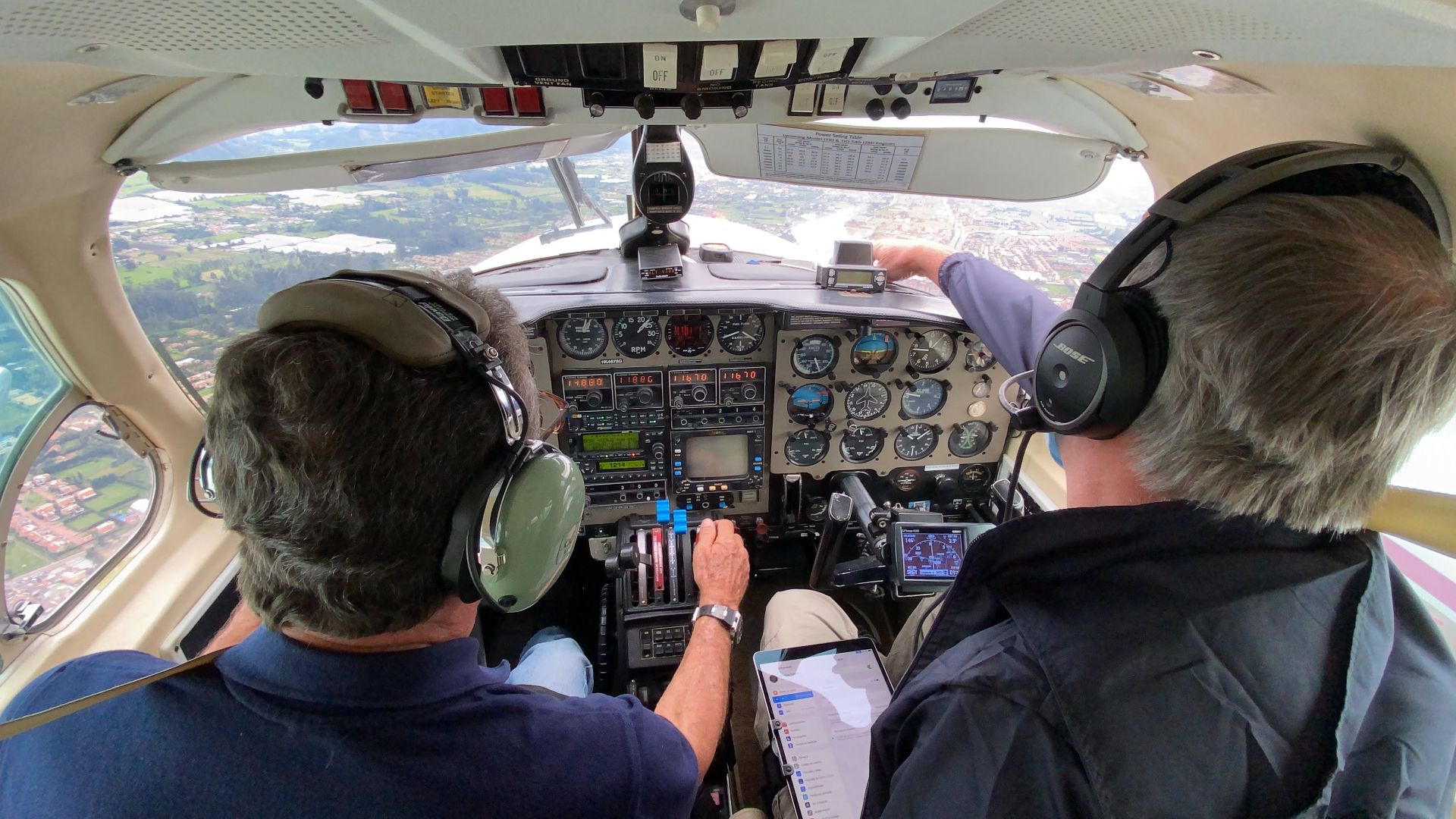
To show me a typical day in the life of a PAC pilot, Hernan flies us in a four-seater propeller plane from Bogota, over the mountains and towards the eastern plains of Los Llanos. From above, I see rivers snaking through a patchwork of lime-green rice fields and yawning savannahs dotted with cattle.
Wetlands home to caimans and capybaras shine green and gold, glinting in the morning light. I glimpse few roads, only twisting tracks of red earth, attesting to the extreme remoteness of these scattered rural communities.
Orocue’s far-flung beauty is both a blessing and a curse. The nearest hospital is more than six hours away along a rutted road. When the rains fall between April and November, the journey stretches to nine hours. Lorries transporting oil and rice often get stuck in thick mud.
I ask Jenny how she would have otherwise got her tubes tied. ‘If the Patrulla didn’t come, it would be very difficult’, she admits.
Getting an appointment with Colombia’s state healthcare system is hard, explains a softly spoken older man called German Ricardo Torres. He had been waiting to see a specialist for six years. This, he says, is why ‘many people are so hopeful when PAC comes’.


Outreaching into rural communities
Overhearing our conversation, a slim, energetic woman wearing an Orocue cap comes over. She introduces herself as Marta Castro, a mother of three. ‘I had been waiting six months for a breast ultrasound’, she says. ‘Here we don’t have the equipment for an ultrasound scan, we don’t have a specialist.’
Travelling to the hospital would be too expensive, Marta explains. ‘My salary is not enough to cover those expenses, so the Patrulla is really a blessing’, she says, holding an envelope with her completed scan results.
The centre fills up around us as we speak. I notice a hummingbird fluttering by the orange flowers of the courtyard’s African tulip tree. My experience of hospitals is the NHS Accident and Emergency Room in Britain. In comparison, this friendly space feels orderly and calm.
Much of that is due to the military precision of PAC’s operations. Around a week before the doctors fly in, a convoy of medicines, surgical machines, computers and tech goes ahead of the personnel, travelling overland or by boat.
The man in charge of all this is Enrique Martin Poveda, a radiologist who joined PAC following his first trip to the deserts of La Guajira, 32 years ago. I catch him as he shuttles between the surgery and hospital, greeting patients and instructing teams via a walkie-talkie. He seems never to run out of energy, reacting to whatever challenge arises.
There have been many over the years, Enrique tells me. He recalls being on the Pacific coast when a two year old went into cardiac arrest. ‘Without us, he would have died.’ The paediatricians resuscitated the toddler, stabilised him and sent him by helicopter to the nearest city. ‘He was saved’, says Enrique.
During another brigade in Vichada, a sparsely populated region in eastern Colombia, only PAC’s timely intervention stopped a child’s arm from being amputated. ‘Another week and he was about to lose it’.


Operating in the wilderness
I’m struck by how well the medics and pilots know their country. German Arango, a gynaecological oncologist from Manizales, who has been a volunteer for 25 years, tells me about an 11-year-old Wayuu girl from Guajira.
She needed surgery to remove a cyst on her ovaries, but her Indigenous elders forbade it. ‘If it means transferring them to another place, they do not allow it’, German explains.
When he returned five years later – this time with PAC – ‘the tumour looked like a full-term pregnancy’, he recalls. ‘It was growing so much that it looked like it was going to burst.’ He and another gynaecologist operated on her right there, removing the tumour in 15 minutes. Understanding Colombia’s diverse cultures is a nuance of their medical training, I realise.
Marta insists that I experience dawn on the Meta River before I leave. So, just before daybreak, I clamber into a boat and set off. Clouds striped apricot, lilac and gold skim overhead. For a moment, the rising sun casts the trees in a brilliant bronze. A flock of geese flap past in a V formation – and I’m reminded of another fleet that glides around Colombia, delivering vital healthcare on synchronised sets of neatly arranged wings.
You can support the Patrulla Aerea Civil Colombiana (PAC) by donating via The Intrepid Foundation and plan your next adventure by exploring Intrepid’s trips in Colombia.