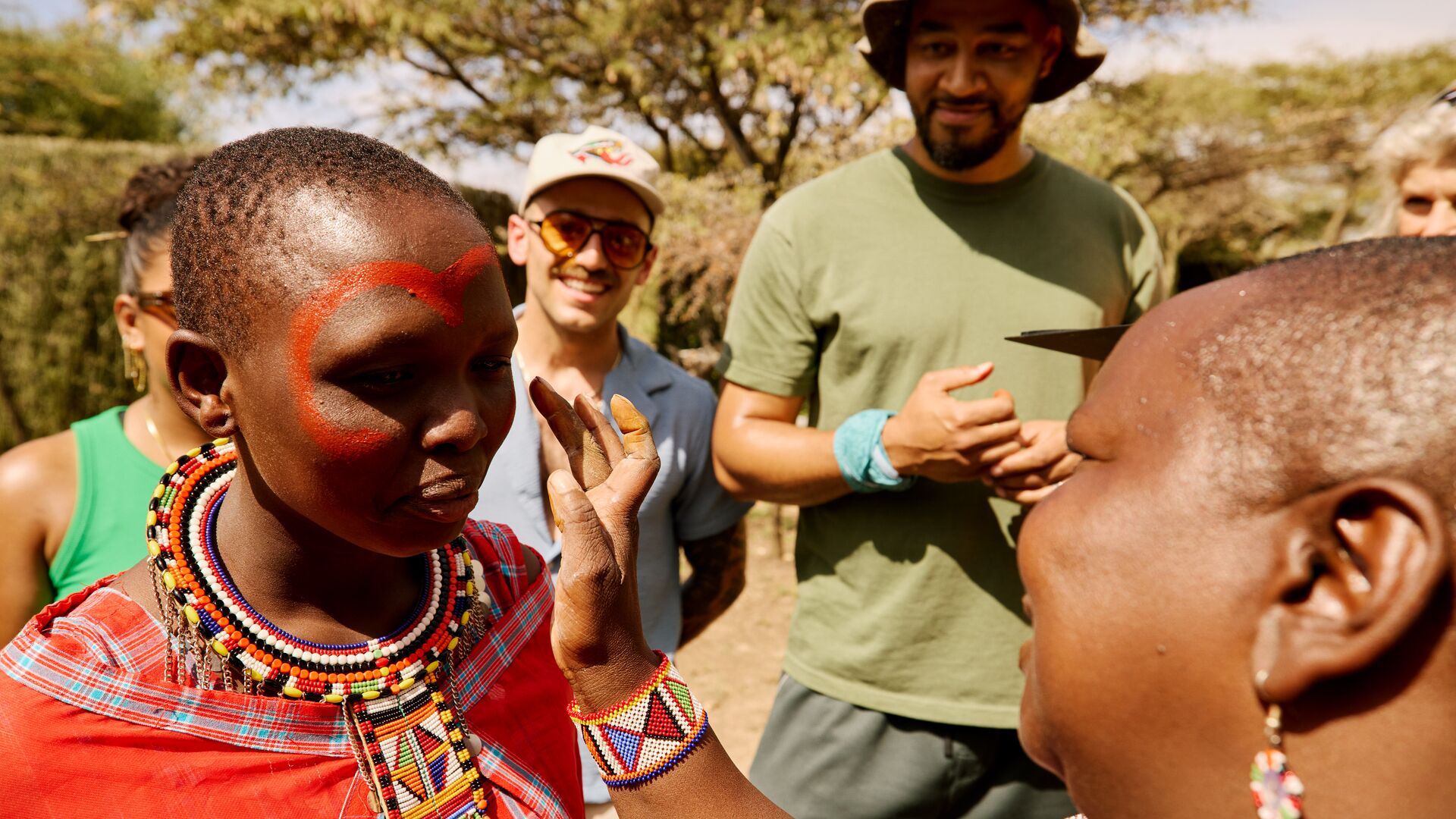
On the edge of the Maasai Mara, where red dust swirls across the plains and Maasai warriors still patrol the land, one woman is reshaping the future of her community.
Hellen Nkuraiya has spent years challenging deeply entrenched cultural traditions, like female genital mutilation (FGM) and forced marriage, while creating education pathways and economic opportunities for Maasai girls and women of all ages.
Australian traveller Leeanne first met Hellen on an Intrepid trip in 2023 that included a stop at Tepesua, the community-based organisation Hellen founded in 2015.
‘We knew we would be visiting the Maasai Mara, which we thought was cool, but we had no idea what we were really going to see,’ Leeanne says. ‘Our leaders told us about Hellen and explained how she rescues young girls from FGM. We thought it was outlawed, but they said it’s a tribal custom.’
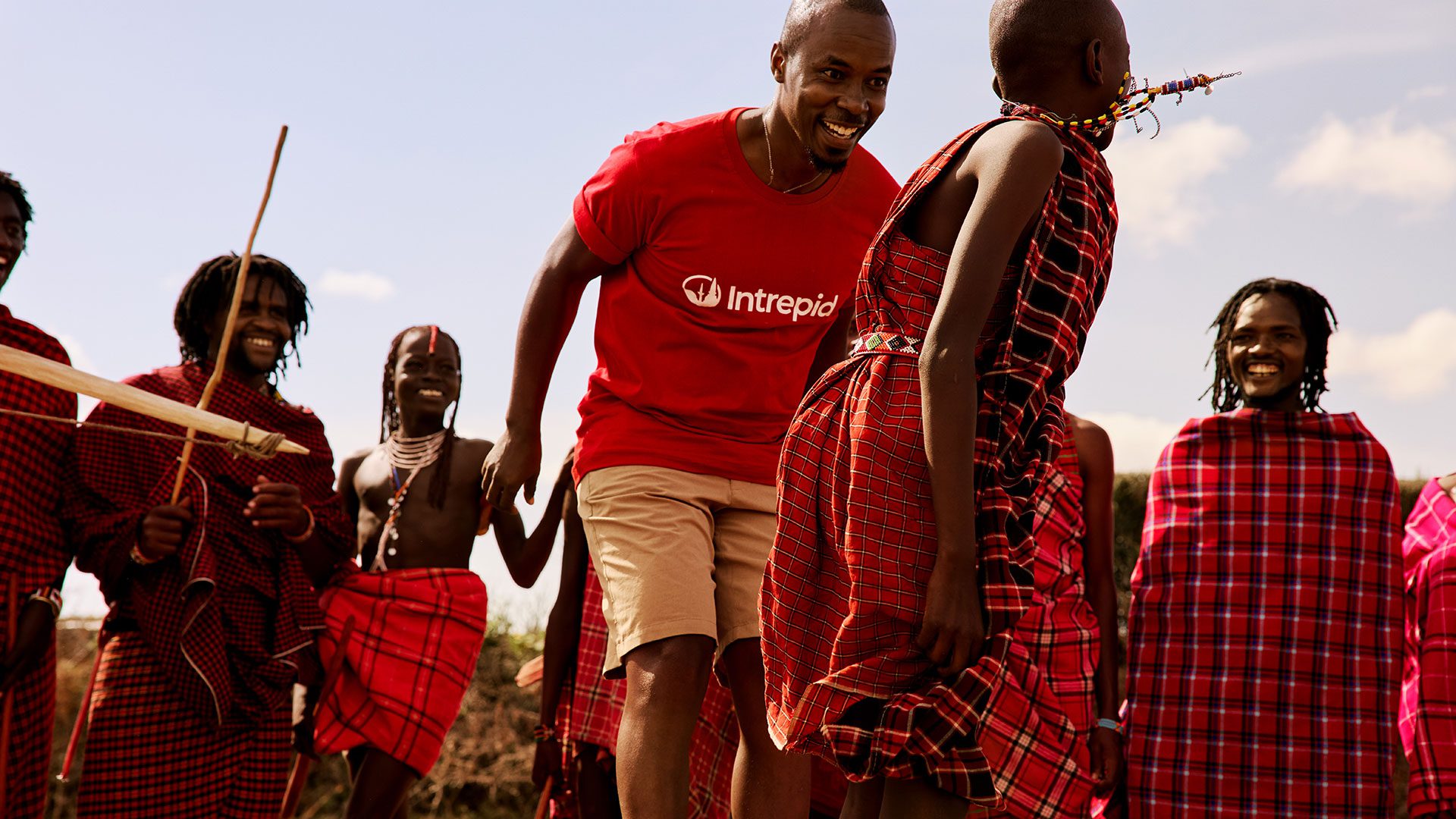
A warm welcome to Tepesua
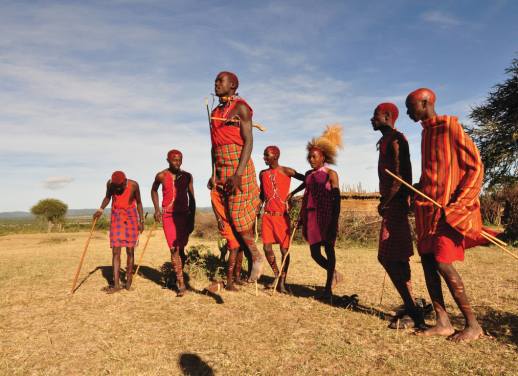
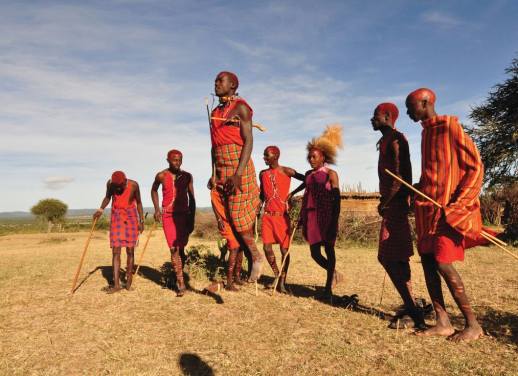
When Leeanne, alongside her partner Gary and the rest of their group arrived at Tepesua, nearly 200 kilometres (124 miles) west of Nairobi, they were greeted by Maasai warriors draped in bright red and blue shukas, beadwork catching the afternoon light as songs and rhythmic chants carried across the village. After a brief welcoming ceremony – part dance, part storytelling – Hellen and the warriors shared glimpses into Maasai traditions and daily life.
‘They showed us how to pick thorns off acacia trees to use as teeth cleaners,’ Leanne says. ‘Then they showed us around the village and told us the whole story about FGM and how Hellen is trying to make a difference. She has this tagline – “Don’t trade a girl for a cow” – because that’s what happens.’
Read more: How a traveller’s disposable rain poncho spawned a movement to clean up the Inca Trail
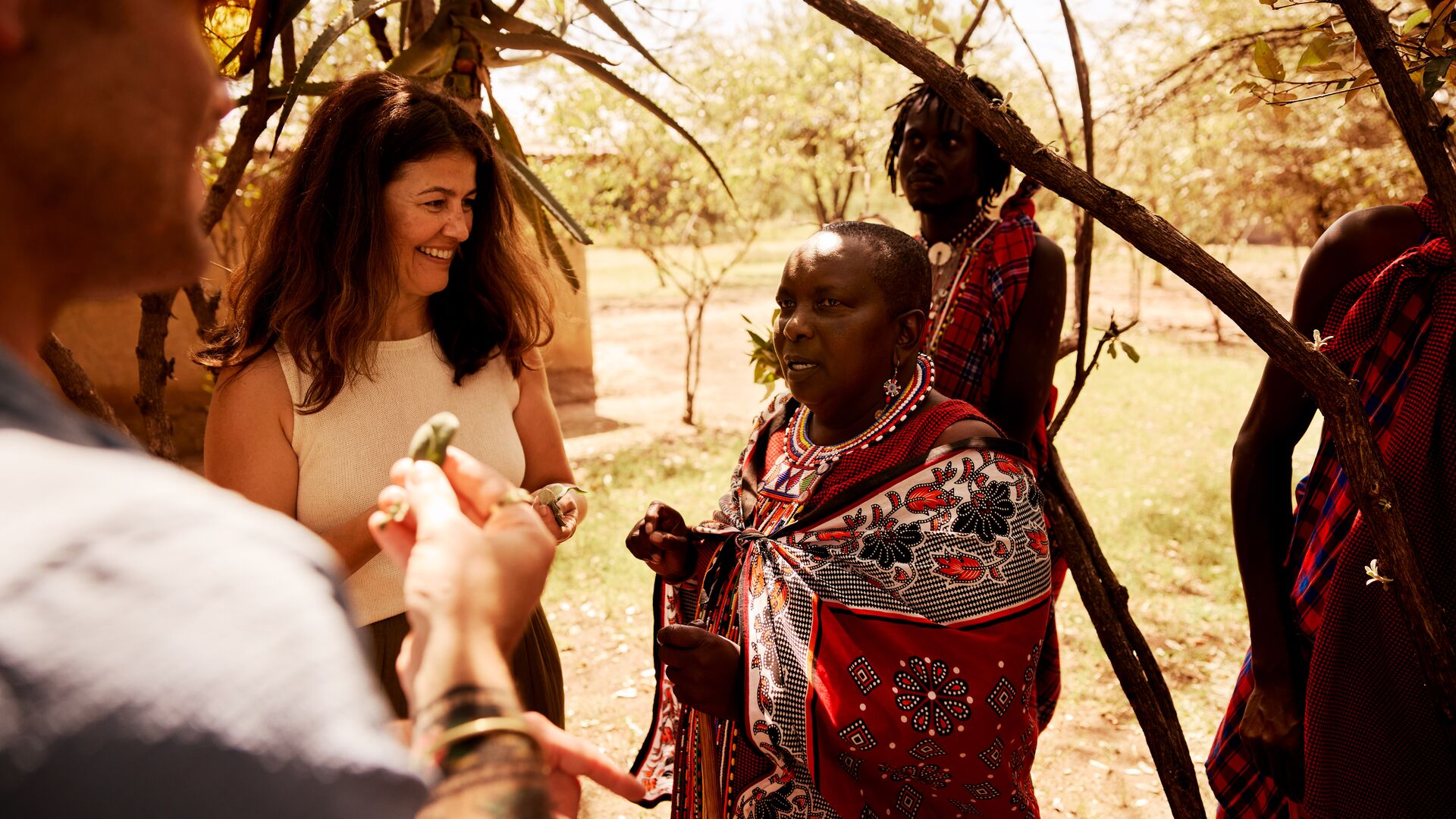
A survivor of FGM herself, Hellen was sold to an elderly man at the age of 11 in exchange for a dowry of cows. With the support of a Catholic nun, she escaped the marriage and completed her primary and secondary education before training as a teacher. Hellen resigned after seeing how many young girls were dropping out of school and being married off and mutilated. She wanted to push back against these practices and believed education could create long-term cultural change.
In 1998, about 38% of Kenyan women aged 15 to 49 had been ‘cut’. The practice was banned in Kenya in 2011, however it persists among some cultural groups, including some Maasai communities. Rates of FGM dropped to around 15% by 2022 and continue to decrease, though an estimated 57% of Maasai women have been cut, nearly 45% of whom were between 10 and 14 years old at the time.
‘Hellen’s biggest enemies are actually [her fellow] Maasai who want to keep the custom going,’ Leeanne says. ‘She’s literally got to protect these girls because fathers and brothers are coming in to try and steal them back again.’


From safe haven to sustainable community
Tepesua is a safe haven for Maasai women fleeing FGM and forced marriage – over 100 girls have taken refuge in the community over the years. Now comprising two schools, an eco-camp for travellers and a village for widows and families, the community plays a critical role in promoting education and empowering women. Intrepid first started taking travellers there in 2018, on both overnight stays and day visits, to give visitors a first-hand look at Hellen’s dedication to improving conditions for women in what has traditionally been a very patriarchal culture. These visits also generate a sustainable source of tourism income that funds the entire community.
Tepesua’s eco-camp, where Intrepid travellers stay and participate in cultural experiences, not only generates capital and creates employment, but also doubles as a market for the women’s handmade crafts. Intrepid is the only tour operator that stops at Tepesua, and over the years the company’s team in Kenya has exchanged ideas with Hellen on things like waste management and accommodation options that help the community evolve its tourism business in ways that are both environmentally responsible and commercially viable.
Further community programs include a livestock ownership scheme that is strengthening food security and helping widows and families build stable livelihoods. Together, these initiatives move the community towards long-term independence rather than reliance on donors.
While staying at Tepesua, Leeanne and Gary learned that a cow means everything in Maasai culture; if you don’t have a cow, you have nothing. This is why Hellen introduced a borehole initiative in the community and allowed only the families who enrolled their daughters in school to access the water source. Hellen named the school ‘Enkiteng Lepa’ – or ‘Our Purple Cow School’ – to honour the transformative power of education.


Unsurprisingly, Leeanne and Gary are quick to describe Hellen as an incredible woman. ‘She has this amazing laugh and is so passionate about what she’s doing,’ says Leeanne. ‘It’s impossible not to fall in love with her.’
Other members of the group shared Leeanne and Gary’s adoration.
‘I think it was only a few days earlier that we’d been in Uganda and seen the gorillas,’ Leeanne recalls. ‘It was an incredible experience being metres away from these gorillas. Every night, we would sit down as a group and talk about our high and low points. Pretty much everyone said the same thing: meeting the gorillas was mind-blowing. So many of us were in tears. But we all kept coming back to Hellen – to her story and what she’s trying to do.’
Read more: On a rickshaw ride in India that puts women in the driver’s seat


A hero’s welcome back to Tepesua
For Gary, Hellen’s work held particular emotional resonance. His daughter passed away at a young age and he wanted to contribute to keeping young girls safe. After leaving Tepesua, he and Leeanne stayed in touch with Hellen and returned 12 months later as volunteers. What they expected to be a rewarding experience – helping to repaint classrooms alongside local workers and students – immediately became something more personal.
‘When we arrived, the Maasai warriors came out to perform their tribal dance and welcome,’ Leeanne says. ‘And I’m saying to Helen, “You don’t have to do this. We’re not visitors now. We’ve come to help.” And then I realised it was different to before. The chanting and singing was getting louder. They went round and round in a circle, which got tighter and tighter until we were completely surrounded in the middle. They covered us with their shukas and I was bawling. Helen said, “They’re welcoming you. You’re now part of the tribe.”’


It’s a moment Leeanne and Gary won’t ever forget. The two of them have travelled to more than 60 countries but nothing, they say, has affected them as profoundly as Tepesua and Hellen’s work. On their return visit, they met one of the girls who’d been rescued by Hellen. She’d been educated at Tepesua and was now learning a trade at beauty school.
‘She’d clearly been educated really well,’ Leeanne says. ‘We could see firsthand the difference Hellen is making. The women in these younger generations aren’t going to be like the widows in the village, who have to rely on making jewellery for a living. They can do anything. University is now an option.’
‘Hellen is a hero without a cape,’ says Leeanne.
She’s not alone in that sentiment. In 2025, the Kenyan government declared Hellen a national hero, under the Kenya Heroes Act, for her efforts to uplift and empower marginalised communities. Her impact is felt by the travellers who witness it firsthand and the women she’s protecting. And at Tepesua, the work continues. One young girl at a time.
Find out how your travels can create real change with The Intrepid Effect. You too can visit Tepesua on various Intrepid trips in Kenya.