Not seeing Central America’s resplendent quetzal led Richard Mellor to reframe the idea of failure as a prerequisite to appreciating success.
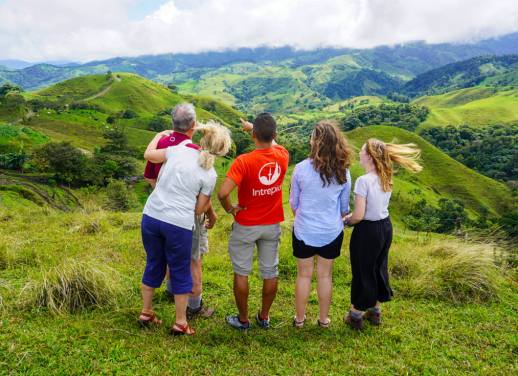
All I felt, sitting in my hillside suite, overlooking volcanic slopes densely cloaked in cloud forest, was disappointment. Despite these exuberant tropical surroundings in Costa Rica’s Central Highlands, my spirits sagged. I felt like I’d failed; like I’d been failed. Like the world had done me a disservice.
The reason for all this self-centred angst? The resplendent quetzal. Or, rather, the lack of one. The area I was in, a vast sweep of forest between Juan Castro Blanco and Poas Volcano national parks, was known as a great place to see one of Costa Rica’s most emblematic birds: part of the trogon family, whose show-off, limelight-stealing males have dazzlingly green backs, set around vivid crimson chests.
This, too, was April – within the breeding season and therefore peak time for visibility. Desperate to glimpse this iridescent beauty, I’d duly risen at the crack of dawn and postponed breakfast in order to join a guided walk around the estate with an expert avian spotter. And yet… no quetzal.
No matter that I had been introduced to darting, diminutive hummingbirds, tropical kingbirds and red-billed pigeons on the walk. Not spotting the animal I most wanted to see felt like a total downer.


A slothful revelation
My time in Costa Rica did soon yield wildlife success, however, though it demanded that I reframe what ‘success’ actually means. First, I saw tens of frogs on a nocturnal stroll, including a tiny, transparent example whose internal organs and blood vessels were peculiarly visible.
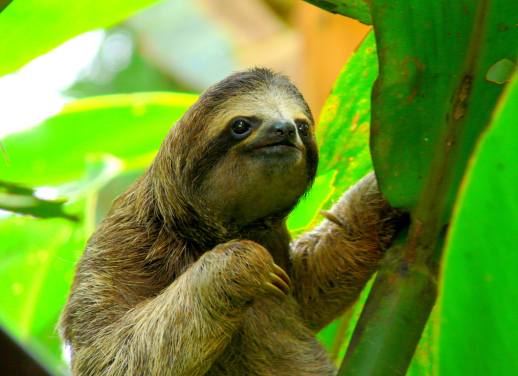
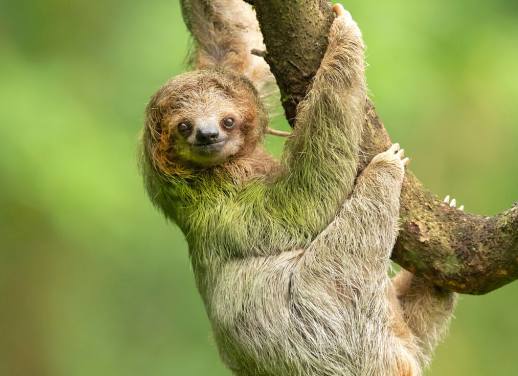
Next came two yellow-striped chestnut-mandibled toucans, spied just off a backroad, prompting my group’s minivan driver to reverse so we could greedily, gratefully photograph them. Finally, the crowning glory: in Manuel Antonio National Park, instinctively looking upwards, I sighted a three-toed sloth, living up to its name by slumbering motionlessly on a thick guanacaste tree branch. Cue much oohing and aahing.
Reflecting later that day, I realised that a large reason why encountering this sloth – and the frogs, and the toucans – felt so tremendous was because I hadn’t seen a quetzal. Knowing precisely how disappointed I’d felt then made the subsequent joy all the more, well, joyous. Turns out, that first futile outing ultimately improved my whole trip. Or more simply put: it gave me context.
Dr Adrian Banks, a Senior Lecturer in Psychology at the University of Surrey, isn’t surprised. ‘Your example reflects a general psychological principle,’ he explains, ‘that we judge and experience outcomes relative to a reference point rather than to an absolute value. For instance, £100 feels less valuable to a rich person than to someone with no money, even though it has the same value. Accordingly, if you have some failures, your current baseline will be lower and a success will then feel sweeter,’ he says.
Read more: 15 adventures where nature leads the way


From hunters to humpbacks
Ever since, I’ve firmly believed that failure is a prerequisite for fully appreciating success. This has particularly informed my experience of African safaris. On the first few that I was lucky enough to take, I didn’t set eyes on a cheetah, easily my favourite animal. When I finally did, on the fourth, I burst into tears. Again, the prior disappointment had made the eventual win more wonderful.
That same mentality has also come to play on whale- and dolphin-watching trips, of varying success, in the Canary Islands and in Sao Tome and Principe, when initially missing out on humpbacks – yep, I was looking in the wrong direction – made subsequently seeing one suddenly breach feel extra sweet.
And more recently at home, when I’ve been trying – to no avail, so far – to lay eyes on a kingfisher for the first time by sitting sloth-still beside south London’s waterways at the crack of crowd-free dawns, camera poised.
I’ve applied it away from wildlife, too, on a trip to Morocco, when I saw a shooting star. On my third night of searching and after peering skywards for hours in the hope of catching part of a supposed meteor shower, I couldn’t stop laughing at the pure elation I felt when a single star finally streaked through the Saharan sky.
I don’t always ace this approach; after the second failed meteor attempt, I felt glum and was tempted to give up. Now, I’m glad I didn’t. The trick, I’m slowly learning, is to always position my initial (hopefully) lack of success as a beneficial experience – as part of the search.
‘I don’t think that we naturally reframe failure as good,’ counsels Dr Banks. ‘Losses can feel greater than their equivalent gains; we have a negativity bias meaning that negative information makes a greater impact than positive information.’
Even so, he continues, we do have the power to decide whether our glass is half full or half empty. ‘You can choose,’ he explains, ‘to redefine how you experience your next outcome by changing the baseline you’re comparing it to.’
Read more: 11 exciting trips in Mexico and Central America


For the love of looking
Over the years I’ve learnt to try and relish the looking: to be in the moment, to appreciate the landscape, to tune into the wider experience. Whether I spy a quetzal, cheetah or meteor or not, it’s fun just to try – making the journey the goal, not the destination, to speak in travel terms.
Turns out it’s fun simply to find excitement in what’s possible and, even though this can seem counter-intuitive, to accept my lack of control over nature’s eternal caprice. After all, why fight the outcome so hard? Raising that white flag can actually prove exhilarating and even empowering, given the chance.
It’s all too easy to make ticking items off a wishlist the end goal – with your overall satisfaction purely defined by whether this was accomplished or not. Far better to simply relish the search, and to treat everything else as a bonus. Accomplish this, and disappointment is far less likely.
This approach is applicable too to other scenarios where I can’t control the outcome: to weather-influenced photography days, to my freelance career, to fantasy football and even to dating. To life in general, frankly.
I also now try to guard against taking success for granted once it does occur – or jumping on the ‘hedonic treadmill’, as Dr Banks terms it. ‘When something really good happens,’ he outlines, ‘we feel great. But we soon adapt to this and it becomes our new normal. Our happiness drifts back towards a set point. Now we need another, bigger reward to feel happy; we constantly need to seek out new positive experiences to maintain our temporary happiness.’
This trap has echoes of addiction and is duly guarded against in the classic 12-step programme ritual of gratitude lists. Whenever I produce these, they remind me to always be thankful and to keep perspective.
My favourite tool, however, is a quote by Albert Einstein. The great, crazy-haired physicist might have developed the theory of relativity, but he was seemingly just as sage when it came to everyday philosophy. ‘Failure,’ Einstein declared, ‘is success in progress’. I’ll remind myself of that when I do finally see the quetzal.
Embark on your own wildlife-spotting odyssey by joining a small-group tour to Costa Rica, including a new experience to spot resplendent quetzals.