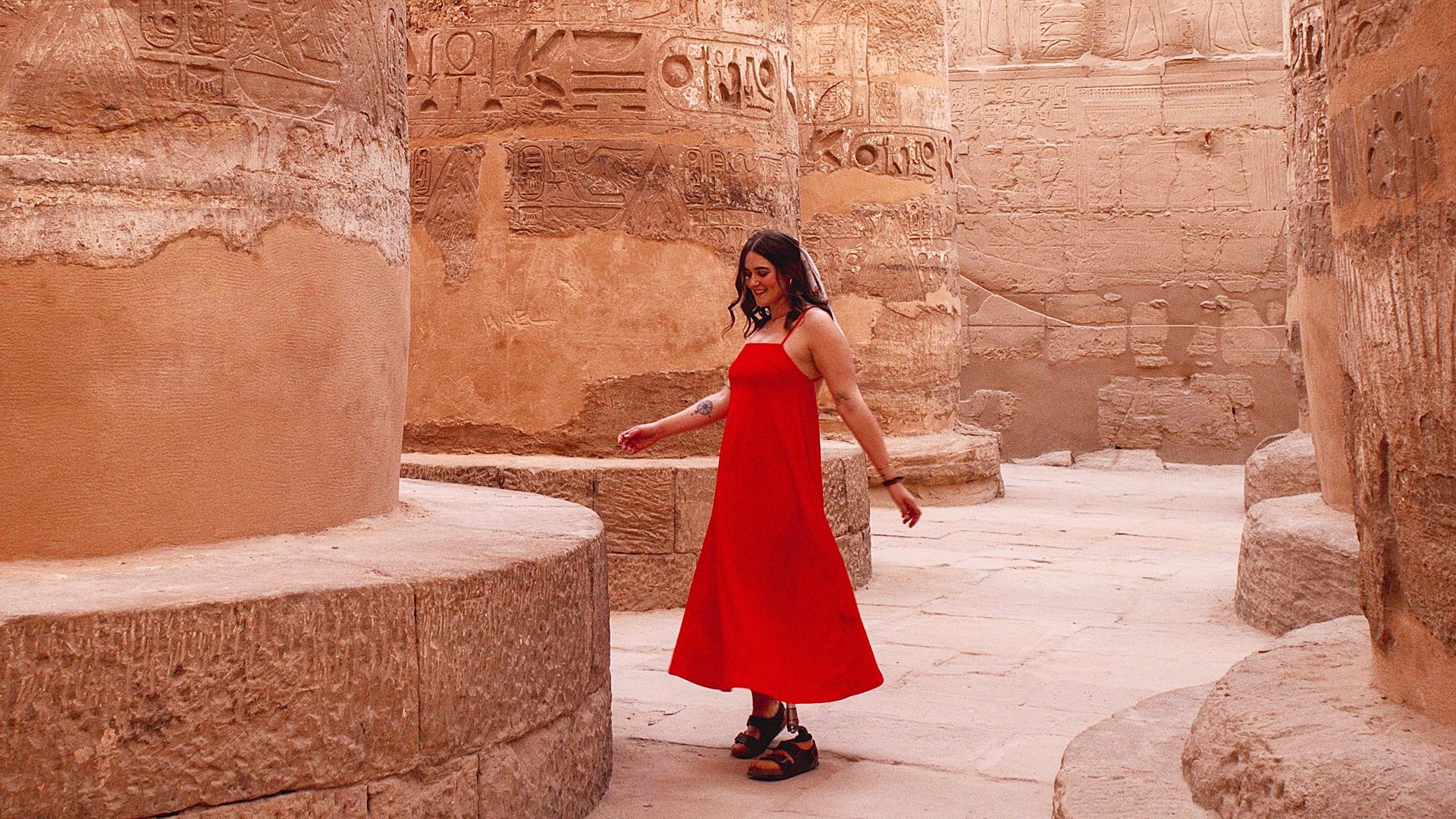
Paralympic bronze medallist, model, motivational speaker – Allison Lang is many things, but first and foremost, she’s a passionate disability advocate whose travels have changed how she sees herself and shows up for others too.
Take a scroll down Allison Lang’s Instagram feed and you’ll see a woman who embodies the term ‘badass’. Action shots from her Paralympic sporting career with Team Canada are interspliced with beaming selfies, fashion-shoot stills and an array of envy-inducing travel snaps.
Anyone can see that she’s outgoing, adventurous, clearly comfortable in her own skin – and just so happens to wear a prosthetic leg.
Social media rarely gives you the whole picture, of course. Her captions are candid about the challenges she’s faced around her limb difference – Allison was born with fibular hemimelia, a rare condition that meant her left leg hadn’t fully formed and was later amputated – and she’d be the first to tell you that she hasn’t always been so self-accepting. It’s been a journey – one that’s taken her from the beaches of South East Asia to the volcanoes of Central America and shown her the power of living authentically.


The road to role model
Allison was always sporty and grew up playing soccer, swimming and snowboarding in her home province of Alberta, Canada. But by the time she reached her early teens, insecurities about her disability had started to creep in.
‘I struggled with my body image. I was badly bullied at school for being different, which really dimmed my spark. All I wanted was to blend in. I ended up quitting sports around the age of 13 because I couldn’t hide my leg when I was wearing a bathing suit or playing soccer. I was just so insecure.’
A couple of years later, the Canadian national sitting volleyball team invited Allison to try her hand at the new adaptive sport. She wasn’t keen: ‘I didn’t want to play a sport that emphasised my disability and I was worried what kids in high school would think,’ she says. But with her mum’s encouragement, she gave it a go. This decision would ultimately change her life.
‘Although I didn’t fall in love with the sport at first, I quickly fell in love with the community around it. I met women that I aspired to be; women who had disabilities, yes, but also partners and children, their own homes and careers. I’d never seen women like that in the media. It was like a switch flipped in my head. I thought to myself, OK, if they can be my role models, hopefully I can be that for someone else in the future.’


Finding her place in the world
At 16, Allison found herself representing her country on the world stage, travelling to Europe and South America to compete for Team Canada. She soon caught the travel bug and from the age of 18, took every opportunity between volleyball seasons to go backpacking in places like Bali and Central America, either with friends or solo.
While she still grappled with insecurities, Allison knew that if she wanted to become the kind of role model she’d found in her teammates, she’d have to fake it ‘til she made it. On a trip to Thailand, emboldened by the fact she was a world away from home, she posted a photo of herself in a bikini on the beach with her prosthetic on show, along with a jokey hashtag: #hoparoundtheworldwithme.
This was back in the 2010s, when Instagram was a different beast. Allison was using it as a personal travel scrapbook. So, when she received a message from a new mother who’d just given birth to a baby with one arm, thanking Allison for showing her that her daughter has the potential to lead a fulfilling life, she was shocked. ‘I still get goosebumps thinking about that. That message shifted everything for me. It showed me the real impact sharing my story could have. You can use social media for good.’
From that moment, Allison decided to use her platform to nurture a community – for anyone, disabled or not, to learn about and share in the highs and lows of life with a disability.
Read more: After long Covid, I thought I’d never travel again. Luckily, I was wrong


People with disabilities travel too
Normalising disability became a big part of Allison’s mission – especially in the context of travel. ‘[People with disabilities] are citizens of the world as well. We’re often left out of the conversation just because we might travel a little bit differently, but we want to do it just as much as the next person.’
She also points out that the obstacles she faces could one day affect you too. ‘My fun fact is that the disabled community is the largest marginalised community in the entire world and we don’t discriminate. Anybody can become disabled at any moment in time due to illness or accident. And we may all experience a lack of mobility if we have the privilege to grow very old.’
People with disabilities are citizens of the world as well. We want to travel just as much as the next person.
Despite this fact, like so many others with disabilities, Allison is often underestimated. Family friends have asked, ‘should she be doing that?’ when they hear about her adventures. And while Allison knows she has nothing to prove, there’s also a part of her that says, ‘Watch me.’
She’s gone zip lining and surfing in Costa Rica, sailed from Panama to Colombia, and hiked up dunes in the Sahara. She’s carried her own heavy bags on solo trips across Europe and joined small-group trips with Intrepid through Jordan, Egypt, Morocco, Vietnam and Cambodia. Doubters, be gone.
As her confidence grew, she also stopped trying to hide the fact she wears a prosthetic, often opting to wear an unfinished metal leg – the perfect conversation starter when she’s on the road.
‘Fellow travellers often ask what happened to my leg or remark on how cool it is that I can travel the way I do. By being open and creating space to just be myself, I’ve been able to make more meaningful connections.’
Read more: Travelling with ADHD? Try a group trip


Small-group travel can support you
While she loves travelling independently, Allison is also a big fan of joining small-group trips and is quick to point out the benefits for those with additional accessibility needs.
‘When you have a disability, having to anticipate and plan for every eventuality can be exhausting. Small-group travel alleviates a lot of that stress. On my latest Intrepid trip in Vietnam, our leader Ning was able to advise me on what prosthetic to wear for different activities ahead of time – such as a swim leg for a waterfall visit – which meant I could participate fully. I also think group trips are great for people who just want to show up and enjoy what’s happening in the moment.’
So, where’s next for Allison? ‘I’m going to China for the sitting volleyball World Championships – that’ll be my 40th country. Then hopefully South Korea or Japan.’
By sharing her experiences openly and travelling the world on her own terms, Allison has given herself the greatest gift – of finally feeling at home in her own skin.
She has some advice for anyone who craves adventure but can’t quite find the confidence to go after it. ‘If you want to travel and you’re not doing it out of fear – of what other people might think, or something else – who are you truly living this life for? You can do hard things. We only get one opportunity to experience life. Travelling set me free in so many ways. My wish is for everyone – in the disabled community and beyond – to experience that for themselves.’
Allison Lang helped shape Intrepid’s Ethical Marketing Guidelines. Find out more about accessible travel and see if Intrepid has the right adventure for you.