From prehistoric rock art to ancient cave dwellings, writer Liz Carr heads to Arizona to explore one of the longest continuously inhabited landscapes in North America as part of a new Intrepid experience for 2026.
‘Listen to this’, my guide Lee says, in the Navajo-run tribal lands of northeastern Arizona, before letting out a ‘whooooop’ so loud it bounces off every one of Canyon de Chelly’s walls. The sound stretches and softens, twisting through the red cliffs before disappearing behind us.
Not a second later, a curious cattle dog who’s been trotting alongside our Jeep throws its head back and responds with a howl, long and loud enough to compete with Lee’s. We stare at each other, bursting out laughing.
It is so quiet. For now, the only sounds are the olive-scented winds carrying the last remaining bits of the dog’s howl through the mahogany-sloped walls. Then nothing. The quiet emphasises how few people are here, a stark contrast to well-trodden, commercialised nearby attractions like Antelope Canyon, which have begun issuing timed entry and permits to cut down on overtourism. Here on the floor of Canyon de Chelly (pronounced ‘de-shay’), the air is still, the earth feels sacred and we have room to breathe.
Read more: 26 totally new Intrepid trips and experiences


Inside the Navajo Nation
I feel lucky to be in Canyon de Chelly – cooperatively managed by the Navajo Nation, the Bureau of Indian Affairs and the National Park Service.
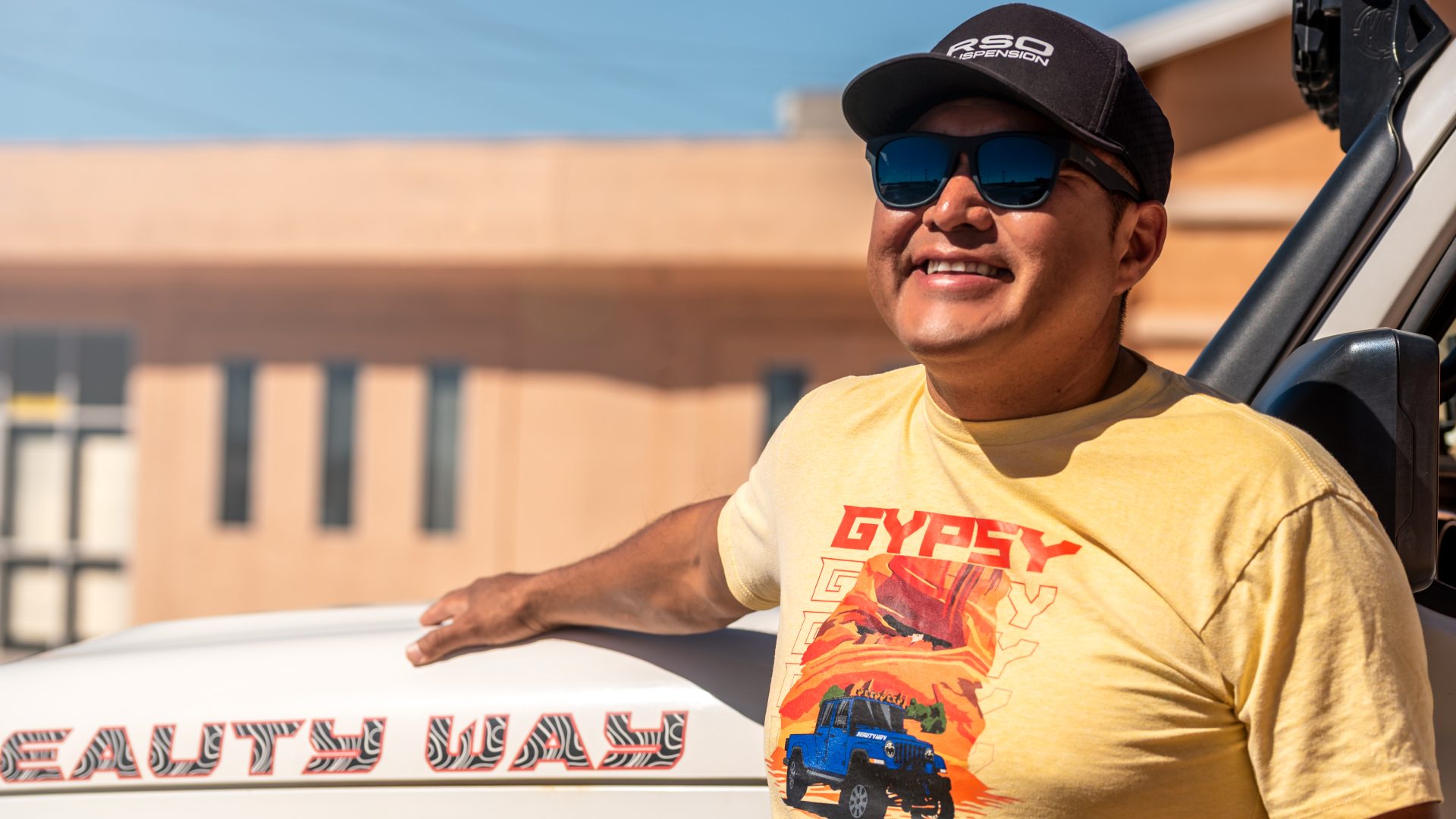
My companion, Leander Staley, or Lee, owns a family business that has provided tours into the canyon for over 60 years. He’s a fourth-generation Navajo guide and my escort for the day, as access to the canyon floor is restricted unless you’re with a licensed Navajo guide. This rule protects both the land and the visitors and means that you’re guaranteed to be shown around by someone whose family has known this place for generations.
Inside the small office this morning, the sense of family and community is palpable. Uncle James is here, coffee in hand, ready to head out on a tour. He tells me he knows Canyon de Chelly like the palm of his hand. ‘It’s a family thing,’ he says. ‘The Navajo are a very family oriented culture.’ It’s clear that guiding here isn’t just a job, it’s a shared responsibility.
Lee is part of a long lineage rooted in the canyon. His great-grandfather, Chauncey, was one of the first guides in Canyon de Chelly and worked for the National Park service as an archaeologist and interpreter for over 60 years. His father started their family’s guiding business and his mother works for the Park Service.
‘This is all I knew,’ he says. ‘I was guiding before I even had my driver’s license.’
Read more: 6 new trips and experiences in the US and Canada


We like our elbow room
Canyon de Chelly sits at the heart of the 24,000-square-mile Navajo Nation, which stretches across Arizona, New Mexico and Utah. Designated a National Monument in 1931, its 84,000 acres are jointly managed by the Navajo and the US government, with all permits to access the canyon floor issued by Navajo authorities.
It’s one of only two National Monuments in the country where people are allowed to live. The other? ‘The White House in Washington, D.C,’ Lee chuckles. ‘But our White House came first,’ he adds, referring to the canyon’s most famous Ancestral Puebloan cliff dwelling, the White House Ruin.
Today, about 50 Navajo families – or Dine, as they refer to themselves – call the canyon home. Sporadic fences separate plots of land used for farming and growing fruit. Homesteads and the occasional hogan – traditional Navajo residence – pop up here and there. Livestock and wild horses roam freely. The canyon floor feels expansive. Lee grins. ‘Navajos don’t live in villages. We spread out, so we don’t use up all the resources in one spot. We like our elbow room.’


Life on the canyon floor
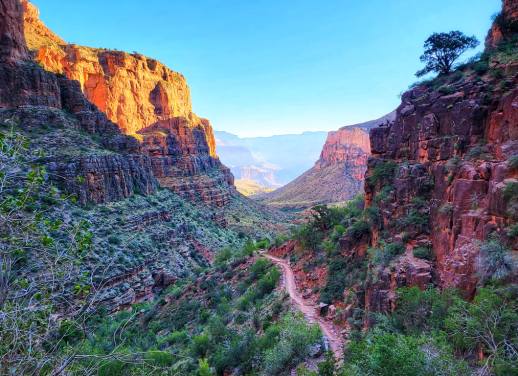
With the Jeep top down, we bump along dirt roads, past golden cottonwood trees. Most visitors tend to view the canyon from the road along its rim, but dropping down to the base of the towering red sandstone plateaus gives a wildly different perspective.
The canyon floor is wetter than I imagined, the riverbeds recently emptied from a storm. Although the ground looks dry and sandy, it squishes beneath my boots when we stretch our legs. Lee shows me a video on his phone of dozens of waterfalls cascading over the cliffs after recent rains.
We’ve reached the boundary of his family’s farmland, where peaches, plums and apricots grow seasonally. ‘There’s a rhythm to life,’ Lee tells me, explaining how most canyon residents live there during the summer. ‘You come back down here and are reunited with your family, your land, your stories.’
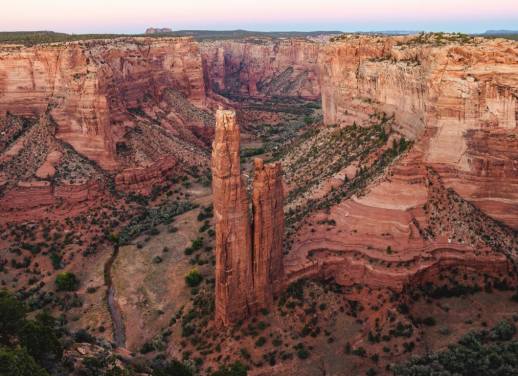
The canyon feels alive, a storyteller in its own right. As the walls morph into a thousand shades of red and orange, every turn reveals something new. A cliff face painted with petroglyphs depicts a flute-playing trickster deity called the Kokopelli. A hidden alcove catches the mid-morning light. The wind sketches wave-like patterns into the riverbed.
In the distance, an Ancestral Puebloan, or Anasazi, cliff dwelling appears. There are hundreds in Canyon de Chelly, most impeccably preserved by overhanging cliffs that protect them from the elements. While you can get a bird’s-eye view from the rim, close encounters are only possible accompanied by a Navajo guide.
We’re back in the Jeep, driving deeper into the canyon, as Lee shares some Navajo knowledge. Twins, he explains, are sacred in Navajo culture, and the number four is considered lucky. Talking about death is avoided. If you speak something into existence, it will come true. Between these facts, the stories grow more personal.
Like many young people, Lee once rebelled against his culture, resisting what he calls ‘the old ways.’ But after the birth of his daughter Emily, the canyon and his culture called him back. Now he’s relearning his native language through song and ceremonies where stories are told through sound.
Read more: 10 new ways to connect with Indigenous culture
The next generation
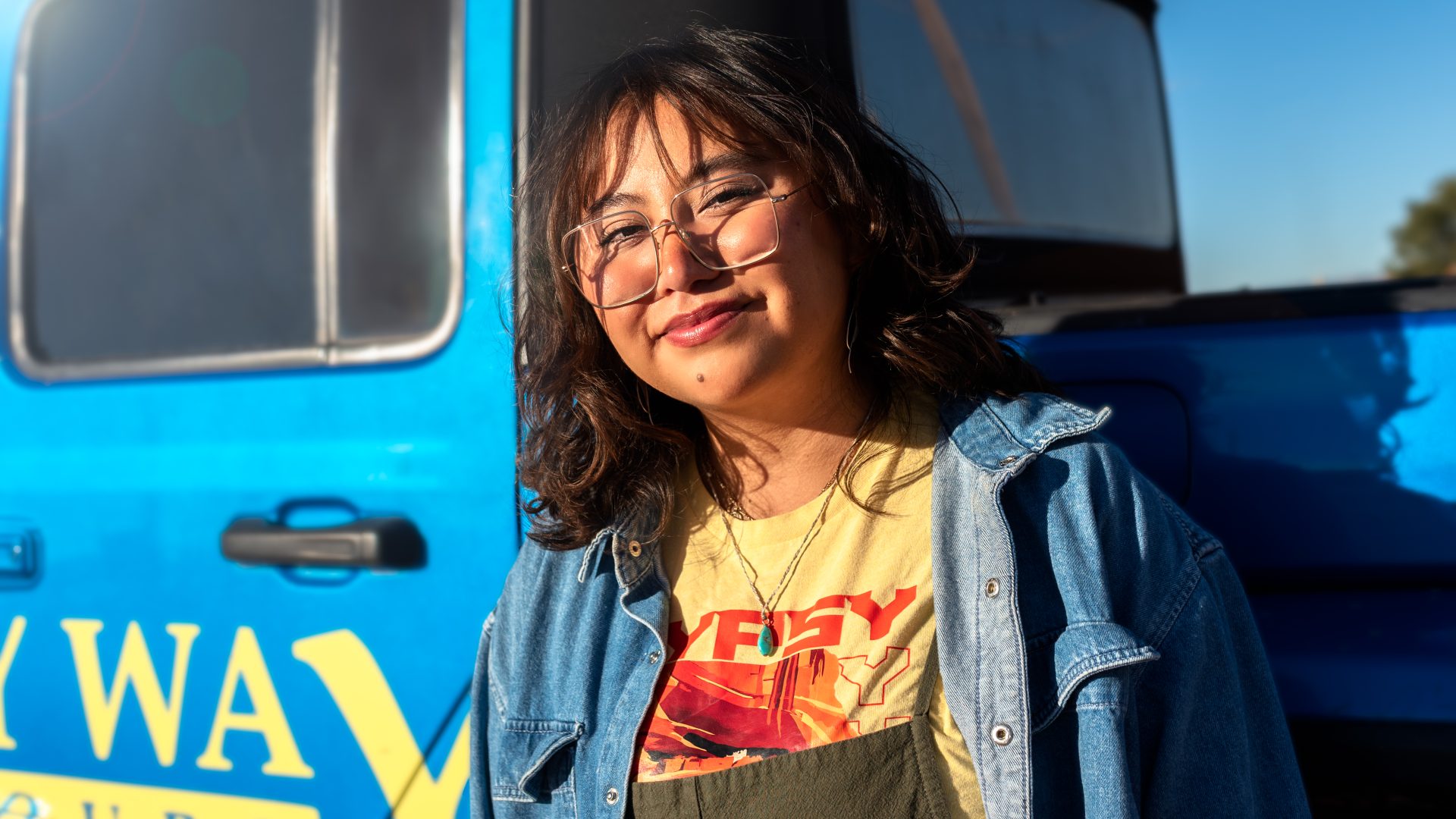
As we glide through the canyon floor, Lee chats about Emily. She’s 24 now, and also guides on breaks from college. ‘I didn’t push her,’ Lee says, ‘I wanted her to find her own way back.’
Emily represents the next chapter. She’s a fifth-generation Navajo, raised in a multigenerational household. ‘I’m an only child, but I grew up with both my mum’s and dad’s sides and all my cousins. Lots of family, lots of stories,’ she says.
Before heading out this morning, Uncle James had schooled me on the importance of passing on the Navajo culture and language to future generations: ‘It’s how we teach the younger ones. We’re bilingual and I speak 100% my native language at home. It’s how we were raised.’
Emily can speak Navajo, something she’s passionate about. Her dad is part of a generation whose parents endured Indigenous boarding schools run by the US government. These schools were part of a brutal policy meant to erase Native languages, cultures and identities, leaving lasting generational trauma. ‘They were punished for speaking Navajo,’ Lee tells me.
Today, they work with over 20 guides, many Navajo first-language speakers. Continuing to speak Navajo and upholding what’s considered a dying language is essential to the Staleys.


Why Indigenous guides matter
For both Lee and Emily, guiding in Canyon de Chelly isn’t just a job; it’s an act of cultural preservation.
When I ask Lee what it means to guide visitors, he takes a thoughtful pause. ‘We’re often the first Navajo people that tourists actually talk to. Sometimes, visitors are nervous, like they expect us to be unwelcoming. But we want them to ask questions. That’s how the learning happens.’
The importance of curiosity is a common theme as I chat with Lee. Between his own stories, he slips in fragments from books he’s read – a line from American naturalist and wilderness explorer Craig Childs here, an observation from Southwestern archeologist Earl Morris there. It’s clear that Lee’s work as a guide isn’t only about sharing knowledge. It’s about continuing his own education and finding new ways to see the stories that have always been here.
That’s also why it matters who leads you through a place like this. An Indigenous guide doesn’t just know the landscape; they belong to it. They carry stories that aren’t on informational plaques but are born from past generations. ‘Our ancestors endured such hardship,’ Lee says. ‘Now, we should make them proud.’
Experience Canyon de Chelly with Navajo guides on Intrepid’s Southwest USA Canyons and Cultures trip and find out what else is new for 2026 with The Goods – a collection of new trips and experiences to inspire a year of adventure.