
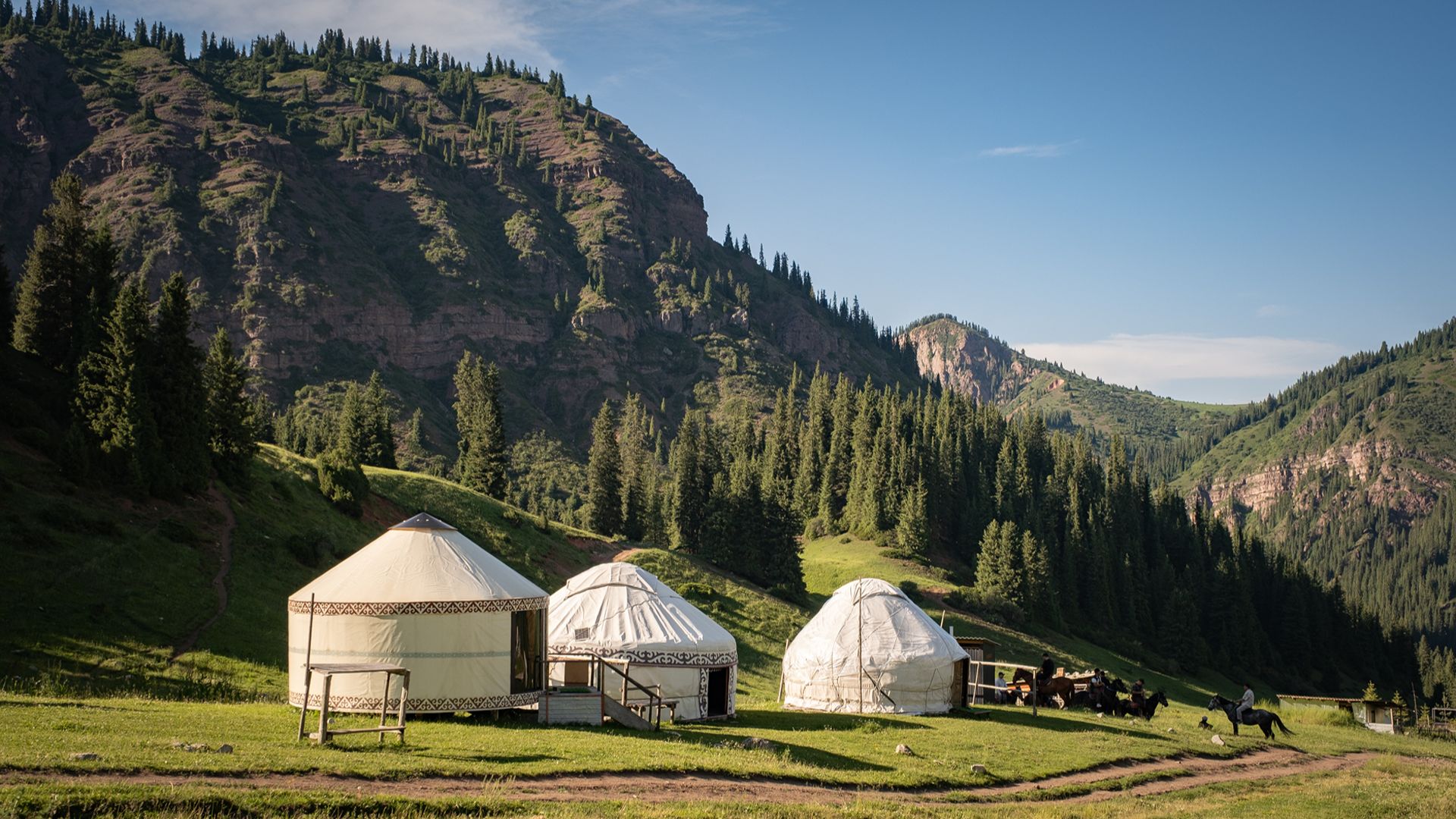
After a winter of discontent, Diana Jarvis tackles the high-altitude passes of Central Asia, where medicinal wildflowers, glacial lakes and nomadic camps prove the ideal tonic.
‘I wanna be high, so high,’ I spontaneously sing, as I hop over a fresh mountain stream, deep in Kyrgyzstan’s Tien Shan mountains. However, despite the classic 1977 Commodores song Easy springing to mind, it hasn’t exactly been the case today.
Along with my fellow hikers on Intrepid’s new Kyrgyzstan hiking adventure, we’ve been walking steeply uphill under a hot sun, through nomadic farmsteads, grazing pasture and wildflower meadows, all morning. The shaded woody valley we now find ourselves in – bisected by a braided river – proves both mercifully flat and a cool respite from the constant sweaty upward trajectory.
‘I’m easy. Easy like Sunday mor-or-or-or-ning’ I continue, unabated, realising in typical holiday fashion, I’ve lost all sense of days and it is indeed the day of rest. Not that it feels it.
Because incredible scenery aside, I’ve been finding the going tough – as I knew I would. I’d booked the trip six months previously when I’d been in full health with a weekly regime of swims, bike rides and gym sessions. But throughout winter, a series of unrelated health situations, culminating in routine surgery under general anaesthetic, had assailed me and kept me away from my regular routines.
I awoke into my spring body in mid-April barely able to walk up the hill to the supermarket, let alone spend days climbing to altitudes of up to 3000 metres (10,000 feet). How was I going to be fit enough to walk 50-plus miles (over 80 kilometres) in the thin air of Kyrgyzstan’s lofty peaks?


Red rocks and a canyon scramble
Yet here I am, underprepared and more than mildly anxious among a group of seven very pro-looking hikers with their trekking poles and seasoned outdoor gear.
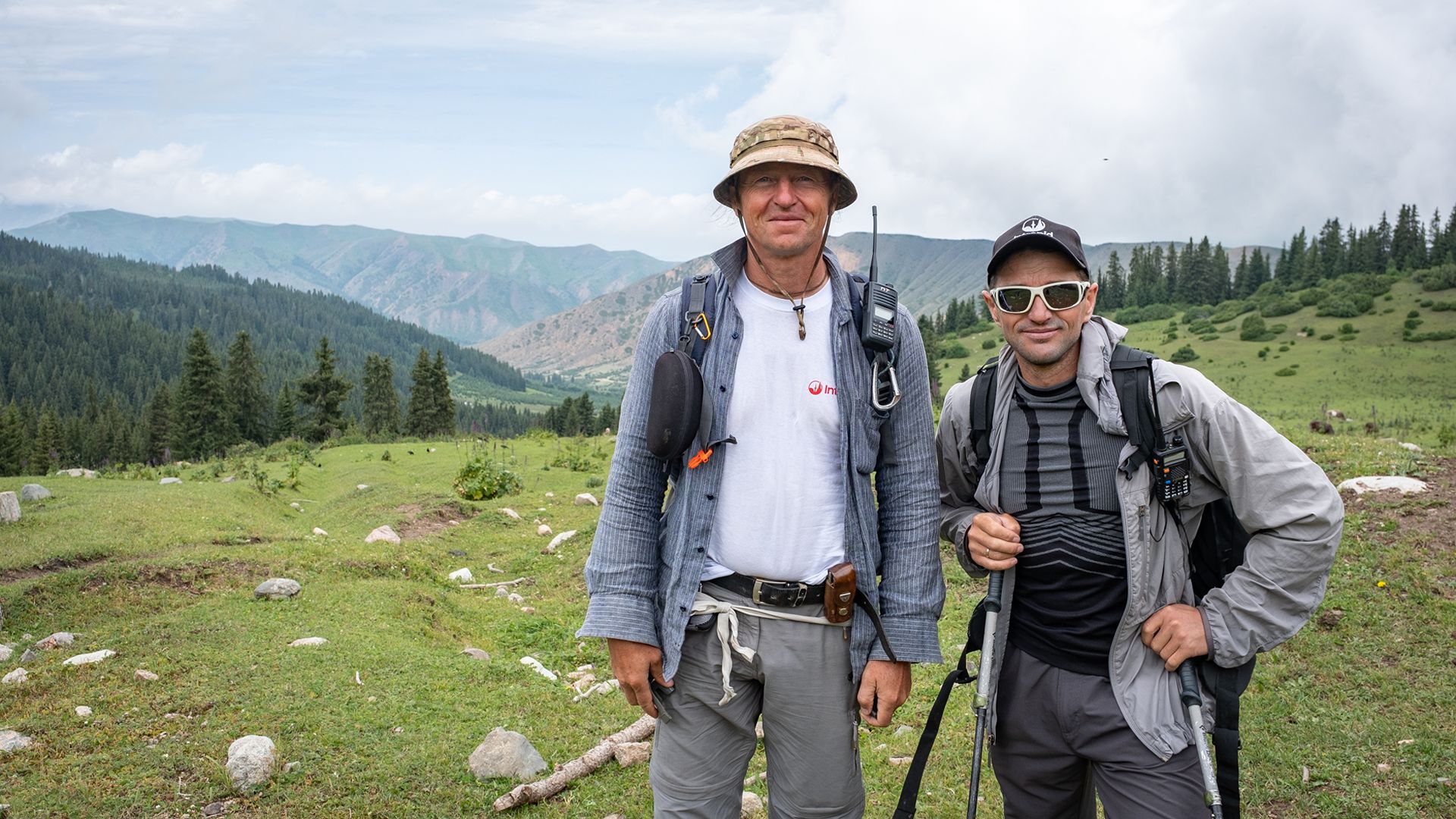
Intriguingly, the first hike on the itinerary is described as a ‘leg stretch’. However, scrambling up sections of the dry riverbed through Kok Moniok Canyon proves somewhat more than a leisurely stroll. As we walk through the arid scree, our local leader, Vadim, a wiry Russian-speaking Kyrgyz with a friendly weather-lined face, points out tiny edible cherries, soon-to-be-ripe barberries, sea buckthorn and bulging orange ephedra seeds (with supposed hallucinogenic properties).


With burnt orange rocks, sculpted by ancient winds into cathedral-like formations contrasting with the green hillside vegetation, the scenery takes my breath away – in more ways than one. Faraway rumbles of thunder add to the drama as I keep, ahem, ‘stopping for photos’ just to keep up with the general upward trajectory. From the outset, I claim my position as last in the group.
Happily, I’m not made to feel bad about it, as Vadim explains that on these hiking trips, there’s always a leader at the front and a ‘sweeper’ at the back to make sure everyone is safe. Vassily, an experienced mountaineer, is at the head, but I’m glad Vadim is the sweeper, as he entertains me endlessly with his exceptional plant knowledge, even when I lag behind.
Mountain highs and hillside healing
Warm up over, legs well and truly stretched, the hike proper begins the following day. We drive to Sutty Bulak, a red-rock valley surrounded by looming jagged peaks where our camp crew, Masha and Illya, welcome us with a hearty hike-fuelling lunch of spicy noodle stew in a scenic dining-room tent, pitched by a stream. Bellies full, we set off in the intense midday sun.
The dirt track takes us past more wind-hewn rusty rocks and some curious cows before petering out into no path at all. I notice the otherwise closely munched hillsides are pock-marked with tall stands of a purple flower avoided by the grazers.
‘It’s korgoshun,’ Vadim, tells me ‘it’s poisonous, so the cows don’t eat it, but in Chinese medicine it’s believed to have cancer-fighting properties.’ Looking it up later, I discover it’s known as wolfsbane, monkshood or its Latin name aconite. It’s deeply poisonous but active properties in it can be extracted for a cancer treatment.


Under the seemingly watchful eye of one specific peak, looming higher than the rest, we plod upwards through the valley, guided by Vassily’s expert navigational skills.
But despite his keen knowledge of the peaks, it transpires that here they’re acknowledged differently. ‘What’s the name of that mountain?’ I ask, after at least an hour of it in my sights.
‘Oh that one? I don’t know. I don’t think it has a special name’, says Vadim in his slow articulated accent. I’m perplexed. It has such a powerful grip on my psyche right now. Surely other hikers have felt this, too, and named it? ‘You know, about 95% of the mountains in Kyrgyzstan don’t have names. With more or less 90% of the country as mountains, it’s tricky to name them all,’ he says casually. When it comes to mountains and Kyrgyzstan, they’re spoilt for choice it seems.
What the country is light on is people. With a population of around 7.4 million people, and a land mass slightly smaller than the UK, Kyrgyzstan is very sparsely populated – something which we feel acutely over our 10-day trek, rarely seeing another soul, except a few riders on horseback.


Moved by the motion of nomad life
It’s not completely uncharted, of course. The nomadic herders, following their seasonal movement of livestock between high and low pastures, know the best grazing spots and build temporary camps in the valleys. During one slightly daunting river crossing with fast-running water and boulders to jump precariously between, we’re closely followed across by a herd of cows, a herder on horseback and his three trusty Alsatians. We follow them to the edge of the forest to a makeshift homestead of a yurt, caravan and temporary wooden fences for livestock.
Talai, the herd’s owner, offers us a glass of fermented mare’s milk and explains how his winters are spent between Karakol, the nearest big city, and Bishkek, the capital, and even visiting Europe on occasion. While the horse milk isn’t for me, the insight into herd-life shows how this ancient, time-honoured way of living isn’t as remote all year round as I’d imagined. Just like me, after a period of isolation, they crave connection, too.


After several days following their tracks, I can certainly see the appeal of their semi-nomadic lifestyle: tapping into a more natural cadence is creating the momentum I need to allow my body the chance to heal – the simple everyday motion curing my latent fatigue.
Together, our group falls into a pleasing daily rhythm: we camp overnight by a stream, awaken to birdsong and fill up on a hearty breakfast. The mornings are all about going up the mountains, lunch is taken at the highest point of the day and in the afternoons we go down, sometimes precipitously. I am, without exception, always last, taking constant breathers but no one seems to mind too much; we always reach the new camp in time for dinner.
Then, right on cue, Masha and Illya cook up traditional Kyrgyz feasts each night. After a particularly sweaty day, cold okroshka soup (fermented milk with diced cucumbers, radishes, spring onions, boiled potatoes and eggs) is refreshingly welcome and, after a day exploring Irdyk Lakes – a pair of scenic alpine lakes in the Terskey Alatau range – in the cold drizzle and mist, dimlama stew (slow-cooked, layered and steamed vegetables with lamb) revitalises us.


Mountains as medicine
To my surprise, each day’s hike and night’s sleep on a thin camping mat on the ground somehow makes me stronger and straightens me out. The aches and strains of the past winter slip away, as the views continuously feed my soul with calm. In total, we walk over 50 miles (80 kilometres) at altitude, covering vertiginous heights and drops through meadows and tall pine woodlands, past glacial lakes enshrouded in mist and streams crossed with log bridges.
For the final hike, we tackle the Old Jeep Road, one of the many strands of the Silk Road between Karakol and China. The air is fresh with mixed aromas of tarragon, mustard, wild sage, lavender and artemisia. Perhaps it’s knowing we’re at the end, or the much gentler incline, but it’s the most medicinal and restorative of all the hikes – and I’m not even last anymore.


We reach a ridge to see the city of Karakol beneath us, running alongside the turquoise glacial lake of Ala-Kul. It turns out we were never all that far from civilisation after all. Mentally, physically, it just felt like it, to me at least – the distance acting as the departure I needed to reset from what had come before.
We walk down into the city to spend our last night with the group in a karaoke restaurant, of all places. Do we sing? Of course we do. In between mouthfuls of ‘lazy tongues’ (our new favourite Kyrgz-Chinese dish, made of lightly fried aubergines), I scour the list and breathily croon (after all, Karakol is a city at altitude) Easy – feeling fortified and believing it this time around.
While the hikes were far from it, step by step, I’d made it up the mountains and, day by day, I’d returned to peak health.
Challenge yourself in the mountains of Central Asia on Intrepid’s Kyrgyzstan adventure.
Images: Photography taken on location on Kyrgyzstan for Intrepid by Diana Jarvis.