As Intrepid launches three new Women’s Expeditions this International Women’s Day, Laura Holt speaks to leading explorers to find out why representation is still the last mountain to climb.
Name a female adventurer, past or present? Go on, I dare you. Truth is, that while most of us can list tens of male travel heroes, adventurers and explorers, few can bring to mind even one female equivalent.
As a journalist of nearly 20 years – many of them spent specialising in travel, adventure and the outdoors – it’s taken me a lifetime to unearth these names.
They are there, peppered throughout every age of exploration. That’s not why they aren’t visible. The problem is, to find them, you really have to dig.


Icicles on beard: the image of adventurer
Women’s names weren’t always the first to spring to mind for Cecilie Skog, the prolific Norwegian mountaineer who grew up amid Alesund’s mountains, before summiting K2, trekking unassisted across Antarctica and conquering the Seven Summits.
Her initial image of an adventurer was the archetypal icicles-on-beard explorer: strong, stoney faced, swaddled in furs.
‘In Norway, the picture of a hero is that of a male polar adventurer’ she tells me. ‘In school, they were part of the storytelling. But it’s a narrow picture of how a hero looks, because there were women explorers, too.’
To understand why women’s names are not part of the narrative you have to go back to a time when national expeditions were operated by the military arm of conquering nations, favouring men and excluding women.
In addition, women weren’t allowed into exploration clubs, such as the Royal Geographical Society (RGS), which only admitted women as permanent members in 1913, so their efforts went unrecorded. But chapeau to the RGS, because they were way ahead of The Alpine Club, which only allowed women in 1974. Which means that 117 years passed before its Alpine Journal – the oldest in the world – started covering women’s stories in earnest.
Read more: 5 ways Intrepid’s new Women’s Expeditions are making positive change


Redacted and written out of history
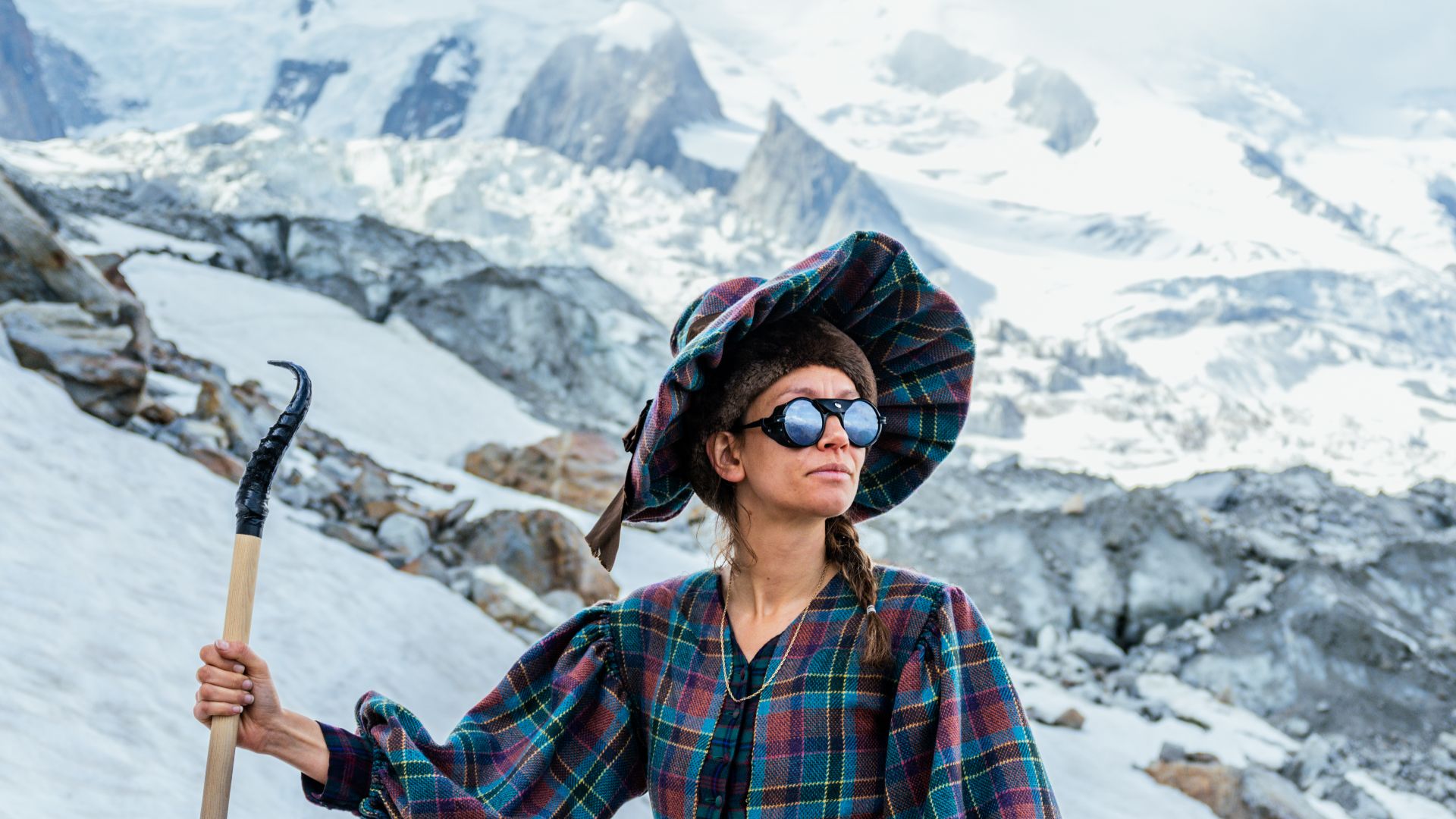
It’s something that Lise Wortley, a modern-day explorer, is trying to reverse through her pioneering Woman with Altitude project. She’s recorded the stories of 150 women adventurers in an effort to redress the historic imbalance, physically recreating six journeys in period dress, after deciding she wouldn’t be able to do them justice in modern clothes. Cue yak-wool coats, wooden backpacks and clunky, cumbersome boots…
After Lise’s first trip to Sikkim, India, in the footsteps of Belgian-French explorer, Alexandra David-Neel, she’s since reenacted Nan Shepherd’s Cairngorms hikes and Freya Stark’s Iran journey, guided through The Valleys of the Assassins by one of Intrepid’s female leaders. ‘I try to keep the whole team female to support women in this space,’ she says.
Why does she think these figures went forgotten for so long, I ask? ‘All journalists back then [in the early 20th century] were men,’ she says. ‘So, a lot of them never got the press coverage they deserved or weren’t taken seriously. They never got the book deals and that’s had a knock-on effect.’


Overcoming cultural barriers
No press, no book deals, no exposure? It sounds like she could be speaking about visibility today, rather than a century ago. But even now, cultural pressures still stand in the way of women breaking through from backgrounds where they’re viewed, in the words of Indian-born ultra-cyclist Vedangi Kulkarni, as ‘second-class citizens’.
Growing up in Pune, Maharashtra, Vedangi tells me her mother’s family were very narrow minded. Vedangi wasn’t even allowed to go to the corner shop.
‘It wasn’t a very healthy atmosphere. But that’s what led to me coming up with all these huge [dreams] because… when you come from that overprotectiveness, suddenly you’re not scared of being alone. You look at everything that’s not being in a cage as the ultimate freedom’.
Luckily, Vedangi had an ally in her father, who worked on oil rigs and had been exposed to people from around the world. ‘That meant, when the time came for me to say “I wanna ride my bike across the Indian Himalayas” at 17, my dad was like, “yeah, sounds great”.’
She moved to the UK alone at 18 and, on a whim, decided to cycle solo around the world, becoming the youngest woman to do so.
But it’s the idea of ‘passport privilege’, which Vedangi raises, that really strikes me as the biggest barrier to women from backgrounds like hers. After cycling around the world and encountering many, many visa refusals due to her poorly indexed Indian passport, she now sees it as: ‘an early introduction to how you can lose opportunities. Because now there are [events and film] shoots in Europe that – since I started talking about my Indian passport – I’m not even asked about’.
This lays bare a little-spoken fact about exploration: that to be allowed into the club, it helps if you’re male, yes – but also white, privileged and/or rich too. Because race, class and economic background can often be greater impediments to access than gender. Not that it’s ever stopped Vedangi.
Read more: Jessica Nabongo on why she’s glad she took the risk with solo travel


Questioned on being in this space
How many other women would be dissuaded from even taking the first step given the barrage of questions female adventurers face? Many of the women I speak to tell me how their feats are often framed as reckless or dangerous rather than worthy of awe and admiration.
Like Annie Londonderry, the Latvian Jew from Boston who cycled around the world for women’s suffrage in 1894, leaving three young kids at home for a year, much to the consternation of the world’s (mostly male) press.
But even a century later, Cecilie Skog was constantly questioned on the biological reality of being a woman – will she, won’t she have children? – both before and after losing her husband, mountaineer Rolf Bae, in K2’s worst single-event tragedy in 2008.
‘When I got a new boyfriend, I got all these questions again. I didn’t know if I could become a mother. You don’t want to talk about it publicly.’
Then there are the financial questions that women frequently face. Questions like: how will I even fund this expedition? Who will invest in me?
‘[It’s] the bit I hate most,’ Lise Wortley admits. ‘For example, to climb Mont Blanc, the cost, if I went on my own, is £5000. But if you want to film it and share it and be visible in the adventure space, then it triples or quadruples, because you’ve got to pay [crew] and get extra guides’.
She ended up self-raising through brand partnerships and private investors, though admits it’s always stressful.


Yes then, but why now?
Speaking to these women, you realise the answer to why there are so few visible female adventure heroes comes down to a range of factors, historically. It’s societal, cultural, financial and deeply ingrained since the dawn of exploration.
But what niggles is why it’s still happening. Today. Right now. In 2026. Even after a resurgence in revisionist books, it feels like mainstream media hasn’t caught up with the real-life demographics of the adventure community today, which is diverse – at its grassroots and professionally.
Lise Wortley agrees: ‘I’ve been pitching a TV show for years… but they’re not willing to put money into a woman-led adventure show. They think it’s softer. People won’t watch it. They think people want the Bear Grylls stuff. They just don’t commission women’s shows.’
I put this to Beki Henderson, an RGS fellow and expedition-pro film producer, who’s worked with some of the best male presenters, including Steve Backshall, Ben Fogle, Levison Wood and Aldo Kane.
We start by agreeing that representation is not a binary issue. That the problem of women not being visible isn’t down to the prevalence of men. That these talented male presenters absolutely deserve their place.
But she thinks the reason for shows like Lise’s being declined is more deep-rooted than people simply not wanting to put women on TV. She thinks it’s systemic, pointing to a 2023 We Are Doc Women report which highlights only 24% of UK directors in factual TV were women in 2021/22.
So until we change what’s happening behind the camera, the lens is never going to refocus. ‘If half of the UK population identify as women, then why aren’t half of our stories, and half of our history, also being told by women?’ the report asks.
‘As long as what is defined as adventure sits within a male lens of record-chasing and going faster, harder, longer, compared to women – who are more likely to look at something deeper – it’s going to be hard to sell,’ Beki says. ‘I’m inspired by women who are challenging the classic “conquer the landscape” narrative by expanding what counts as meaningful adventure.’
She thinks we need to redefine adventure at its root in order to see more women on screen. And the good news is, that’s already happening. It’s there in the profusion of grassroots communities that now welcome women from all backgrounds. In the wave of new on-screen talent, such as Lucy Shepherd, Lizzie Daly and Eva zu Beck who are turning to YouTube and social media to tell their stories – employing women-only and indigenous teams to do so.
And it’s there in Cecilie Skog writing inspiring adventure books for little girls like her and in Vedangi Kulkarni setting up an expedition fund to break down barriers for future generations.
Ironically, in trying to make their stories mainstream, the answer might not actually be in mainstream media, but in an online space that has democratised access for all.
Let’s watch them. Let’s support them. Let’s make them names to remember.
Embark on your own adventure with Intrepid’s new Women’s Expeditions to Cambodia, Bhutan and Peru, launched this International Women’s Day.
Image credits: Lise Wortley photography by Grace T.S.P and Emily Almond Barr. Vedangi Kulkarni photography by Callum Howard.