During Vietnam’s Pride season, Intrepid catches up with two of its local leaders who are out and openly showing off their country’s colours.
From Pride parades to the legendary Lo To shows – Vietnam’s all-singing, all-dancing answer to drag bingo – LGBTQIA+ people in Vietnam find many avenues to express themselves.
While there are still pockets of prejudice, government policy is gradually catching up to changing attitudes and a nascent queer scene is emerging. Travellers can dance at gay clubs, visit queer-owned and queer-friendly bars, or participate in a Pride season, which in Vietnam stretches from the globally recognised month of June to Hanoi and Ho Chi Minh’s centrepiece celebrations in September, where marches weave a rainbow past the country’s lamplit cafes, street-food markets and riverfront promenades.
Intrepid’s team in Vietnam is proud to name several members of the LGBTQIA+ community among its own – people who may have encountered judgement from their family and society, but have still found acceptance with colleagues and travellers in their groups.
Among them are Anh Vuong and Phuong Le: two trip leaders, both 35 years old and proud members of the LGBTQIA+ community. In celebration of Pride, we sat down with them to hear their stories.


Pride – and prejudice
Anh Vuong has been working for Intrepid since 2016; Phuong Le, since 2019. They have both worked as tour guides for their entire career, with Phuong studying tourism management at university. ‘The career choice came pretty easy,’ says Phuong. ‘A career where you don’t have to wear business attire, which tends to be gendered, is the most obvious option for me.’
According to Phuong, LGBTQIA+ travellers generally feel safe in Vietnam. ‘I know Asian countries tend to be very conservative, but Vietnam is not that hard on the LGBTQIA+ community,’ she says. ‘We don’t really care nowadays; the stereotypes and judgment are slowly fading away, especially among the younger generation. Nobody will show any hate or bad manners towards you, in my experience.’
When travelling to the countryside, however, Anh suggests being discreet – though this applies to gay and straight couples alike. ‘People in the big cities are used to LGBTQIA+ people, but not in the countryside,’ she says. ‘They may be curious and stare at LGBTQIA+ couples if they show their love in public areas.’
While queer-traveller experiences of Vietnam are typically positive, historically local experiences have been more mixed. Broadly speaking, those growing up in southern Vietnam and more cosmopolitan urban areas had an easier time than those growing up in rural areas and the more conservative north.
This is down to the country’s history, which was split along a north-south divide as far back as the 17th century, cemented by the post-WWII Geneva Accords in 1954, which carved the country into two halves: the Communist North and the pro-Western South. Divisions grew greater during the 20-year Vietnam War, before final Reunification in 1975.
Read more: Taking on the trails with drag-queen environmentalist Pattie Gonia


Phuong’s experience was of growing up among the French colonial architecture and buzzing scooters of Ho Chi Minh City, formerly Saigon and capital of Vietnam’s South, which she describes as ‘one of the most open-minded cities in Vietnam.’
She describes her own upbringing as ‘not super hard’ but still witnessed societal prejudice. ‘We were all taught, either by our parents or by society, that being a homosexual person is a bad thing: that it’s wrong, it’s a disease, it’s going to spread around, or it’s “just a phase”. You learn from a very young age to keep your head down. Even in Ho Chi Minh City, you learn not to talk too openly about it.’
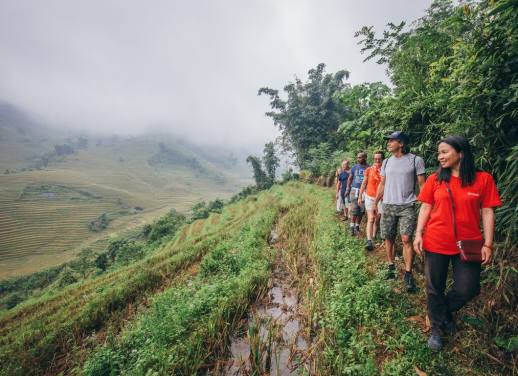
Meanwhile, Anh grew up in Thai Nguyen city, among the mountains and tea plantations of Thai Nguyen province. As a relatively rural northern hub – just beyond Hanoi – Anh faced discrimination both within her family and outside. ‘When I had to put on my uniform for primary school, my father laughed at me and said I looked like a boy wearing a skirt; I was so ashamed,’ says Anh. ‘When I was crossing the street, people shouted “lesbian!” at me.’
Read more: Why I travel as a gay man to unlikely places


Slow but steady progress
However, 30 years later, progress is being made. ‘Nowadays, with more cultural exchange and the internet, LGBTQIA+ people in Vietnam feel more able to come out,’ Anh continues. ‘The community is becoming bigger; in big cities, people are more familiar with LGBTQIA+ people’.
‘In the past, LGBTQIA+ people were depicted as satirical characters in TV dramas; there were few job opportunities for them. So, many LGBTQIA+ people got together to create opportunities to earn their living. They joined Lo To, the special singing shows, only performed by LGBTQIA+ people.’
Recent government policy has improved the lives of LGBTQIA+ people in Vietnam, too. Same-sex marriage was decriminalised in 2015 (though still not legally recognised); in 2022, Vietnam’s Health Ministry officially confirmed that same-sex attraction and being transgender are not mental-health conditions, bringing the country’s policy in line with global-health standards. To some that’s seen as progress, to others that there’s more to be achieved.
But wherever you side, the highlight of the community’s calendar is, of course, Pride, when all congregate under one flag. ‘Pride season makes me happy,’ says Phuong. ‘Having something like that happen annually in Vietnam proves our country has come a long way.’
‘At Hanoi Pride last year, everyone came with friendly smiles, even straight people,’ adds Anh.


Chosen family and true friends
Being part of Intrepid, and meeting travellers from all over the world, has shaped Anh and Phuong’s experiences as LGBTQIA+ people. Anh was the first person in Intrepid’s Vietnam team to officially come out, which she says she didn’t expect.
‘I came out just because I want to be real with myself, not for any reason. I don’t want people to look at me as a “representative”; I just want to prove that our sexual preference doesn’t make us different.’
‘Their reception made me realise I had true friends, whom I regard as brothers and sisters,’ continues Anh. ‘I can talk to them in the role that I want to take, which never happened in my family. My sister said I could confide in her, but when I tell her my thoughts or who I like, she doesn’t want to listen. She says same-sex relationships aren’t genuine.’


Acceptance from her colleagues led Anh to be more open with clients, too. ‘I was comfortable to say who I am on the trip because I feel safe with them, and I feel safe with Intrepid. I have many friends and colleagues who are truly respectful to me. In the Vietnamese language, I would like to be addressed as “anh” (older brother), but some people still call me “chị” (older sister). What makes me happy is that I feel true respect from them.’
‘Everybody in the company encouraged me to be more open about my sexuality,’ adds Phuong. ‘Before Intrepid, it was only once or twice that I openly admitted to my travellers that I’m a queer person. But since starting to work with Intrepid, the feeling of having a safe place pushed me to normalise my feelings about my sexuality.’
Phuong’s groups often comment that she makes them feel seen – testament to her qualities as a leader. ‘I always try to take care of everyone in the group, no matter where they come from, their sexual orientation, their gender, their race… In the end, we are all human beings, and human beings crave connection. I listen to them without judgement’.
It’s a tangible kind of empathy that can only be offered by someone who’s experienced adversity and emerged – rainbow-like – even brighter.
Join Intrepid on a small-group adventure in Vietnam to travel with like-minded people.